

The death of Daria Shipilova, who worked at a plague research institute in Irkutsk Oblast in Siberia, continues to reverberate around the world and reached the White House on Monday evening. President Donald Trump was asked by reporters what Washington planned to do in light of the risk that pneumonic plague could reach the United States from Russia.
We're looking at it very strongly, we just heard about it,” he replied. “We'll help them, we'll help them as much as we can.”
U.S. President Donald Trump addresses the death of a laboratory worker in Siberia after she broke a test tube containing plague bacteria
(Credit: X, Fox News)


Trump spoke to reporters on the South Lawn before boarding the presidential helicopter on his way to a campaign rally in Grand Island, Nebraska. He described the incident as “a big problem for Russia,” adding: “Well, I hate to see them having it. It's a rough disease”
The president also offered his own explanation for the danger: “We used to be able to control [the disease], but somehow those microbes have gotten stronger and smarter. The germs have really become relatively stronger than they were, and things that used to work on pneumonia don’t work as well anymore.”
The U.S. State Department, however, said earlier in a statement that “plague is a known disease and is treatable with common antibiotics, especially when treatment starts early.”
Secretary of State Marco Rubio told reporters at Joint Base Andrews in Maryland before departing for Iceland: “I don't think it's cause for alarm, but it is cause for focus and a cause to just keep an eye on it.”
Based on information provided by the Russians, he said, it appears that a laboratory employee was infected.
“There’s very limited travel between the U.S. and Russia, obviously. But like anything else, something like that gets out, it could quickly spread,” Rubio added.
Gallery

Daria Shipilova, a laboratory worker at a plague research facility in Siberia, broke a test tube containing bacteria and died
The State Department said it was closely monitoring the situation together with the Centers for Disease Control and Prevention. It noted that many details remain unverified and called on Russian authorities to share accurate information quickly and transparently.
According to the World Health Organization (WHO), plague has a high fatality rate but can be readily treated with antibiotics when diagnosed early.
WHO said it was in contact with Russian health authorities to verify the incident and its circumstances and to determine what laboratory tests were being conducted and their results. The organization said it was aware of reports that the employee died of severe pneumonia, but that the cause of death had not yet been officially confirmed and, according to the information provided, laboratory testing was still underway.
“Based on unofficial information available, the public health risk to the general population appears to be low,” WHO said, adding that it would update its risk assessment as more information became available.
The European Commission also said it was monitoring the case closely and was in contact with the European Centre for Disease Prevention and Control.
Kremlin: ‘Don’t listen to rumors’
Publicly, Moscow is seeking to present a relatively calm picture. In the Kremlin’s only response to the case, spokesman Dmitry Peskov said Monday: “We should rely on the official statements from Rospotrebnadzor and not listen to various rumors and speculation.”
Rospotrebnadzor, Russia’s public health authority, said samples taken from Shipilova contained no microorganisms connected to her work. It said no accident involving pathogens had occurred at the institute and that the epidemiological situation in the region was stable.
Irkutsk Oblast Gov. Igor Kobzev said a special expert commission had determined the cause of death to be “pneumonia of unknown origin,” adding: “The situation remains under our control and the control of specialists.”
“Things that used to work on pneumonia don’t work as well as they used to.” U.S. President Donald Trump

'The germs have really become relatively stronger than they were'
(Photo: AP Photo/Jacquelyn Martin)
On the ground, however, restrictions remain in place. More than 60 institute employees have been isolated inside the building since Friday. In Irkutsk, three municipal hospitals, the Ivano-Matreninskaya Children’s Hospital and the city maternity hospital are under quarantine, with no explanation given.
Maxim Modin, head of the Shelekhov district in Irkutsk Oblast, where the institute is located, said no infectious diseases had been reported among institute employees over the past 10 days and that everyone who recently came into contact with Shipilova was being tested.
The institute itself declined to respond to a request for comment from CNN. At the Irkutsk aluminum plant in Shelekhov, near the laboratory, employees were instructed to wear masks. Plant director Artyom Fominikh said “conflicting reports” were circulating and urged people to remain calm.
Central Asian countries also did not wait for further clarification. Kazakhstan’s Health Ministry assessed the risk as “very low” but introduced sanitary and quarantine controls at border crossings. Uzbekistan said it had increased authorities’ preparedness to deal with particularly dangerous infectious diseases.
Kyrgyzstan, which has no land border with Russia and lies about 2,400 kilometers (1,500 miles) from Irkutsk, announced Monday that it was introducing quarantine controls at its border crossings.
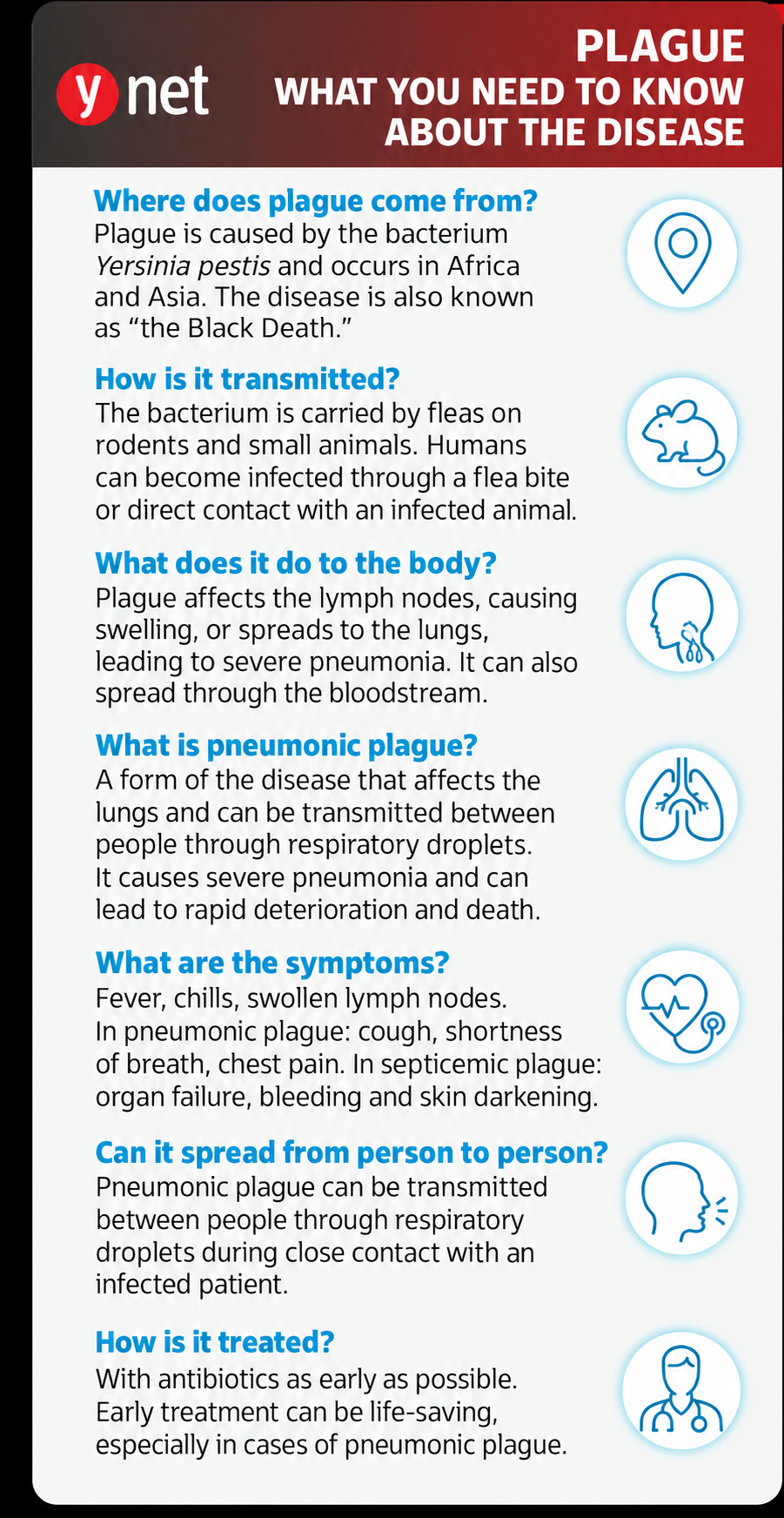
Prof. Tal Brosh-Nissimov is the Head of the Infectious Diseases Unit at Samson Assuta Ashdod University Hospital, spoke with ynet this week about the possibility that Shipilova was infected in a laboratory accident.
“Let’s assume what’s being reported is true. I have no idea what the safety level is there or what their procedures are. When people work in laboratories with dangerous bacteria, accidents happen and people are exposed. The description of what happened to this woman is consistent with exposure to the plague bacterium,” he said.
According to Brosh, the key to understanding this scenario is how the bacterium entered the body.
“If a test tube containing the plague bacterium broke and an aerosol was released from the tube — meaning droplets were dispersed into the air — you can develop pneumonic plague if you inhale the bacterium,” he explained.
“There are several forms of plague. The most severe, the deadliest and the most contagious is pneumonic plague. It is an extremely fast-moving and aggressive disease, and the description of her condition deteriorating within days is consistent with it. It’s not certain, but it fits. It progresses very quickly and causes extremely severe pneumonia.
“Plague can be treated, but treatment has to begin very quickly. It does not respond well to late treatment.”