


Israel on Friday declared a national emergency on the home front following the start of Operation Rising Lion in Iran. At around 3 a.m., emergency alerts were sent to mobile phones warning of a “significant threat,” prompting the cancellation of school and morning activities. By 10:47 a.m., orders to remain near protected spaces were lifted.
The IDF said any incoming Iranian strike would trigger a 10-minute warning. While reinforced home shelters are preferred, stairwells or interior rooms may suffice if needed. “In this campaign, broad alerts are expected,” Home Front Command chief Lt. Gen. Rafi Milo told residents. He urged the public to know their safest shelters, minimize travel and remain indoors until further notice.

Under the directives effective from 3 a.m. June 13 to 8 p.m. June 14, all educational institutions—including daycare, schools, youth groups and summer camps—are closed. Workplaces and large gatherings are also banned, except for essential services.
Milo warned of “powerful and complex days ahead,” emphasizing that Israel is “strong and ready together to protect the State of Israel.”
The guidelines apply to educational activities, workplaces, gatherings and services, as detailed below:
Educational activities: Regulations for operating institutions that provide instruction, including daycare centers and home-based daycares (up to age 6), schools, after-school programs, special education, higher education, vocational training, summer camps, informal education programs, youth movements, seminars, children’s enrichment classes and competitive sports activities held under recognized sports associations and federations for children and youth up to age 18.
Workplaces: Regulations for the operation of workplaces, businesses and commerce, including customer service, as well as competitive sports activities organized by official sports associations and federations for adults over the age of 18.
Gatherings and services: Regulations concerning the gathering of people at a given time in a specific area, including public venues such as shopping centers, entertainment events, weddings, synagogues and cultural activities. This also covers recreational sports activities, gyms and studio classes for adults over the age of 18, as well as restrictions on public services available to citizens.
Priority order for choosing your shelter:
Residential, floor or institutional safe room (Mamad, Mamak, or Mamam): A Mamad (residential shelter room), Mamak (shelter room on a shared floor) or Mamam (institutional shelter) is the preferred choice. Upon receiving a warning, close the door securely and turn the handle 90 degrees. Ensure both the outer steel shutter and the inner glass window are closed. If a double-wing glass window is installed, its panes must be removed in advance and stored outside the room for the duration of the emergency.
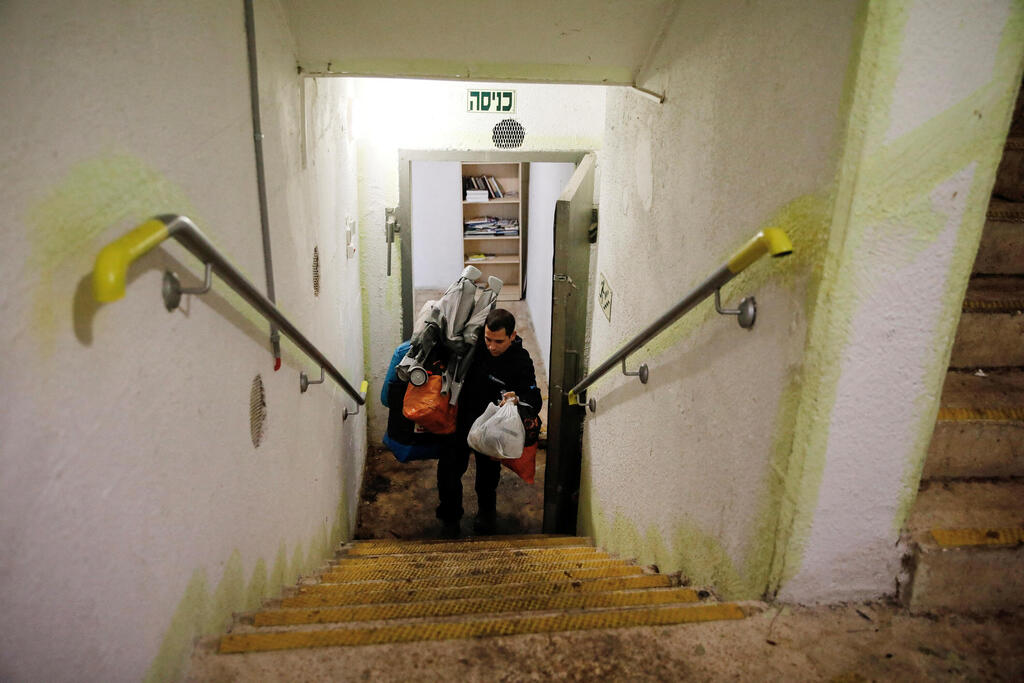
A public shelter in Acre
(Photo: REUTERS/Shir Torem)
Shelter (Miklat): A shelter in a residential building may be used if it can be reached within the available response time, or without time constraints if it can be accessed through an internal stairwell (a staircase without windows).
A public shelter may be used only if it is reachable within the designated response time.
Important: If a Mamad, Mamak, Mamam or shelter is not available, choose a secondary option: an internal stairwell or an interior space within the building.
Internal stairwell:
An internal staircase (without windows or exterior-facing walls) can serve as a protected space. Stay in the center of the stairwell—not on the top or ground floors.
In buildings with more than three floors, remain in a stairwell that has at least two stories above it. In buildings with fewer than three floors, stay in the stairwell on the middle floor. Do not stay at the building’s entrance. Ensure stairwells are clear of any objects that may obstruct movement.
Interior space: If no Mamad, Mamak, shelter or internal stairwell is available, use an interior room surrounded by multiple walls and with minimal windows or openings. Ensure the space is free of ceramic tiles, porcelain or glass that could shatter. A hallway may also be used. Close all doors and windows.
Upon receiving a warning, sit close to an interior wall, below the window line and not in front of a door.
Why does an interior space offer protection?
It is usually surrounded by other rooms and walls, providing better shielding from shockwaves and shrapnel.
Safety precautions: Sit against an interior wall, as shrapnel or shockwaves may penetrate or collapse an external wall. Stay below window level and away from doors to avoid injury from shattered glass or flying debris.
Spaces that should not be used as a protected area: Do not choose the kitchen, bathroom or toilet. Avoid spaces with ceramic tiles, porcelain or glass surfaces that could shatter.
Key safety notes:
- Do not stay at the building’s entrance, which is vulnerable to blast and shrapnel damage.
- Always close and lock the steel shutter and inner window in a Mamad until the emergency ends. If a sliding glass window is installed, remove it and place it outside the room.
- If no protected space is accessible, lie flat on the ground and shield your head with your hands.
- If inside a lightweight structure, such as a trailer, wood-frame or plaster building, exit immediately and head to the nearest protected space. If you cannot reach one in time, lie on the ground and cover your head with your hands.
- Maintain your protected space in good condition, plan and practice your route to it, and ensure all stairwells and pathways are clear of obstructions. Prepare emergency supplies and communication tools.
- For many, the stairwell is the most accessible protected area. Be sure to place a chair for elderly residents.
Official Instructions from the Home Front Command:
As part of preparations for a potential attack, extensive efforts have been made to enhance protection for populations lacking adequate shelter.
Following a comprehensive review and analysis of lessons learned from the ongoing war, it has been determined that the most effective response is to activate a nationwide alert immediately upon the onset of a threat. Accordingly, the current protocol includes a one-minute national siren and a notification sent through the Home Front Command mobile app. This alert is not routine; it is intended to wake the public and convey the seriousness of the situation. Spokespersons are dispatched to media studios within minutes to provide guidance.

Nationwide alert warning of an impending attack on Home Front Command mobile app
(Photo: IDF)
The current operational phase is defined as pre-response. The absence of an immediate military response is attributed to the magnitude of the initial attack, which caused widespread shock. A response may be initiated at any moment.
Get the Ynetnews app on your smartphone: Google Play: https://bit.ly/4eJ37pE | Apple App Store: https://bit.ly/3ZL7iNv
A key operational focus is ensuring coordination between the Home Front Command and local authorities. A structured readiness process has been implemented to prepare local governments for the demands of large-scale conflict, balancing confidentiality with preparedness.
When an imminent strike is detected, direct shelter alerts will be issued to enable civilians to take protective action.
The national alert level remains at its highest—Alert Level 4.
In coordination with the chief rabbis, synagogues will not operate on Shabbat and public gatherings are prohibited. These measures are essential for managing the threat effectively.
The Home Front Command aims to provide approximately ten minutes of advance warning based on real-time system data, with a high degree of confidence in its accuracy.
Alert sequence, timing and dissemination protocol:
- Preliminary alert to heighten readiness: Issued through media channels. This alert signals increased vigilance but does not include a specific timeframe.
- Notification of incoming launches toward Israel: Delivered via the Home Front Command mobile application. This alert is typically issued approximately 10 minutes before the anticipated impact.
- Shelter alert: Issued through the Home Front Command app and activated sirens across the country. The timing of this alert varies based on geographic location and threat trajectory.