


It's been lingering in the air for quite a while now, and at 2:59 a.m., it happened; this widely expected scenario has materialized. Unusual alerts from the Home Front Command about a “significant threat preparedness” woke up all of Israel, and within minutes, it became clear: Israel was striking Iran in an unprecedented operation, codenamed Operation Rising Lion.
According to Israeli sources, dozens of senior Iranian officials were killed. Iran officially confirmed that among the dead are:
IAF strikes in Iran
(Video: IDF Spokesperson's Unit)


- Armed Forces Chief of Staff Mohammad Bagheri
- His deputy Gholam Ali Rashid
- Mohammad Mehdi Tehranchi, a nuclear physicist and president of Islamic Azad University.
Iran has already announced new commanders for both the military and the Revolutionary Guards. This is the updated list of those killed—and their replacements.
Footage from the strikes
In Israel, Bagheri, Salami and Rashid were described as the regime’s three most senior military commanders. Over 200 Israeli Air Force fighter jets, guided by precise intelligence from the Military Intelligence Directorate, attacked more than 100 targets across Iran, including safehouses used by senior members of the Iranian military leadership.
Where Israel struck
The opening phase of the assault involved neutralizing air defense and detection systems in northern Iran and Iraq. Most of the sorties were flown through routes in Syria, which had previously been highly dangerous—until the Israeli Air Force dismantled Assad’s air defense network.
Israeli Air Force pummels Iran
According to The New York Times, Israel struck six military bases in the Tehran area, including the Parchin base, as well as residential buildings inside two heavily secured compounds where senior military officers live. Additional homes around Tehran were also struck as part of the targeted assassinations of Iranian officials.
Other reports indicated that targets in Tabriz and Arak were also hit—Arak being the site of a heavy water reactor—as well as missile bases near Tehran and in Kermanshah. According to a senior Israeli official, alongside the extensive Air Force operations, Mossad carried out a series of covert sabotage missions deep inside Iran. These missions aimed to cripple Iran’s strategic missile array and its air defense capabilities.
That same night, Israel also attacked Iran’s uranium enrichment complexes. Footage from the Natanz area, home to Iran’s main enrichment facilities and thousands of centrifuges, showed heavy smoke rising. The facility was later reported to have been destroyed in the attack.
What led to the strike
Ynet military commentator Ron Ben-Yishai noted that Iran had recently completed a new underground facility at Natanz, where it planned to relocate thousands of advanced centrifuges capable of accelerating uranium enrichment dramatically.
Air Force strikes Tabriz
Another key factor behind the decision to launch the strike now was that, in recent days, Iran had begun a full-scale sprint toward developing a nuclear bomb, under direct orders from Ayatollah Ali Khamenei. The accelerated program was expected to allow Tehran to assemble a basic nuclear explosive device within a few months. The timing of the attack was also influenced by a rare statement from the IAEA, which accused Iran of violating oversight agreements and obstructing international monitoring of its nuclear program, effectively giving Israel a window of political legitimacy for action. Iran, in turn, alleged "collusion" between Israel and the IAEA.
Iran's response
Three hours after the attacks began, Ayatollah Khamenei issued his first statement, announcing that “Iran is on war alert” at his order. Khamenei declared: “At dawn, the Zionist regime extended its filthy and bloody hand to commit crimes on our beloved land, exposing its evil nature more than ever by targeting residential centers. The regime should expect severe punishment.”
Get the Ynetnews app on your smartphone: Google Play: https://bit.ly/4eJ37pE | Apple App Store: https://bit.ly/3ZL7iNv
Initially, Iranian sources claimed that Chief of Staff Bagheri was “in the command center,” but later admitted that he too had been killed, along with many other senior figures.
By morning, Iran’s military retaliation began. IDF spokesperson Brig. Gen. Effi Defrin reported that Iran had launched more than 100 drones toward Israel, later announcing that all were intercepted outside Israeli airspace.
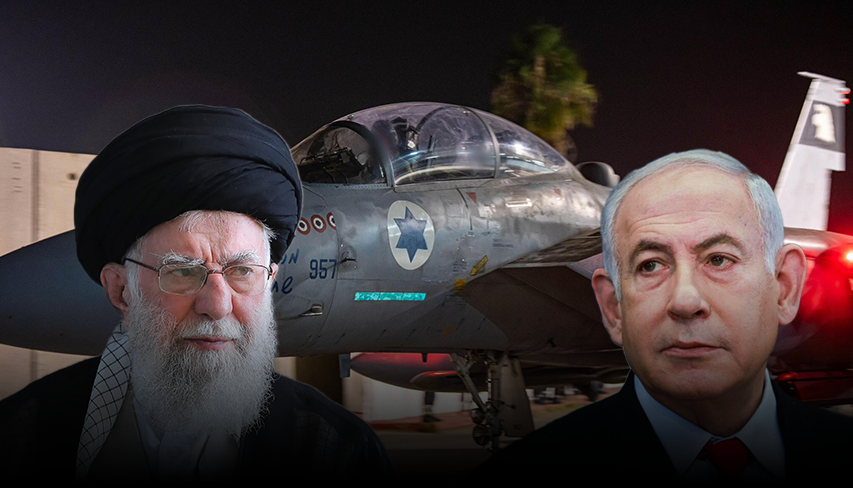
Iranian Supreme Leader Ali Khamenei and Prime Minister Benjamin Netanyahu
(Photo: Iranian Leader's Press Office - HandoutGetty Images, IDF, Chaim Goldberg/Flash90)
While Israel conducted its strike on Iran without direct U.S. military involvement, officials told Ynet that the United States later assisted with the drone interceptions. Officials assessed early Friday that the U.S. would likely be first to offer support, followed by other coalition partners. Ultimately, Washington did not leave Israel to defend itself alone.
How the Trump administration responded
U.S. Secretary of State Marco Rubio was the first American official to respond to the Israeli strike, saying that the United States was not involved. “Tonight, Israel took unilateral action against Iran,” he said, but warned Tehran against targeting U.S. interests.
Shortly after, President Donald Trump commented in an interview with Fox News, saying he had been informed of the operation in advance. “There were no surprises,” he said, again emphasizing that “the United States is not involved.” He expressed hope that Iran would soon return to the negotiating table, while also making clear that the United States will defend Israel if it comes under attack.