

The Pentagon made an unusually public show of force this week, revealing the location of a U.S. Navy nuclear-armed submarine just a day after President Donald Trump rejected Iran’s latest proposal to end the war.
The Ohio-class ballistic missile submarine arrived Sunday in Gibraltar, the British territory on Spain’s southern coast, the US Sixth Fleet said Monday. Such announcements are rare because the locations of America’s nuclear-armed submarines are usually among the military’s most closely guarded secrets.
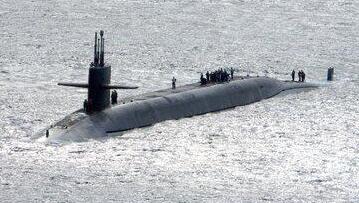
The Sixth Fleet did not initially identify the submarine by name, but local reports said it was the USS Alaska — one of the largest and most powerful submarines in the US Navy.
“The port visit demonstrates U.S. capability, flexibility and continuing commitment to its NATO allies,” the Sixth Fleet said in a statement. “Ohio-class ballistic missile submarines are undetectable launch platforms for submarine-launched ballistic missiles, providing the U.S. with its most survivable leg of the nuclear triad.”
The timing of the visit immediately drew attention. It came after Trump said the US ceasefire with Iran was on “life support” and described it as “unbelievably weak.” On Sunday, he rejected Iran’s counterproposal to end the war, calling it “totally unacceptable.”
Iran’s reported demands included war reparations, recognition of its sovereignty over the Strait of Hormuz and an end to US sanctions. Trump’s rejection has raised fears that Washington and Tehran are drifting back toward escalation.
The public disclosure of the submarine’s location appeared to send a clear signal. Ohio-class ballistic missile submarines are designed to remain hidden at sea for extended periods, forming the most survivable part of the US nuclear triad. Their mission is deterrence: to guarantee that the United States can respond even if its land-based missiles and bombers are targeted.

USS Alaska
(Photo: U.S. Navy)
The Ohio class includes 14 ballistic missile submarines and four guided-missile submarines. Ballistic missile versions can carry Trident II D5 missiles capable of delivering nuclear warheads. Guided-missile variants can carry more than 150 Tomahawk cruise missiles.
The USS Alaska’s arrival in Gibraltar also carried a diplomatic message. The submarine bypassed the nearby US naval base in Rota, Spain, about 141 kilometers away, and instead docked at the British-controlled territory. British Royal Marines were deployed to receive it, and a 200-meter exclusion zone was set up around the vessel.
The move comes amid strained relations between Washington and Madrid. Spanish Prime Minister Pedro Sánchez has criticized the US war in Iran and reportedly refused to allow the United States to use Spanish bases in Rota and Morón as part of its offensive. Trump responded by threatening to “cut off all trade” with Spain and said he would “probably” remove American troops from the country, where about 3,800 US personnel are stationed.
Spain has objected before to US nuclear submarine stops in Gibraltar. In 2022, Madrid protested after US submarines used services there instead of Rota, arguing that the Spanish base had special protocols for nuclear vessels meant to reduce environmental risk and protect public safety.
The USS Alaska has visited Gibraltar before, including in June 2021. Other Ohio-class submarines, including the USS Florida, USS Rhode Island and USS Georgia, also made stopovers there in 2022.
Authorities have not said how long the Alaska will remain in Gibraltar or what the purpose of the visit is beyond the official US statement about capability, flexibility and commitment to NATO allies.
But the message was hard to miss. As Trump weighs his next move on Iran, the United States has chosen to publicly place one of its most secretive nuclear platforms at the edge of the Mediterranean — close enough to be noticed, rare enough to matter, and powerful enough to remind Tehran what is at stake.