

On the table in Ora Hatan's living room in Moshav Shtula sits a plastic bowl filled with onions. A few days ago she drove to the market in Nahariya and bought several crates of vegetables, paying with a check deferred for 60 days. Now, as she peels them one by one to prepare stuffed vegetables for soldiers, her eyes fill with tears.
But it is not only the onions that bring tears to Ora’s eyes. She was born on the day Shtula was connected to the electricity grid and was given her name because she “brought light” into the world.
The last time we visited her, at the height of the ground operation in Lebanon, the northern border community was empty. Even then, Ora was optimistic and her face radiated. This time her eyes are dim. It seems this woman has reached the brink of despair.
Gallery
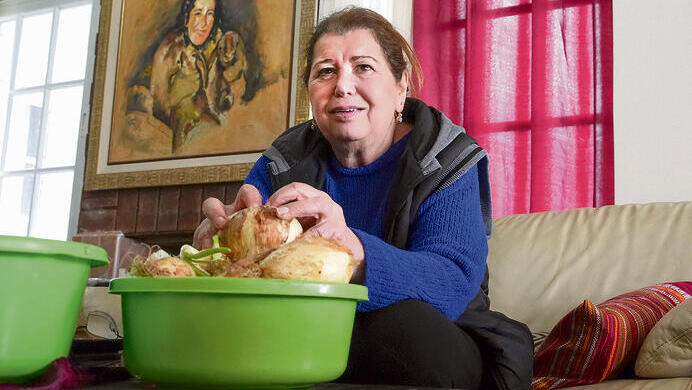
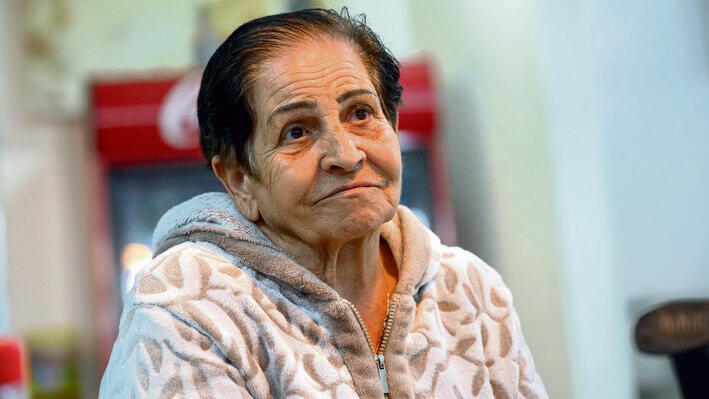
Ora Hatan prepares food for soldiers instead of serving customers in her restaurant
(Photo: Effie Sharir)
When the previous round of fighting ended, she decided to open a restaurant in her home, serving Kurdish dishes and telling diners about her family’s story. “I invested half a million shekels,” she says. “I took loans from the bank and was sure that after the war, tourists and visitors would come. But they didn’t come. Even when it was quiet. And I don’t understand why. I’ve been here through all the wars and rounds of fighting. After a week or two, people would forget and the Galilee would fill up. Today everything is dead. And this is one of the most beautiful places in the country. Look for yourself — everything is blooming, everything is green.”
The banks, apparently, are not interested — and neither, she says, is the state. “A loan is a wonderful thing,” Ora says. “Do you know what the problem is? You have to pay it back. With interest. I also have a mortgage on the house. And people aren’t coming. What am I supposed to do?”
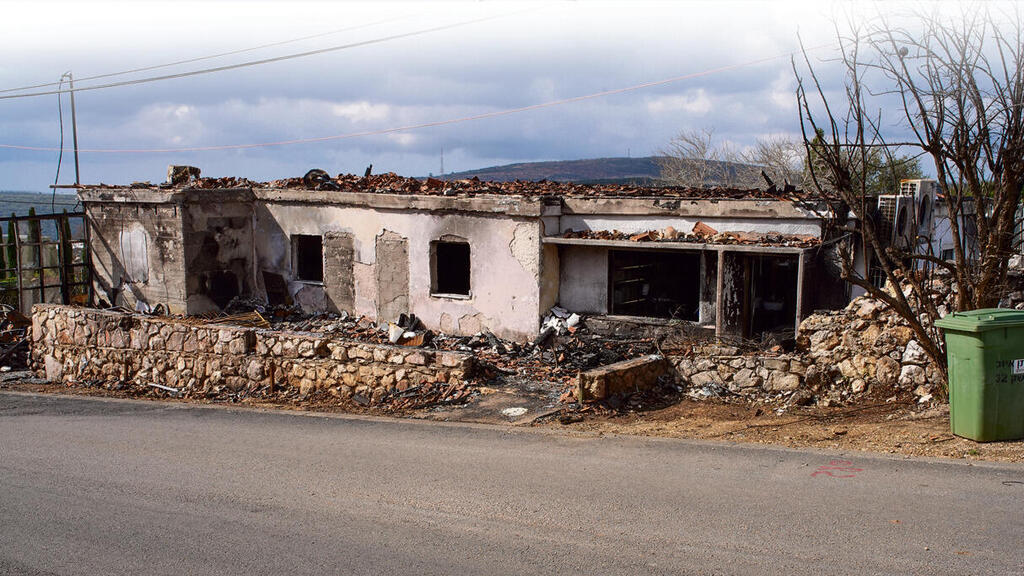
The Hatan family's restaurant was struck by a Hezbollah missile in the last war
(Photo: Effie Sharir)
This is not the Hatan family’s first restaurant. Up the street, Hemedat HaGalil, which she ran with her mother for 30 years and included guest rooms, operated until it was partially destroyed by a direct hit during the war.
“My brother Dudu, who managed the place after my mother died, received an advance from the Property Tax Authority and was about to start renovations,” Ora says. “Then, three weeks ago, a fire broke out and everything burned. We don’t know how it happened. And the place wasn’t insured. Walls can be rebuilt. But what was inside — all the memories, the special utensils my mother brought with her to Israel, the oven she used to bake Kurdish bread — it’s all gone.”
With one restaurant standing empty and the other reduced to ruins, she is left with the only thing that gives her strength: cooking voluntarily for soldiers along the northern border. “They’re like my sons,” explains Ora, a single mother of two. “They love the spicy fish I make for Friday night. Just now someone brought me a few crates of chicken donated by a good Jew.”
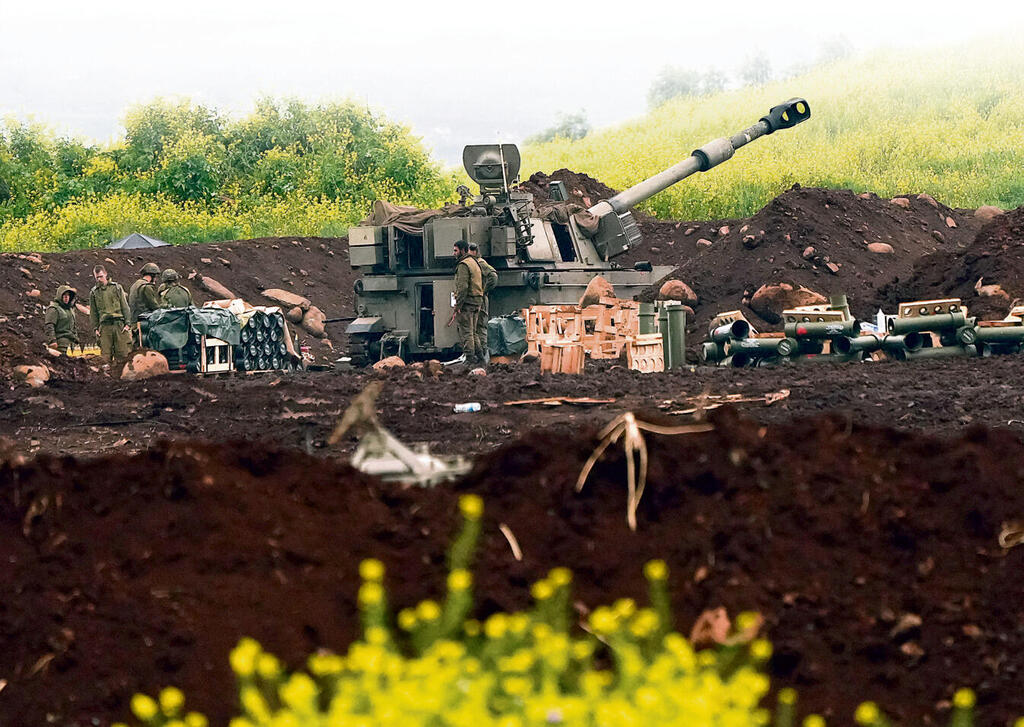
IDF operates on the border with Lebanon
(Photo: Effie Sharir)
Like many residents along the northern border, she has no safe room. “There are constant sirens here. Both rockets and drones. I don’t even wake up. At most I turn over — I’m a woman of faith. Whatever happen will happen. Where would I go, tell me? Where exactly?”
On the border, without protection
At the entrance to the nearby moshav, Zarit, two members of the local civilian defense squad (now called a “defense unit”) are waiting for us. A., 29, married and a father of three young children, moved here from Lod about six months ago as part of a group of nine families who decided to strengthen the northern border.
“Listen, the biggest victory is having young families here, not just soldiers,” he says, petting Luna, an especially sweet puppy that recently joined his family.
A. served in the Golani Brigade’s reconnaissance unit and later in the Alexandroni reserve brigade. He joined Zar’it’s defense squad after several rounds in Gaza, Lebanon and Syria. “Just two and a half weeks ago we finished a deployment in Gaza, on the ‘yellow line,’ and the next day the war with Iran broke out,” he says.
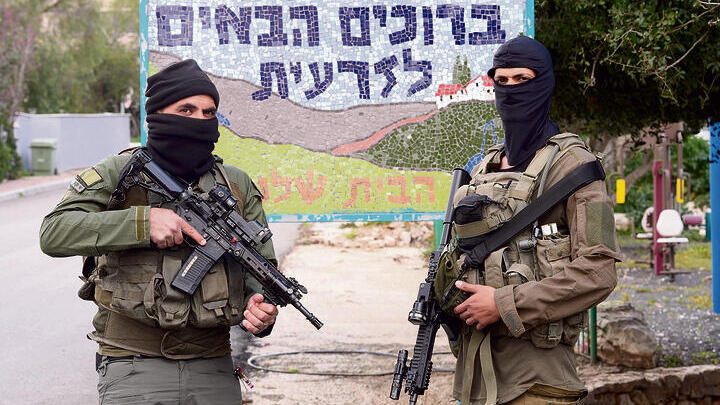
A. and S., members of the Moshav Zarit civilian emergency defense squad
(Photo: Effie Sharir)
“On Saturday morning we got an alert, and within 10 minutes we were in uniform,” recalls S., 45, married with two children, who grew up in Tiberias and moved to Zar’it about 25 years ago. His oldest son, who was discharged about six months ago, also joined the defense squad.
“He was in Golani, Battalion 51. A veteran of the Shuja’iyya incident, unfortunately. He was part of the rescue force in the incident in which the commander of Battalion 13, Lt. Col. Tomer Grinberg, was killed. His platoon commander, Capt. Liel Hayo, and his company commander, Maj. Moshe Bar-On, were also killed. He lost friends. It’s not easy. That’s why I pulled him into the defense squad. I keep him close to me.”
The family has been evacuated to Nahariya for two and a half years. “In November 2023 our house took a direct hit from a Burkan rocket and was completely destroyed,” S. says. “Now I’m rebuilding it. We’re not giving up on this place.”
On March 6, a mortar struck a position near Zar’it, wounding eight Givati Brigade soldiers. “We heard the impacts,” S. says. “We realized it was in the battalion and checked over the radio if they needed help. Once they said there were casualties, we joined the forces and helped evacuate them. We evacuated three wounded on the back of a pickup truck.”
Unlike the previous round, the north has not been evacuated this time. “We don’t have a safe room at home,” A. says. “During the day, when there are sirens, we go down to the lower floor, and at night we sleep with the kids at neighbors’ homes who have a safe room.” The children, he adds, are “climbing the walls.”
Breakfast with Lebanese neighbors
We met 77-year-old Shula Assayag, one of Zar’it’s founders, at Kubo, a restaurant opened by her grandson. Her daughter Ilanit was making pizzas in a wood-fired oven, while her grandson Kobi fried schnitzels in the kitchen. Another granddaughter, a young lawyer who lives in central Israel, had come to help.
'We cannot allow Hezbollah to win.' says Moshav Zarit resident Shula Assayag
(Photo: Effie Sharir)
Shula, who grew up in Moshav Goren, arrived in Zar’it in 1967. “We settled the land when the first houses were built. There was no border then, no fences. We would pick peaches and sit down for breakfast with farmers from the Lebanese side.”
She was also the first to warn about tunnels crossing the border. “My house would shake all the time, things would fall off the shelves. For 12 years I fought with the army and they told me there was nothing. They thought I was crazy, that I was imagining things. When they found the tunnels, they called me at four in the morning and said: ‘Shula, we apologize.’”
She was evacuated to Tiberias for a year and a half, during which her home was hit twice. “I’m right next to the base and I also let soldiers sleep in my house, so I take hits,” she says. “The first hit was relatively minor. But the second time a Burkan rocket hit the house, and everything I built over 60 years was destroyed. Five minutes earlier the soldiers had gone to a briefing in the shelter. Thank God, none of them were hurt. To this day they haven’t finished repairing my house.”
For now, she lives in a small temporary caravan. “But it’s not safe because I don’t have a safe room. I begged them to build me one because it’s hard for me to get to the shelter, but there’s no one to talk to. My daughter also doesn’t have a protected space. So I rely on God.”
Despite everything, Shula has no intention of leaving Zar’it. “If the border residents leave, it will be a victory for Hezbollah,” she says. “And we will not give them that pleasure. We will not let them win.”
First published: 08:57, 03.18.26