

As Iran intensifies attacks on American bases and U.S. allies across the Persian Gulf and the wider Middle East, its leaders are projecting unity and determination to show that the Islamic Republic can withstand a prolonged confrontation.
Behind that public front, however, a deepening struggle is unfolding at the highest levels of power in Tehran over how the war should end and what Iran should look like afterward.
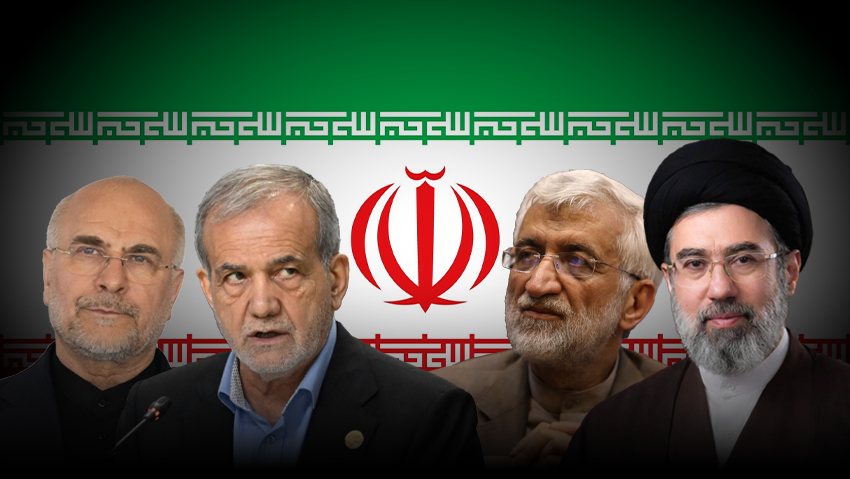
Ghalibaf, Pezeshkian, Jalili, Khamenei
(Photo: ATTA KENARE / AFP, Alexander NEMENOV / POOL / AFP, AP Photo/Eraldo Peres, Shutterstock/Elena_Titova)
U.S. President Donald Trump announced early Sunday that he had canceled a planned American strike on Iran after saying the outlines of a possible agreement had been reached. Yet inside the Islamic Republic, rival camps remain sharply divided over the purpose of the war and whether military pressure should lead to negotiations or total confrontation.
On one side are the hardliners associated with the Paydari movement, whose name means “steadfastness” in Persian. They reject negotiations with Washington, call for complete military victory and want the state to restore tighter religious and social controls inside Iran.
Opposing them is a more pragmatic camp identified with President Masoud Pezeshkian and parliament speaker Mohammad Bagher Ghalibaf.
That faction sees military pressure as a means rather than an end, intended to force concessions from Washington at the negotiating table. Its position is shaped by the mounting economic damage caused by the war and by the belief that the government must show greater flexibility toward social change inside Iran.
“Negotiation is a political tool that complements military action, designed to bring the enemy to a point of compulsion and extract genuine concessions,” said Mehdi Mohammadi, an adviser to Ghalibaf.
A battle over the ‘day after’
The unusually public rivalry reflects a broader struggle for influence over the postwar order.
At the center of the uncertainty is the position of Iran’s new supreme leader, Mojtaba Khamenei, who was reportedly wounded in the February 28 strike that killed his father, Ayatollah Ali Khamenei.
Both camps are trying to claim that the new leader, who has remained in hiding, supports their approach.
Under pressure from Pezeshkian and Ghalibaf, the ceasefire agreement reached with the United States in April won overwhelming support from Iran’s Supreme National Security Council.
Twelve of its 13 members approved the deal, including senior figures in the Revolutionary Guards and the Iranian military. Saeed Jalili, one of the regime’s most prominent hardliners and a leading figure in the Paydari movement, was the sole opponent.
Iran’s radio warning to ships in Strait of Hormuz


The ceasefire later collapsed, and the United States and Iran resumed exchanging strikes. Frustration in Tehran also grew after commitments included in a June memorandum of understanding failed to materialize.
The funeral of Ayatollah Ali Khamenei became a show of strength for the hardline camp. Crowds called for revenge against the United States and Israel, while videos showed mourners warmly greeting Jalili.
Pezeshkian, by contrast, was met with insults and chants of “Death to the compromiser.”
Hardliners have also used nighttime rallies and their influence over state broadcaster IRIB to stir opposition to negotiations.
Speakers at those events portrayed Iran as marching toward total victory and condemned those willing to negotiate with the Islamic Republic’s sworn enemy.
State television cut away from speeches by Pezeshkian and Ghalibaf, escalating the confrontation.
Pezeshkian and his allies responded by accusing the broadcaster of dividing the country during wartime.
The president said IRIB was creating the false impression that “the military is on one side and the government on the other.” His communications team also condemned what it described as the censorship of Pezeshkian and other government officials.
‘A lot of money and power’
“Although Jalili’s supporters are a minority, they are highly influential,” said Vali Nasr, a professor of international affairs and Middle East studies at Johns Hopkins University in Maryland.
“They have a lot of money, a lot of power, they have placed many people throughout the bureaucracy and developed extensive ties with the Revolutionary Guards.”
The more pragmatic camp argues that preserving unity during wartime requires addressing public anger over economic hardship, political repression and social restrictions.
Iran’s currency continues to fall, inflation is surging and unemployment is rising.
A final agreement with Washington could bring enormous economic benefits through sanctions relief and the release of assets worth billions of dollars.
More than 250 former lawmakers, clerics, academics and other public figures signed an anti-war petition in July warning of the cost of continuing the confrontation.
“We believe that the overwhelming majority of the Iranian people want peace and the right to live with dignity,” the petition said.
A leading reformist party that supported Pezeshkian’s presidential campaign also warned that the domestic cost of the war was “eroding internal social cohesion.”
Tasnim, a news agency close to the Revolutionary Guards, rebuked the moderates in response.
Ultimately, both camps are competing for power and influence in the uncertain period after the war, amid the most dramatic change in Iran’s supreme leadership in decades.
Some believe Mojtaba Khamenei may prove even more hardline than his father. Others see him as a possible vehicle for more moderate change.
For now, Iran’s leadership remains united in its confrontation with the United States, but deeply divided over whether the war should end in total victory, negotiation or a reshaping of the Islamic Republic itself.