

North of Jerusalem, between Pisgat Ze’ev and Beit Hanina, stands the unfinished shell of King Hussein’s palace. At Tel al-Ful, the Jordanian king began building a summer palace, but construction was halted during the 1967 Six-Day War and the structure has stood abandoned ever since.
On a clear day, the hill — also identified as biblical Gibeah of Saul — offers a panoramic view of the Jerusalem hills. It is a striking vista, but one that also raises security concerns.
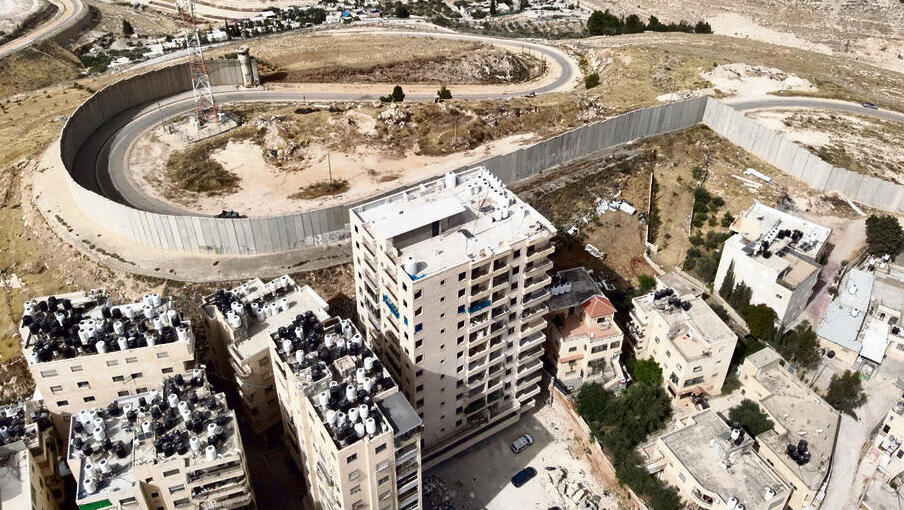
Illegal construction around Jerusalem
(Photo: Courtesy of Regavim)
Standing on the roof of the deserted building and turning from north to east, east to south and south to west, one can see a continuous chain of Arab villages, towns and neighborhoods — some Palestinian, some Israeli. To the north are the tall white towers of Ramallah, with Kafr Aqab below it, a village that is partly Palestinian and partly within Jerusalem’s municipal boundaries, effectively linking Ramallah and Jerusalem.
To the east are the settlement of Adam, the Palestinian town of al-Ram and the Qalandiya refugee camp. Farther east lie Anata, al-Eizariya, Abu Dis and Jerusalem’s Sur Baher neighborhood. To the south are Jabal Mukaber, the Har Homa neighborhood, Beit Sahour and Bethlehem. To the west are Mevaseret Zion, Har Adar and the Palestinian villages of Biddu and Qubeiba.
In the early 2000s, Israel built the separation barrier from Har Adar to Gush Etzion to improve security and prevent illegal entry of Palestinians into Israel, as well as terror attacks. However, a report published last week by State Comptroller Matanyahu Englman found that the barrier around Jerusalem does not provide an adequate response to prevent the entry of undocumented Palestinians or terrorists.
Englman wrote that although the barrier was built to block and thwart infiltration, it has, for a long time, failed to deliver the required level of protection. He described this as a serious failure that endangers Israeli residents in general, and nearby neighborhoods in particular, especially in light of the events of October 7.
A study presented here for the first time, conducted by Regavim — a right-wing organization focused on land and construction issues — documents infrastructure and high-rise buildings constructed without permits on the other side of the barrier. According to the group, the construction effectively encircles Jerusalem and raises additional red flags about potential security risks to the capital.
The Regavim study is based on aerial photographs collected over the years and cross-referenced to track building trends. It identifies a sharp increase in construction around Jerusalem since 2008. According to the findings, illegal construction on the city’s outskirts has reached an estimated 40,000 structures, forming what the report describes as a near-continuous ring around Jerusalem. All of the buildings are located in Area C, which is under full Israeli civil and security control. The report says their locations allow observation and control over major access routes.
Girl being smuggled through the West Bank security barrier, suspect arrested
(Video: Israel Police)


A senior Jerusalem municipality official said that “there are things the public does not know that help ensure calm in Jerusalem. Security forces are doing sacred work so we can live safely and quietly. It is no coincidence that since October 7, there has been calm.”
Despite those reassurances, retired police commander Levi Amitai, who previously headed the Jerusalem perimeter unit in the Border Police, offered a starkly different assessment. “From a security standpoint, this is a very serious danger,” he said. “A patrol moving along a fence beneath high-rise buildings is extremely dangerous. We saw what happened along the Philadelphi Corridor — in the end they had to demolish all of Rafah just to move there. Otherwise, you are controlled from all directions. Dealing with such a phenomenon is almost impossible.”
Yehuda Noam, Regavim’s Jerusalem district director, said the construction around the city is not accidental but, in his view, part of a strategy aimed at controlling key points and “creating a stranglehold around Jerusalem.”
“This reality has created a dense civilian infrastructure that serves as perfect cover for the infiltration of undocumented Palestinians and hostile terrorist activity,” Noam said. “There is no security buffer, and the maneuvering and response capability of the security forces drops to zero.”
Referring to the state comptroller’s report, Noam added that “the comptroller dealt with the route of the fence, its design, protection and reinforcement. Terror does not start at the fence. It starts with education, with Israel’s withdrawal from the area, with enforced distance, with irrelevant agreements and with a lack of presence and enforcement.”
The office of Jerusalem Mayor Moshe Lion said in a statement that “the mayor and those responsible for security in the city are in close and continuous contact with security authorities and work in full coordination with them. Responsibility for security and for addressing construction issues in the Jerusalem perimeter lies with the state and the enforcement agencies.”