


Aryeh Deri, the longtime leader of the ultra-Orthodox Shas party and a key political ally of Prime Minister Benjamin Netanyahu, announced Sunday that he would not serve in the newly elected Knesset following his party's disappointing performance in last month's election.
Deri, who will remain chairman of Shas, said he had received approval from the party's Council of Torah Sages, its highest religious authority, to relinquish his parliamentary seat and concentrate on rebuilding the party's support across Israel.
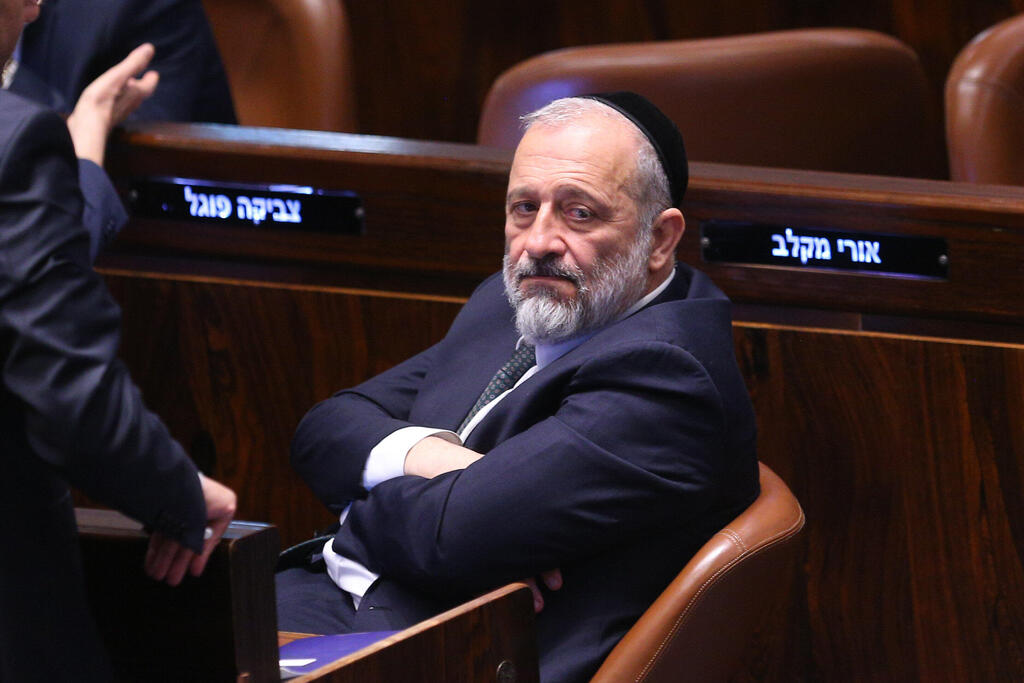
Aryeh Deri
(Photo: Alex Kolomoisky)
His decision comes after Shas secured just six seats in the 120-member parliament, a significant electoral setback for a party that has long played a pivotal role in Israeli coalition politics.
Two other candidates on the party's electoral list, Moshe Abutbul and Dror Amos, also withdrew, clearing the way for Uriel Buso and Yosef Taieb to enter the Knesset.
The six Shas lawmakers scheduled to be sworn in Tuesday are Yinon Azoulay, Michael Malkieli, Yoav Ben-Tzur, Haim Biton, Uriel Buso and Yosef Taieb.
Abutbul, who had been positioned to enter parliament following Deri's withdrawal, also gave up his place in the 26th Knesset.
Last week, reports emerged that Deri had sought to resign as party chairman as well, but Shas denied the claims. His announcement Sunday confirmed that he would retain control of the party while stepping away from parliamentary duties.
Deri vows to rebuild Shas from the grassroots
In a statement Sunday, Deri said the Council of Torah Sages had instructed him last week to remain chairman of Shas, a directive he accepted without hesitation.
"Last week, the revered rabbis of the Council of Torah Sages instructed me to continue serving as chairman of the Shas movement," Deri said. "I accepted their instruction without question, and we have already begun working at full speed."
He said he intended to embark on an extensive series of visits across Israel to strengthen the party's ties with its supporters, local representatives and political activists.
"In light of the many tasks and challenges before us, I intend to conduct comprehensive, in-depth tours throughout the country, strengthening our direct and close connection with the grassroots, with our representatives and activists, and with the public," he said.
"To that end, I requested and received the consent of the Council of Torah Sages to vacate my place on the Shas Knesset list in favor of younger representatives who have already proven themselves in parliamentary work.
"At the same time, I will continue convening the Shas parliamentary faction's weekly meetings as usual, guiding the members of Knesset and closely overseeing legislative work and parliamentary committees.
"With God's help, I will continue serving as chairman of the Shas movement under the guidance of our revered rabbis," he said. "Together, we will continue restoring the crown to its former glory, safeguarding the world of Torah and the Jewish identity of the State of Israel."
The reference to restoring the crown is part of Shas' longstanding political and religious identity, reflecting its mission to strengthen Sephardic and Mizrahi Jewish religious traditions and representation in Israeli public life.
Attempt to attract military voters falls short
Among those withdrawing from the Shas electoral list is Dror Amos, a reserve major in the IDF who had been recruited as part of the party's effort to appeal to soldiers and their families.
His inclusion was intended to broaden Shas' electoral appeal beyond its traditional ultra-Orthodox constituency, particularly as military service and exemptions for ultra-Orthodox men became central issues in the election campaign.
The effort failed to deliver the electoral gains the party had sought, and Amos is now stepping away from politics, at least for the time being.
The issue of ultra-Orthodox military conscription has become especially contentious following years of war and mounting pressure on IDF reserves.
Shas has traditionally defended exemptions for full-time yeshiva students, arguing that religious study is essential to preserving Jewish religious life. Critics contend that the exemptions place an unfair burden on Israelis who serve in the military, particularly reservists and their families.
Deri blames internal and external attacks for election setback
Deri has made relatively few public appearances since the election, although he addressed the results at a Shas parliamentary faction meeting last week.
During the meeting, he suggested that the party had faced an unprecedented campaign of hostility, including attempts to undermine its leadership from within.
"Three hundred thousand people answered the call of the Council of Torah Sages and were not tempted by the insane campaign of incitement against us over the past three years, from within and without," Deri said. "We must thank the Holy One, blessed be He, for the bad as well as the good, even when we do not understand His calculations."
Deri, a veteran of decades of Israeli political campaigns, said he had never encountered an election of comparable difficulty. "I have been involved in these campaigns for decades, and there has never been anything like this," he said. "During wartime, they exploited the restraint and responsibility we demonstrated to harm the movement and its leaders. They even tried to split our spiritual leadership.
"Experts told me they did not believe it was possible to survive such a campaign. It is truly a miracle, and for that we must thank the Holy One, blessed be He."
He argued that despite the electoral losses, Shas had preserved an organizational unity that few Israeli political parties could claim. "Not only did we survive, but we preserved something that barely exists in any other party: one spiritual leadership, one political leadership, one parliamentary faction and all our representatives in local government united," he said. "That is not something to be taken for granted. For all of this, we recited a psalm of thanksgiving."
Shas rules out joining Eisenkot government
Deri's announcement comes as political parties maneuver to form a new government following the election, with Yashar leader Gadi Eisenkot receiving the presidential mandate Sunday after securing recommendations from 67 lawmakers.
Although Eisenkot has sufficient parliamentary backing to receive the mandate, the composition of a potential governing coalition remains uncertain, particularly as parties negotiate over military conscription, religious policy and the role of Arab parties in supporting a government.
One possibility under discussion is that United Torah Judaism, another ultra-Orthodox party, could join an Eisenkot-led coalition.
Asked about that prospect, Deri expressed skepticism about Eisenkot's ability to meet the party's demands. "We need to see whether Eisenkot can deliver what they want," Deri said. "He is not the one calling all the shots. There are Liberman and Bennett, who have different interests," he added, referring to Yisrael Beytenu leader Avigdor Liberman and former prime minister Naftali Bennett, whose positions could complicate negotiations with ultra-Orthodox parties.
Liberman has long campaigned against exemptions from compulsory military service for ultra-Orthodox men, although he signaled over the weekend a willingness to compromise on the issue to facilitate the formation of a government that would replace Netanyahu.
Despite speculation that Shas could follow United Torah Judaism into an Eisenkot coalition, the party categorically rejected that possibility Saturday night.
"This is complete fake news," Shas said in a statement. "As instructed by the Council of Torah Sages, Shas is part of the right-wing bloc, which loves the Torah and Jewish tradition."