

A missile struck King Khalid International Airport in Riyadh on Saturday, wounding multiple people and forcing the evacuation of passengers and suspension of flights, just two days after another deadly attack on Saudi Arabia's main international airport. The latest strike comes amid a sharp escalation in fighting between the kingdom and Yemen's Iran-backed Houthi rebels, with US President Donald Trump saying Washington is considering joining Saudi strikes against the group.
A regional official familiar with the incident told The Associated Press that the missile hit the complex housing Terminals 3 and 4, used for domestic flights, and that many people had been wounded. Ambulances rushed to the airport as passengers were evacuated. Saudi authorities subsequently confirmed that several people were injured, but did not provide a precise casualty figure.
Houthi ballistic missile attacks on King Khalid International Airport in Riyadh, Saudi Arabia
(Video: X)


A medical official in Riyadh told AFP that doctors had been summoned to hospitals across the capital following a "serious emergency," saying many of the casualties had suffered severe injuries. Separately, a witness told Reuters that he saw an explosion at the airport and subsequently noticed several wounded people lying on the floor inside one of its buildings.
Saudi Arabia's civil aviation authority announced that operations at the airport had been temporarily suspended pending a damage assessment and confirmation that its facilities were safe. Media outlets affiliated with the Iranian-led regional axis claimed there were fatalities, but those reports could not immediately be verified.
The strike followed an attack on Thursday in which at least one passenger aircraft, reportedly empty at the time, was damaged and three Saudi citizens, including a pilot, were killed. Earlier attacks on airports in Riyadh and the southern city of Abha had also caused fatalities, as Houthi strikes increasingly targeted civilian aviation infrastructure.
Trump, speaking in Washington on Saturday, said the United States could become directly involved in Saudi Arabia's military campaign against the Houthis, although no decision had been made.
"We may. We're going to look at it," he told reporters. "We just found out about the recent attack. So we'll make a decision. We move very quickly."
Houthis seek to ‘close Saudi skies’
According to flight-tracking website Flightradar24, all flights bound for Riyadh were diverted or canceled following Saturday's strike. At one point, only a single helicopter was visible above the airport. Airport management urged passengers to contact their airlines before traveling to check their flight status.
Kuwait Airways announced that it had canceled flights to and from Riyadh because of the security situation. Etihad Airways and Qatar Airways also canceled services, joining other carriers, including Lufthansa, that had already suspended flights to the Saudi capital earlier in the week. The US and Canadian embassies in Riyadh advised their citizens to avoid the airport.
The Houthi attacks on Saudi cities have increasingly focused on airports as part of an effort to disrupt the kingdom's aviation sector and effectively close its airspace. The rebels describe the attacks as retaliation for Saudi airstrikes against their forces in Yemen, where fighting has intensified with troops loyal to the internationally recognized Yemeni government.
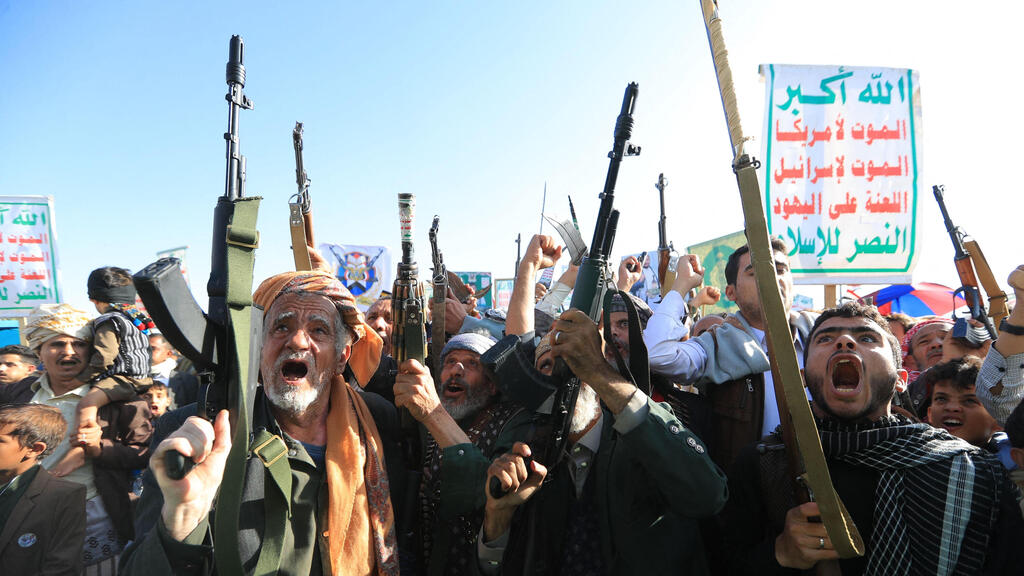
Earlier this week, the Houthis warned international airlines against operating in Saudi airspace, declaring it a theater for their military operations and saying they would not accept responsibility for the consequences if carriers continued flying there. On Thursday, Houthi military spokesman Yahya Saree issued another message, describing it as a "final warning."
Despite the continued attacks, Saudi civil defense authorities have stopped officially reporting the activation of public warning sirens in recent days, even though alerts had been issued during previous attacks over recent months.
The latest escalation is part of a broader confrontation that resumed in July, ending four years of relative calm in Yemen's civil war, which began in 2014. Riyadh has long supported the internationally recognized government against the Houthis, who control large parts of the country and are closely aligned with Iran.
The renewed fighting began after a Houthi attempt to break the Saudi-imposed air blockade, against the backdrop of an escalation in the war involving Iran. Last month, the rebels launched a rapid offensive and captured strategic coastal areas in southwestern Yemen overlooking the Bab al-Mandab Strait.
Although the Houthis already had the ability to attack shipping with drones and missiles from a distance, their territorial gains strengthened their control over the vital maritime passage, which connects the Red Sea and the Gulf of Aden and forms part of the shipping route between Europe and Asia through the Suez Canal. Roughly 12% of global trade passes through the route.
The importance of Bab al-Mandab, particularly for Saudi Arabia, has grown dramatically following the closure of the Strait of Hormuz on the opposite side of the Arabian Peninsula during the war with Iran.
Battle for Bab al-Mandab intensifies
Earlier this week, Yemeni forces aligned with Riyadh launched a major ground offensive, dubbed "Dawn of Yemen," aimed at pushing the Houthis out of their newly captured territories and regaining control of Bab al-Mandab.
Saudi Arabia has provided extensive air support, including heavy strikes against Houthi positions. Reports indicate that pro-Saudi forces have advanced in the area, but the extent of those gains remains disputed.
Forces loyal to the Yemeni government claim they have regained control of the strategic strait, but the Houthis reject those claims. Independent accounts also differ over how much territory has been recaptured.

Pro-Saudi Yemeni government forces fighting in the Taiz area
(Photo: YEMEN GIANTS BRIGADES MEDIA CENTRE / AFP)
Houthi political bureau member Hizam al-Asad responded to the latest developments by accusing the United States and Saudi Arabia of attempting to reverse the rebels' gains.
"There is a desperate attempt by the United States and Saudi Arabia to regain control of Bab al-Mandab," he said. "We dealt a blow to the Saudi regime and to everyone who promoted the narrative that the forces loyal to the Saudi regime had taken control of Bab al-Mandab."
He also warned of further escalation.
"The operations we have carried out so far were merely a dress rehearsal. Our forces have many surprises."
Pakistan denies strikes, Turkey rules out offensive role
As the war intensifies, attention is also turning to Pakistan and Turkey, which signed a mutual defense agreement with Saudi Arabia in August, known as the Mecca Pact.
The agreement stipulates that an attack on one member is considered an attack on all three. It has raised questions about whether Islamabad and Ankara could be drawn into Saudi Arabia's campaign against the Houthis.
Both countries have condemned the attacks, and the alliance has agreed to activate collective defense measures. However, the extent of their potential involvement in military operations inside Yemen remains uncertain.
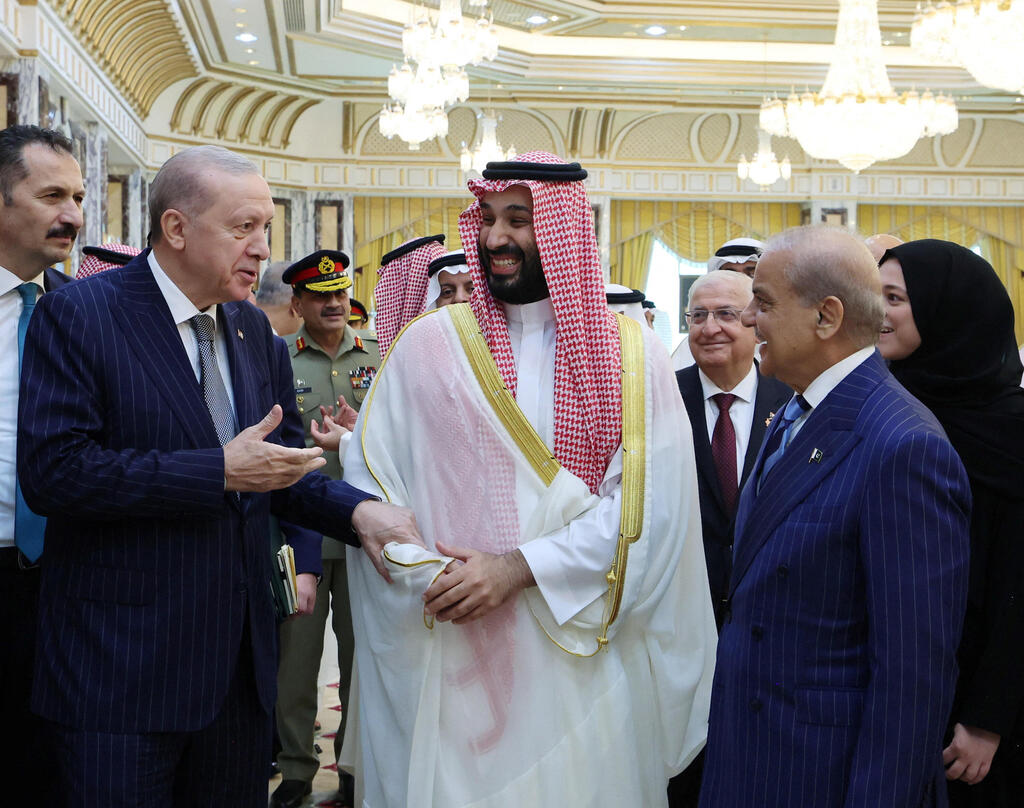
Saudi Crown Prince Mohammed bin Salman, Turkish President Recep Tayyip Erdogan and Pakistani Prime Minister Shehbaz Sharif at the signing of the trilateral agreement
(Photo: Murat Cetinmuhurdar/Turkish Presidential Press Office/Handout via REUTERS)
On Thursday, The New York Times quoted a senior Pakistani military official, speaking anonymously, as saying Pakistani fighter jets had already participated in strikes against the Houthis. Pakistan's Information Ministry denied the allegation within hours.
Pakistan has confirmed sending military personnel to Saudi Arabia. According to The New York Times, analysts monitoring the deployment estimate that approximately 8,000 Pakistani troops are stationed in the kingdom.
Another Pakistani official told the newspaper that Islamabad's assistance would focus primarily on air defenses against Houthi missiles and drones rather than offensive operations in Yemen.
Reuters also reported that Pakistan had sent military equipment to pro-Saudi forces in Aden, the southern Yemeni city where the internationally recognized government fighting the Houthis is currently based.
Turkey, meanwhile, has ruled out participating in offensive operations against the rebels.
Turkish Foreign Minister Hakan Fidan said Thursday that the Mecca Pact was "primarily a defensive alliance, not an offensive one."
According to Fidan, Turkey and Pakistan are continuing to examine how they can support Saudi Arabia against the Houthi attacks, but he stressed that Ankara would not send forces into another country to carry out an attack.
"We will not send military forces into another country's territory to conduct an offensive," he said. "We are studying how to provide Saudi Arabia with military assistance, air defense and electronic warfare capabilities under the alliance."
The distinction between defensive support and direct participation in the fighting is becoming increasingly significant as Houthi missiles continue to threaten Saudi cities, aviation infrastructure and the kingdom's economic interests. With the battle for Bab al-Mandab still unresolved and the Houthis warning that their latest strikes were only a preview, Riyadh faces the prospect of further attacks while its allies weigh how far they are prepared to go.
First published: 19:05, 10.10.26