


Eight minutes passed from the moment reservists from the 55th Brigade's Paratroopers Reconnaissance Battalion raided the Sunni-Syrian town of Beit Jinn, 11 kilometers (6.8 miles) from the Israeli border, until the head of a terror cell was pulled from his bed in the middle of the night and handcuffed, after being identified by Military Intelligence Unit 504 interrogators.
Two additional operatives were arrested with him, but the operation took a violent turn as the force began to withdraw in a convoy of armored Humvees: dozens of gunmen opened fire from multiple directions and began closing in on the reservists. Six soldiers were wounded in the incident, three of them seriously.
IDF forces operating in Beit Jinn, Syria
(Video: IDF)


The raid took place overnight Thursday into Friday. After weeks of preparation, rehearsals and mock-up drills, precise intelligence arrived: the leader of a terrorist network affiliated with the al-Jama’a al-Islamiyya (Islamic Group) organization—believed to be planning attacks on IDF positions on the Syrian Golan Heights, and possibly also on Israeli communities—was confirmed to be at home, along with his brother.
If a mission like this would once have been carried out quietly and exclusively by the Sayeret Matkal commando unit, over the past year it has increasingly become the responsibility of the reserve troops overseeing the sector.
The fighters had been briefed and prepared for the possibility of gunfire, and therefore arrived with pre-gathered aerial intelligence—including drones—and with a heavy Air Force standby presence nearby: attack helicopters, fighter jets and a Hermes 450 reconnaissance drone, with tanks positioned not far away in case the operation escalated.
The force entered the village by vehicle, in the dead of night, using covert operational driving procedures developed extensively during the war in Gaza—no headlights, and night-vision systems fitted to the drivers and commanders.
IDF Humvee burns after coming under ambush in Beit Jinn, Syria
The quiet, swift operation became overt after the arrests. The first shots rang out moments after the battalion radio network reported, “Johnny is in our hands.”
“We began pulling out with the detainees when we heard sporadic gunfire, initially from quite a distance,” Maj. A., the battalion’s deputy commander who was on the ground with the troops, told ynet on Saturday night. “We immediately activated the brigade’s fire-support envelope, which included artillery, attack helicopters and drones, in addition to our own battalion assets. But the terrorists kept closing in and fired at close range on the cover and containment teams.”
The terrorists—several dozen—fired machine guns and light weapons, and apparently nothing heavier. First to be hit were a soldier and an officer in one of the containment teams. The company commander, who led the operation, rushed toward them; he was seriously wounded as he charged forward and evacuated his troops under fire. Within minutes, the senior commanders at the tip of the operation—the company commander, his deputy and a team leader—were all hit.
Their subordinates quickly regrouped and took command, with fighters directing forces and engaging in point-blank combat in built-up terrain, as if battling in Khan Younis or in a refugee camp near Nablus. By Saturday night, the IDF estimated that between 13 and 20 terrorists had been killed, some of them linked to the terror network disrupted by the raid. Two Air Force helicopters landed inside Syrian territory, near the village, to evacuate the six wounded soldiers.
Aftermath of fierce clash between IDF soldier and local terrorists in Beit Jinn, Syria
Beit Jinn is home to numerous armed terrorists affiliated with Hezbollah as well as Hamas. And despite the deceptive calm in the Syrian Golan—captured by the IDF without a battle a year ago, after the fall of the Assad regime—the army has identified in recent months multiple efforts by terrorist elements in the area to prepare attacks on nine IDF outposts that Syrian President Ahmad al-Sharaa is demanding Israel evacuate as a condition for a renewed ceasefire agreement.
For the Paratroopers Reconnaissance Battalion reservists, this was their first operation in Beit Jinn, but not in the sector. The soldiers have already detained operatives in other villages in the Syrian Golan, in what is beginning to resemble the evolving reality long familiar in the West Bank.
Each such arrest points to an attempt to build terrorist infrastructure against the IDF in the area—and to a far less secure future in the region. The army explained that the decision to arrest these operatives, rather than eliminate them from the air, stems from essential intelligence needs that can only be met through interrogation.
“This is already the third company commander the platoon has had during the war, because I was the first—and I, too, was wounded in the fighting in Khan Younis,” added Maj. A. “I recovered and returned to serve as deputy battalion commander. October 7 taught us that the moment terrorists feel safe somewhere, it can eventually reach us—and that’s a significant lesson learned the hard way. That’s why we must defend not only from the line itself but through proactive operations deep in the field.”
According to data from the Northern Command, the IDF has already carried out some 100 different offensive operations on Syrian territory since the beginning of the year, on the ground, dozens of which involved seizing weapons or arresting wanted suspects.
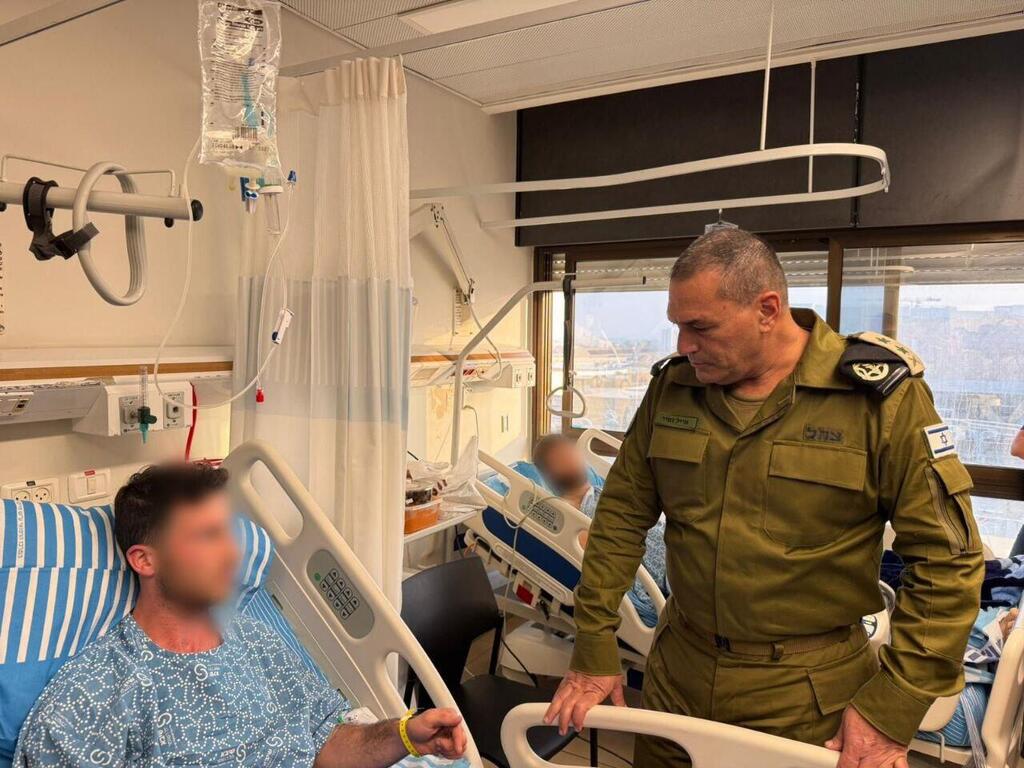
IDF Chief of Staff Lt. Gen. Eyal Zamir visits soldiers wounded in the ambush at Sheba Medical Center in Tel Hashomer
(Photo: IDF)
Over the weekend, IDF Chief of Staff Lt. Gen. Eyal Zamir visited Sheba Medical Center in Tel Hashomer and met with two of the soldiers wounded in the battle. “The chief of staff shook my son’s hand and came to strengthen him and his comrades,” the father of one of the wounded soldiers, who was struck by a bullet and is in mild condition, told ynet and its sister publication Yedioth Ahronoth. “He is very exhausted from what he’s been through.”
The father said his injured son is a 25-year-old student who was serving in reserve duty in Syria and had been scheduled to return home Thursday evening. “He called to say he’d be delayed and would come back on Friday. He didn’t want to give too many details about the operation,” the father recalled, noting that his wounded son has a twin brother—and that both have fought over the past two years, including in the Gaza Strip.