

Lebanon is demanding that Israel withdraw from two “pilot zones” in southern Lebanon before it participates in the next round of direct talks with Israel in Rome, a Lebanese diplomatic source told AFP, casting uncertainty over negotiations that were expected to resume next week.
The source, who requested anonymity, said Lebanon was “stipulating Israel’s withdrawal from two pilot zones in order to participate in the round of negotiations” planned for July 15 and 16 in the Italian capital.
Trump: I think Israel should withdraw from Lebanon
(Video: FOX NEWS)


The talks were announced by Italy and Israel after a framework agreement was signed last month. An Israeli official had told The Times of Israel last month that the IDF needed more time to withdraw from one of the two pilot zones in southern Lebanon from which Israel had agreed to pull back under the U.S.-brokered framework deal with Beirut.
The Rome talks were expected to form part of the agreement signed in Washington between the countries’ ambassadors. Sources familiar with the matter had already said there was uncertainty over whether the talks would take place next week and that the meeting could be pushed back to the following week.
One reason for a possible delay is Lebanese President Joseph Aoun’s planned visit to Washington on July 21. The sides may prefer to hold the talks after that visit.
The talks are moving from Washington to Rome because the working groups are mostly made up of representatives from the Middle East, and Italy was chosen as a closer venue. The meetings are expected to take place at the ambassadorial level, with Israel’s ambassador to Washington, Yechiel Leiter, and Lebanon’s ambassador to Washington, Nada Hamadeh Moawad, traveling to Rome.
The United States is still considering the possibility of a trilateral meeting between U.S. President Donald Trump, Prime Minister Benjamin Netanyahu and Aoun, though Lebanese officials are firmly opposed to a meeting with Netanyahu. Trump may pressure the sides to make such a meeting happen.
No date has been set for Netanyahu’s next visit to Washington. Next week is being discussed, but nothing has been finalized.
Gallery

Trump was asked whether he believes Israel should withdraw IDF troops from southern Lebanon. He replied: 'I talked to Bibi about that. Yeah, I think they’re going to'
(Photo: Mark Schiefelbein/AP, ANWAR AMRO/AFP, shutterstock, Shalev Shalom)
Israel sees ‘huge achievement’
Assessments presented to Israel’s Security Cabinet described Israel’s situation in Lebanon as “excellent.” According to those assessments, the agreement effectively created separation between Israel and Iran and, more importantly, gave Israel recognition as a sovereign actor operating in the area.
Under the agreement, Israeli officials say Israel received international legitimacy to remain in a security zone eight to 10 kilometers deep inside Lebanese territory and continue clearing and dismantling terrorist infrastructure until Hezbollah is dismantled.
“This is a huge achievement for Israel, remaining in the territory with authority and permission while the IDF continues to operate and dismantle infrastructure,” a senior Israeli official said.
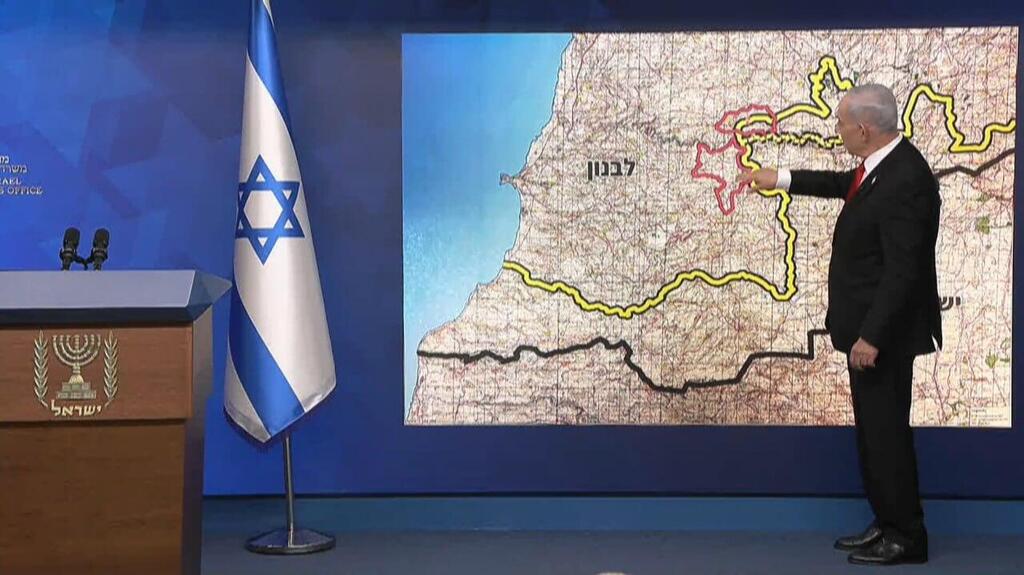
The IDF is still expected to hand over two pilot areas to the Lebanese army. According to the senior Israeli official, it will take at least several weeks before the Lebanese army is ready to assume responsibility for them.
“For Israel, there are no more pilot areas on its side of the yellow line. Everything is moving outward,” the official said. “We assess that the Lebanese army cannot dismantle Hezbollah and that ultimately we will have to do it ourselves, on our own timetable. We will prepare ourselves with intelligence and everything else that is needed.
“But at least during this period we remain in a security zone, keep the enemy away from our communities, remove the threat and thoroughly clear the entire area for complete sterilization, something that has never happened before.”
Trump was asked whether he believed Israel should withdraw IDF troops from southern Lebanon.
“I talked to Bibi about that. Yeah, I think they’re going to. I think they want to. They’re getting along with Lebanon. They’re signing deals with Lebanon. First time ever,” Trump said.
U.S. Secretary of State Marco Rubio added: “We have an agreement, and it calls, that’s the goal at the end. Obviously, Israel’s concerned about their security, but the president did a great job bringing those two countries together for the first time in many years.”
Israelis and Lebanese discuss peace
Against the backdrop of the diplomatic efforts, Israelis and Lebanese held a joint Zoom conversation in an unusual meeting between former National Security Council deputy head Eran Etzion and Lebanese-American peace activist Nizar Zakka, joined by hundreds of participants, including from other countries.
The event, titled “Israelis and Lebanese talking peace,” was moderated by Israeli-American activist Vered Guttman. It centered on a rare public dialogue between Etzion and Zakka, a global public policy expert and former prisoner of the Iranian regime.
'For Israel, there are no more pilot areas on its side of the yellow line'
(Photo: GPO)
Organizers said it was one of the first public conversations of its kind between Israelis and Lebanese, focused on a shared vision of peace, security, stability and prosperity between the two countries.
Zakka, who was imprisoned for four years by Iran’s Revolutionary Guard Corps, is considered one of the most outspoken voices in the Arab world calling for peace, dialogue and normalization between Israel and Lebanon. In recent years, he has worked to promote ties between citizens of the two countries, led regional peace initiatives and publicly supported efforts to bring back the Israeli hostages.
During the meeting, Zakka said his efforts on behalf of the hostages after October 7 strengthened his understanding that “ultimately, Israelis and Lebanese share the same human concerns and the same aspirations for safer and better lives.”
Zakka said research and surveys conducted by his organization in recent years indicated significant support in Lebanon for peace and normalization with Israel.
“The majority of Lebanese want peace and want to live in prosperity. Peace alone is not enough, we want normalization, so people on both sides of the border can enjoy genuine neighborly relations,” he said.
He stressed that residents of southern Lebanon, who have suffered from years of conflict, would be the main beneficiaries of any future agreement.
Etzion welcomed the meeting, saying: “Our two peoples long for peace and normalization and deserve a different future.”
Despite deep skepticism on both sides, Etzion said experience showed that public opinion could change quickly when a genuine diplomatic horizon opened.
“The Israeli, Lebanese and American interest is to achieve a full and complete ceasefire that will allow progress toward long-term agreements,” he said.
According to Zakka, surveys conducted by his organization found that about 62% of Lebanese respondents supported a peace agreement with Israel. He said one of the notable findings was the similarity between Israelis and Lebanese regarding economic expectations from peace.
“When it came to tourism, business, investment and economic cooperation, Lebanese and Israelis were on the same page,” he said.
He said the highest levels of support were recorded among citizens who see peace and normalization as a path to rebuilding the economy, developing border areas and improving quality of life in Lebanon.
Zakka added that in conversations with senior Lebanese officials and politicians, he had identified a significant shift in attitudes toward the idea of peace with Israel.
“A year ago, when I spoke about peace, some people thought I was crazy. Today more and more people understand that the public wants this,” he said.
He said the human cost of continued conflict required a different approach.
“If peace can be achieved one day earlier, that is one less mother who will suffer and one less person who will be harmed,” he said.
At the end of the meeting, a joint Israeli-Lebanese petition was launched calling for the promotion of peace, security, stability and prosperity for both peoples. Organizers said it was the first step in a series of joint civil initiatives aimed at promoting direct dialogue between Israelis and Lebanese.
Meanwhile, in Gaza
Israel currently controls 60% to 70% of the Gaza Strip and is pushing Hamas into a smaller area along the coast, according to the senior Israeli official.
The official said Israel was moving the yellow line in order to clear territory, not to boost morale.
“Every area like this that we take, we drill, destroy tunnels and gradually deepen the clearing and purification of all terrorist infrastructure in Gaza,” the official said. “Hamas is pushed into between 30% and 40% of Gaza along the sea.
“Gaza is in ruins. There is no reconstruction, and that is truly the central issue. We are maintaining international legitimacy. We have full freedom of action. All the headlines claiming Hamas is rebuilding are complete nonsense. It has very limited ability to rebuild because we control everything that enters. So yes, it has some smuggling here and there, but it is not a dramatic development that changes reality.
“The final objective is to reach 100%. Slowly. It could take two years. But the alternative is to mobilize three or four divisions, and we do not want that.”