


The story being sold to the world is about science. Saudi Arabia's cabinet just approved an initiative to design and build the kingdom's first satellite developed jointly with Egypt. The project is dedicated to remote sensing and commercial Earth observation.
Riyadh and Cairo are framing this as another chapter in Gulf economic diversification, and as one more entry in Crown Prince Mohammed bin Salman's Vision 2030 portfolio.
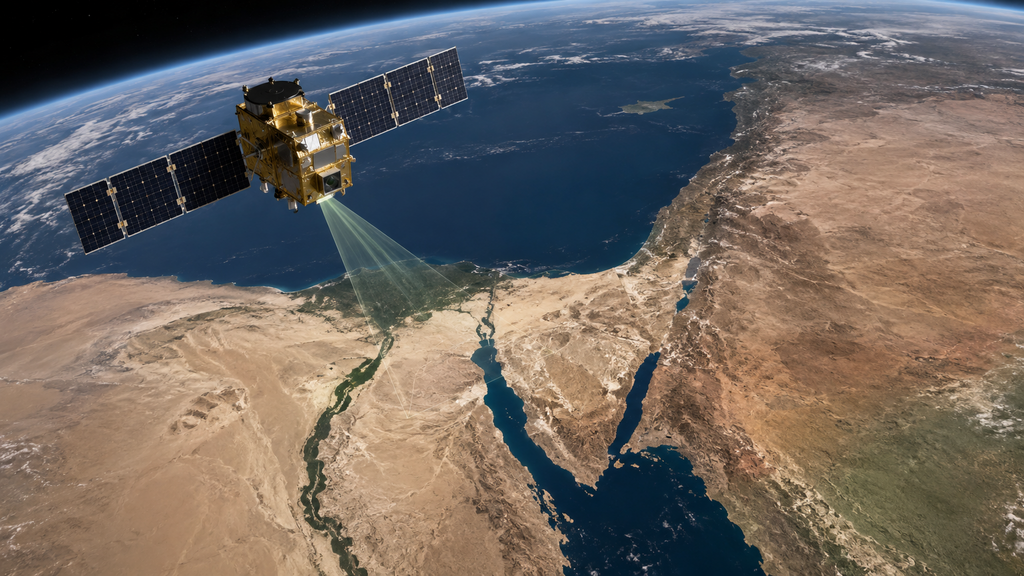
Saudi Arabia to build the kingdom's first satellite jointly with Egypt
But what is actually being built is not primarily a scientific instrument.
It is the latest asset in a patron-client relationship that has already absorbed Egypt's ports, its banks and a slice of its Mediterranean coastline. This time the asset sits in orbit, and it points a sensor at the Sinai.
Cairo's external debt has crossed 40% of GDP, with annual debt servicing approaching $40 billion.
Since the 2011 uprising, Gulf governments have funneled more than $100 billion into Egypt's central bank and state coffers. That figure swelled after the 2024 deal granting the UAE development rights to Ras al Hikma for $35 billion, and after Saudi Arabia's own multibillion-dollar pledges tied to Egyptian healthcare, education, agriculture and finance.
Egypt no longer negotiates with Gulf capital as a sovereign equal. It negotiates as a serial debtor, handing over another slice of the state's commanding heights with each rescue.
The satellite fits that pattern.
But this acquisition is not a stake in a bank or a coastal resort. It is a foothold inside Egypt's national security architecture.
The Saudi Space Agency has cooperated with its Egyptian counterpart since a memorandum of understanding signed in December 2023. According to the limited details released so far, the new project will focus on satellite manufacturing, imaging and commercialization.
Neither government has disclosed the financing split or a launch timeline. That silence is informative.
When Gulf states want a project understood as uncomplicated commerce, they say so loudly. When the architecture is murkier, vague language about strategic cooperation fills the gap.
Egypt's history with remote sensing satellites sharpens this reading.
EgyptSat 1, built with Ukrainian help, and EgyptSat 2, built with Russian help, were marketed as civilian environmental and mapping tools. One Israeli academic who studied the program concluded that the cover story masked a military intelligence function from the start, with the Egyptian armed forces financing and using the imagery behind a scientific facade.A new, more capable satellite, financed in part by Riyadh, would hand Cairo's military a meaningfully upgraded surveillance picture of its own borders, the Red Sea and the Sinai Peninsula.
There is also a branding dimension to this deal.
Egypt hosts the headquarters of the African Space Agency at its New Cairo Space City and presents the facility as proof of indigenous capability. That claim already strained credulity before Riyadh got involved.
Beijing financed the MisrSat 2 satellite, launched on a Chinese rocket in December 2023, and built the assembly and testing center inside Space City that Egypt now showcases as domestic mastery.
That came on top of the earlier Chinese-funded Horus 1 and Horus 2 satellites. Chinese state media has called the project a flagship of Belt and Road cooperation in Africa, and independent trackers rank Egypt among Beijing's most extensive space partners on the continent.
Washington does not need to stop Saudi Arabia from financing Egyptian technology. It needs to stop pretending a satellite pointed at Sinai, built in a Chinese funded facility, is just a satellite
A new, more capable satellite, financed in part by Riyadh, would hand Cairo's military a meaningfully upgraded surveillance picture of its own borders, the Red Sea and the Sinai Peninsula.
There is also a branding dimension to this deal.
Egypt hosts the headquarters of the African Space Agency at its New Cairo Space City and presents the facility as proof of indigenous capability. That claim already strained credulity before Riyadh got involved.
Beijing financed the MisrSat 2 satellite, launched on a Chinese rocket in December 2023, and built the assembly and testing center inside Space City that Egypt now showcases as domestic mastery.
That came on top of the earlier Chinese-funded Horus 1 and Horus 2 satellites. Chinese state media has called the project a flagship of Belt and Road cooperation in Africa, and independent trackers rank Egypt among Beijing's most extensive space partners on the continent.
Layering Saudi money onto an architecture already built with Chinese grants does not make Egypt's space sector more sovereign.
It makes Cairo's prized program a satellite in both senses of the word, orbiting whichever patron is writing the check that year.
That last detail should concern Israel directly.
Senior Israeli officials have spent more than a year protesting an unauthorized buildup of Egyptian armor and troop concentrations in Sinai, beyond what Annex I of the 1979 peace treaty permits. Cairo has alternated between denial and strategic ambiguity.
A new sovereign satellite capability, dual-use by design and funded by a third party with no formal obligations under that treaty, gives Egypt a stronger hand to monitor, anticipate and outmaneuver Israeli responses to its own treaty violations.
Riyadh is not a signatory to Camp David and bears no legal duty to weigh how its investments interact with it. That is precisely why Jerusalem and Washington need to ask the question themselves, since nobody in Riyadh or Cairo will.
Washington does not need to stop Saudi Arabia from financing Egyptian technology.
It needs to stop pretending a satellite pointed at Sinai, built in a Chinese-funded facility, is just a satellite.
For Saudi Arabia, the calculus is straightforward and not hidden.
Vision 2030 demands visible high-technology wins, and a joint satellite with the Arab world's most populous nation photographs well regardless of what it does in orbit.
But Mohammed bin Salman is also accumulating leverage for the next phase of regional diplomacy, one in which Gaza stabilization, a possible Saudi-Israeli normalization track and Red Sea security are all moving simultaneously.
A Saudi-funded eye in the sky over the eastern Mediterranean and the Sinai gives Riyadh the independent situational awareness it currently lacks. It strengthens its negotiating position with everyone, Israel and Washington included, regardless of how the satellite is officially marketed.
 Amine Ayoub
None of this means the project should be blocked or treated as automatically hostile.
It means it should not proceed inside the comfortable fiction of pure scientific cooperation.
Washington holds real leverage here that it has so far left unused. Egypt's IMF program and its annual American military assistance package both give Washington natural points of contact to insist on transparency.
The Chinese-built assembly facility likely to test this new satellite deserves its own scrutiny. Demanding openness on Saudi financing means little if the hardware still passes through Beijing-funded infrastructure on its way to orbit.
A reasonable ask would be a notification mechanism, modeled loosely on the Multinational Force and Observers structure that already monitors Sinai compliance.
Under such a mechanism, any new Egyptian remote sensing capability with military application would be registered, and its imagery-sharing arrangements disclosed to treaty partners.
Riyadh should have no objection to this if its framing of the satellite as peaceful and commercial is sincere. If Saudi officials resist, that alone will tell Washington and Jerusalem what they need to know about the project's true purpose.
Washington's recent habit has been to treat Gulf economic diversification deals as inherently benign.
That assumption has aged poorly, given how many such deals have quietly reshaped the region's military balance from the Red Sea to the Mediterranean.
Washington does not need to stop Saudi Arabia from financing Egyptian technology. It needs to stop pretending a satellite pointed at Sinai, built in a Chinese-funded facility, is just a satellite.
Riyadh is not merely bankrolling Cairo's ports and banks anymore.
It is buying eyes in the sky inside a program Beijing already half owns, and Washington had better start asking who those eyes are really watching.
Amine Ayoub, a fellow at the Middle East Forum, is a policy analyst and writer based in Morocco. Follow him on X: @amineayoubx