

Prime Minister Benjamin Netanyahu on Friday announced Israel’s formal recognition of Somaliland as an independent and sovereign state. In return, Somaliland will establish diplomatic relations with Israel, in what officials described as an agreement “in the spirit of the Abraham Accords.”
Somaliland later issued an official statement saying it intends to join the Abraham Accords following Israel’s recognition.
No UN member state has previously recognized Somaliland as an independent country. The territory has recently been mentioned as a possible destination for Gazans, with officials there saying they would be willing to absorb “one million Gazans,” though no formal agreement has been announced. Somalia, which considers Somaliland part of its sovereign territory, swiftly condemned Israel’s decision in a joint statement with the foreign ministers of Turkey, Egypt and Djibouti.
Netanyahu’s office released the announcement before the prime minister issued his first public response to the deadly terror attack in northern Israel in which two people were killed. Roughly 15 minutes later, Netanyahu published a statement of condolence, saying: “Despite many counterterrorism successes over the past year, we unfortunately continue to face murderous attacks from time to time.”
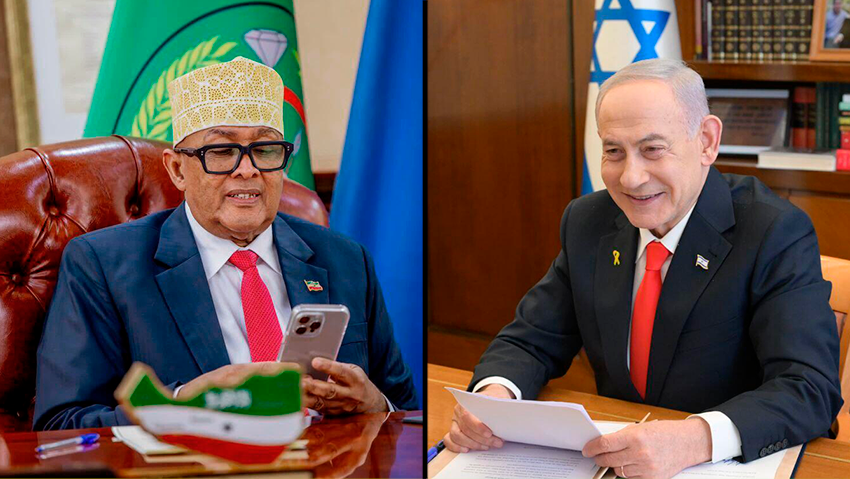
A phone call between the two leaders
(Video: GPO)


Somaliland declared independence from Somalia in 1991 amid the civil war that turned Somalia into a failed state. Since then, Somaliland has functioned de facto as a sovereign entity but has lacked international recognition. Until now, only Taiwan, which is not a UN member, has formally recognized Somaliland. Ethiopia maintains trade and diplomatic ties with Somaliland but has not officially recognized it.
More than 3 million people live in the Muslim-majority territory. Somalia continues to claim the region as part of its sovereign territory, while Somaliland President Abdirahman Mohamed Abdillahi has defined international recognition as a top national priority.
In a statement released Friday afternoon, Netanyahu said he, Foreign Minister Gideon Sa’ar and the Somaliland president signed a joint declaration of mutual recognition. “This declaration is in the spirit of the Abraham Accords initiated by President Trump,” the statement said. Netanyahu congratulated the Somaliland president, praised his leadership and commitment to security, stability and peace, and invited him to make an official visit to Israel.
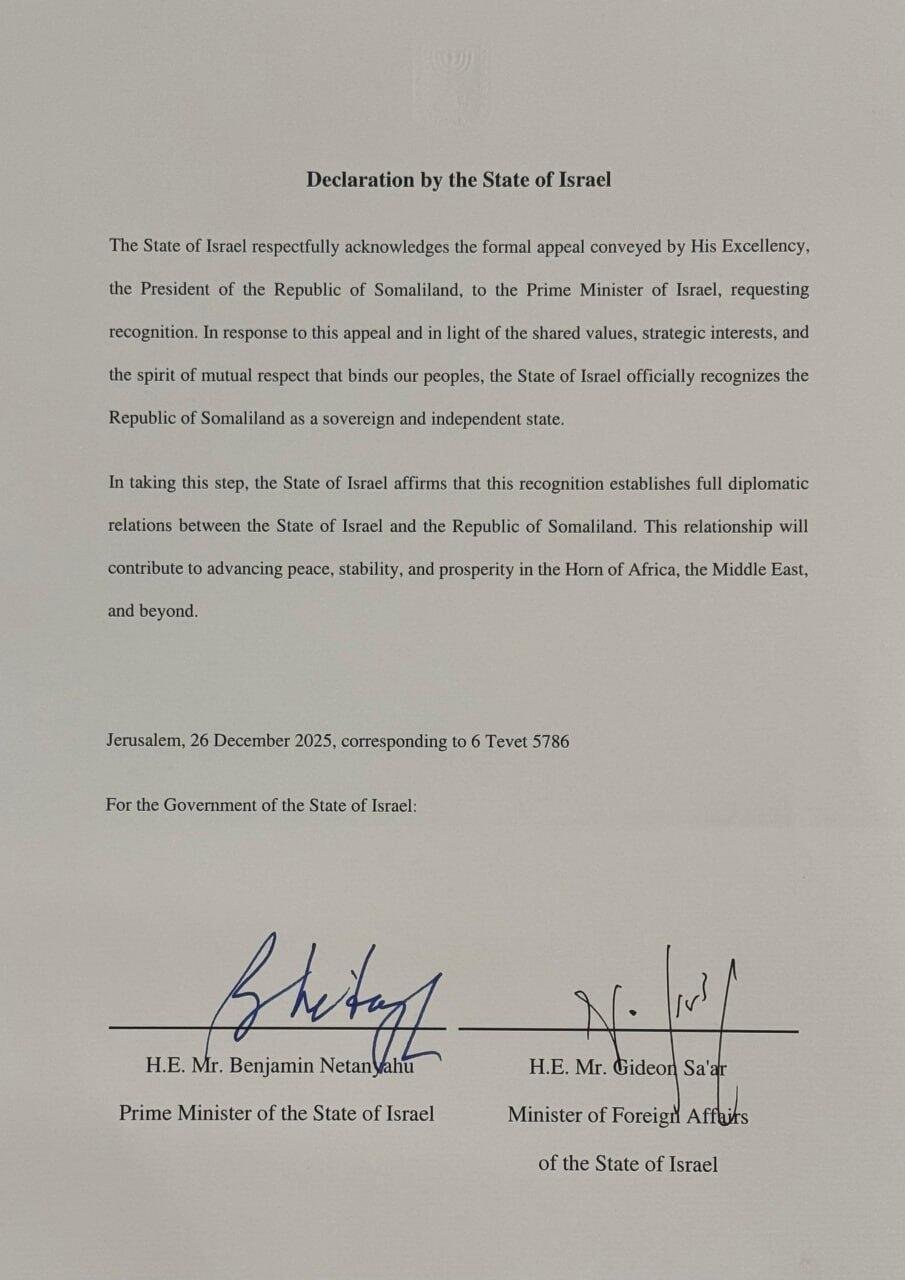
The recognition document
The statement added that the Somaliland president thanked Netanyahu for what he described as a historic decision and expressed appreciation for Israel’s efforts in combating terrorism and advancing regional peace. Netanyahu also thanked Foreign Minister Sa’ar, Mossad Director David Barnea and the intelligence agency for their role in advancing the recognition. Israel said it plans to immediately expand ties with Somaliland in agriculture, health, technology and economic cooperation.
Shortly after Israel’s announcement, Somalia, Egypt, Turkey and Djibouti issued a joint condemnation, reaffirming their support for Somalia’s unity, sovereignty and territorial integrity. Egypt’s Foreign Ministry said the statement followed a call between Egyptian Foreign Minister Badr Abdelatty and his counterparts from the three countries.
Israel, like the United States, has a strong strategic interest in Somaliland due to its long coastline and location in the Horn of Africa. One key factor driving Israel’s interest is Somaliland’s proximity to areas controlled by the Houthis in Yemen, who continue to pose a significant threat to regional shipping lanes despite the cease-fire linked to the Gaza war. Strengthening ties with Somaliland is seen in Israel as a strategic force multiplier against the Houthis.
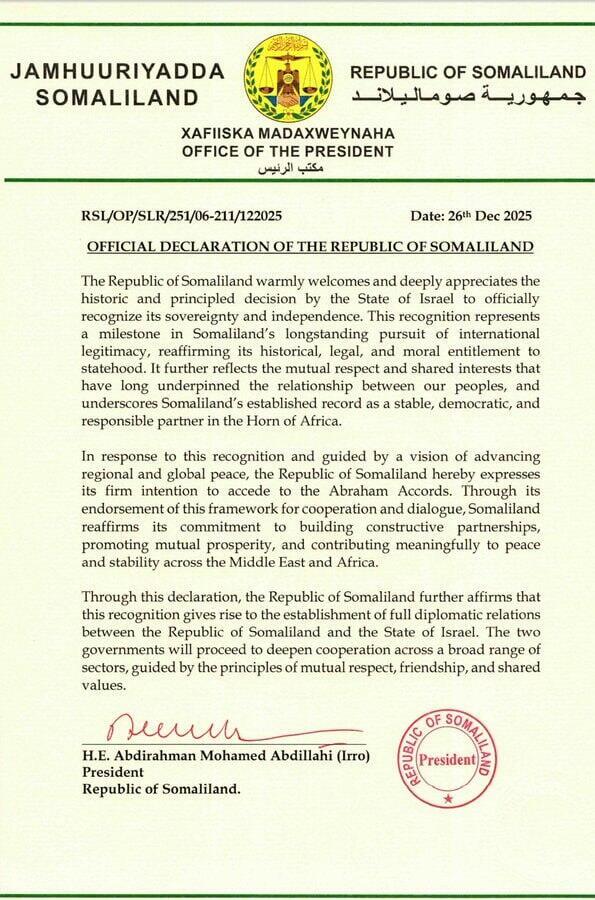
Statement by the president of Somaliland announcing his intention to join the Abraham Accords
Israeli intelligence officials say the Mossad has been active in Somaliland for years, laying the groundwork for the recognition through long-standing, discreet relationships with senior figures there. Mossad chiefs have maintained personal ties with Somaliland officials, and Israeli officials hope the agreement will encourage additional countries to pursue strategic relations with Israel as part of a broader regional alignment.
The mutual recognition followed months of intensive, confidential talks led by Foreign Minister Sa’ar. The initial meeting that set the process in motion took place in April in a third country between Sa’ar and representatives of the Somaliland president. Since then, senior officials from both sides have conducted reciprocal visits under the coordination of the Foreign Ministry.
From Israel’s perspective, the move reflects recognition of an existing reality: Somaliland has functioned as a state for more than three decades, with civilian governance, elected institutions, relative security and peaceful transfers of power. Israeli officials say recognition will promote regional stability in an otherwise volatile area. “This is not a provocation, but an opportunity to enhance stability,” one official said.
Somaliland Foreign Minister Abdirahman Dahir Adam said the decision marked “a pivotal chapter in our nation’s journey.”
“We warmly welcome Prime Minister Netanyahu’s recognition of the Republic of Somaliland, a result of our shared values and vision for peace,” he said. “Somaliland is ready to join the Abraham Accords and build a future rooted in cooperation, stability and mutual respect.”
Foreign Minister Sa’ar said: “Over the past year, following extensive and ongoing dialogue, relations between Israel and Somaliland have taken shape. Following the decision by Prime Minister Benjamin Netanyahu and the president of Somaliland, we signed today a declaration of mutual recognition and the establishment of full diplomatic relations, including the appointment of ambassadors and the opening of embassies.”
“We will work together to advance relations between our countries and peoples, regional stability and economic prosperity,” Sa’ar added.