

Russia warned on Tuesday of the imminent expiration on Thursday of the last remaining nuclear arms control treaty between Moscow and Washington.
The New START treaty limits the number of operational nuclear warheads each power may deploy on its missiles, submarines and bombers to 1,550. Such restrictions have for decades, dating back to the Cold War, been seen as a critical confidence-building measure designed to prevent a dangerous and costly nuclear arms race.
Gallery
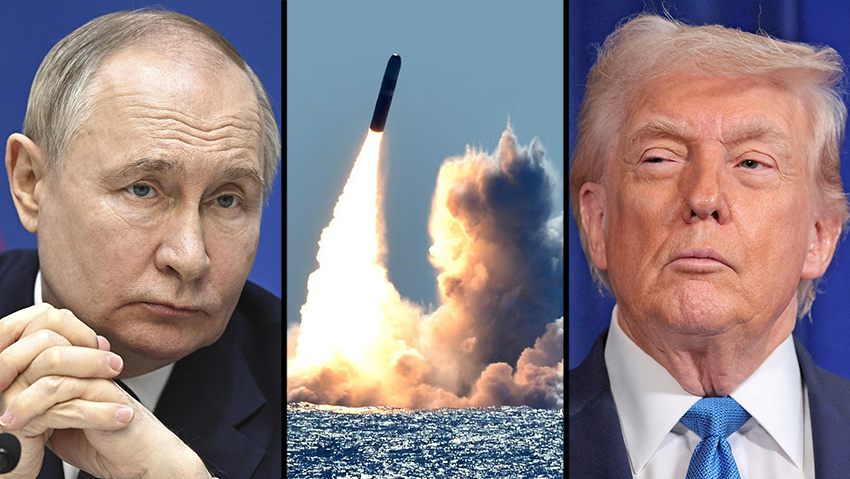
Russian President Vladimir Putin and US President Donald Trump
(Photo: US Navy, Sergei Bobylev, Sputnik, Kremlin Pool Photo/ AP, Reuters/Jonathan Ernst)
Russian President Vladimir Putin proposed in September last year that the United States extend the treaty by one year to allow time for broader negotiations on a new agreement. Washington has not responded to the proposal, and there are currently no signs of diplomatic contacts that could lead to a last-minute extension.
“This is a new moment, a new reality, and we are ready for it,” Russian Deputy Foreign Minister Sergei Ryabkov said Tuesday. Ryabkov, who oversees arms control issues in Moscow, spoke to Russian reporters during a visit to Beijing focused on what he described as consultations on strategic stability. Ryabkov said President Donald Trump’s failure to respond to Russia’s proposal for a temporary extension indicated an intention to allow the treaty to expire without replacement. “No answer is also an answer,” he said.
He also addressed the possibility that the United States could deploy missile defense systems in Greenland, as Trump has hinted when discussing the Arctic island’s importance to the "Golden Dome" missile defense system vision his administration is developing. Ryabkov said such a move would force Russia to take military steps in response.
A similar warning was issued Monday by former Russian president Dmitry Medvedev, who currently serves as deputy chairman of Russia’s Security Council. “It would pointlessly wipe out decades of diplomacy, and could spark another arms race that makes the world less safe," Medvedev said on X, adding that the world should be alarmed if the treaty expired without any understanding of what comes next, suggesting it would speed up the "Doomsday Clock."
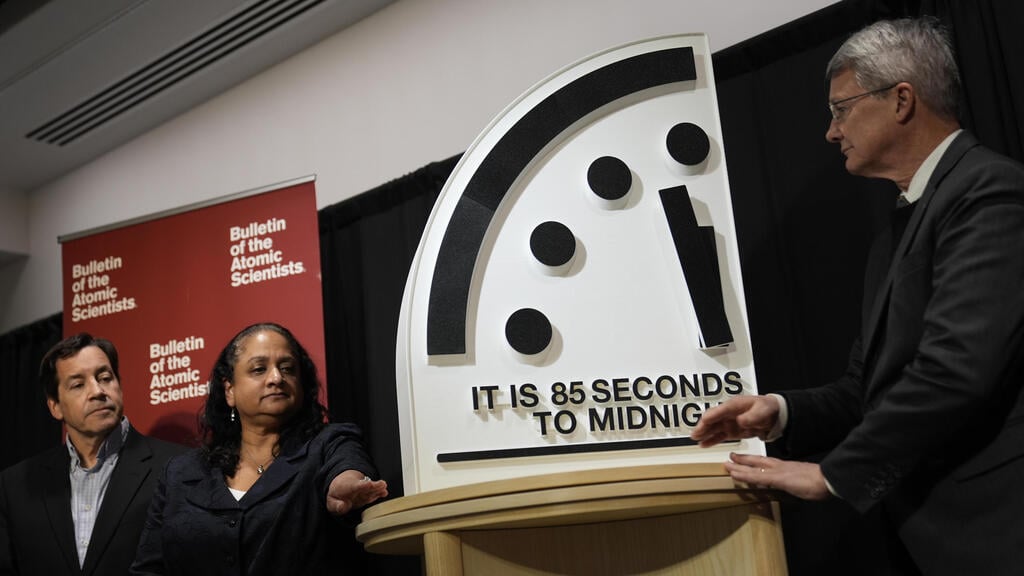
The ‘Doomsday Clock’ in Washington, was moved forward last month and now stands at 85 seconds to midnight, the point symbolizing a nuclear catastrophe
(Photo: Pablo Martinez Monsivais/ AP Photo)
The symbolic clock, whose hands move closer to midnight as global threats intensify, was set last week to 85 seconds before midnight, the closest it has ever been since its creation in 1947. The organization cited the looming expiration of New START as one of the reasons.
Medvedev, who served as Russian president from 2008 to 2012 and signed New START with then U.S. President Barack Obama, has since the outbreak of the war in Ukraine adopted an ultra-hawkish tone toward the West. In Monday’s interview, however, he stressed that Moscow does not seek a global confrontation. “We are not crazy,” he said, adding that the very existence of an agreement imposing limits on nuclear activity creates a certain level of trust between powers. “When there is no agreement, that trust disappears.”
Obama also issued a warning Monday, calling on Congress to act swiftly amid what many see as indifference by the Trump administration to the issue. “If Congress does not act, the last nuclear arms control treaty between the United States and Russia will expire,” Obama said in a statement. “This would unnecessarily erase decades of diplomacy and could spark a new arms race that makes the world less safe.”
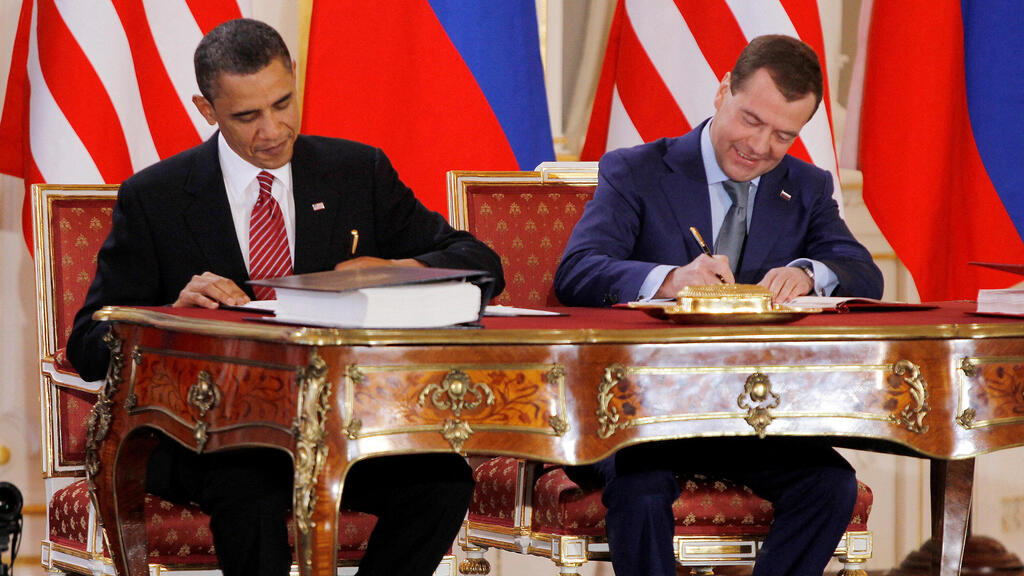
Medvedev signs New START with Obama in April 2010. 'We do not want a global confrontation,' former Russian president says
(Photo: Jason Reed/ Reuters)
New START was signed in 2010 and limits each side to 1,550 deployed nuclear warheads, out of stockpiles of more than 5,000 each, as well as 800 missiles and bombers. The treaty also allows for short-notice inspections at military bases to verify compliance. Those inspections were suspended during the COVID-19 pandemic in 2020 and never resumed. Russia announced in 2023 that it was canceling inspections entirely amid rising tensions with the United States and its allies over the war in Ukraine, while pledging to continue observing the treaty’s limits.
Trump shows little urgency
The treaty was originally set to expire in 2021, but then-U.S. president Joe Biden, upon taking office, quickly agreed with Putin to extend it by five more years. Trump, despite maintaining markedly friendly relations with Putin compared with his predecessor, has shown no sense of urgency regarding the treaty’s expiration. Asked about it last month in an interview with The New York Times, he said, “If it expires, it expires. We’ll just make a better deal.”
During Trump’s first term, U.S. officials held talks with Russia on extending the treaty, but those efforts failed. A central obstacle then, as now, has been Washington’s demand that any new agreement include limits on China.
China is rapidly expanding its nuclear arsenal, though it lags far behind Moscow and Washington. Estimates peg China’s current stockpile at about 600 nuclear warheads, with the Pentagon projecting that number could climb to 1,000 by 2030.
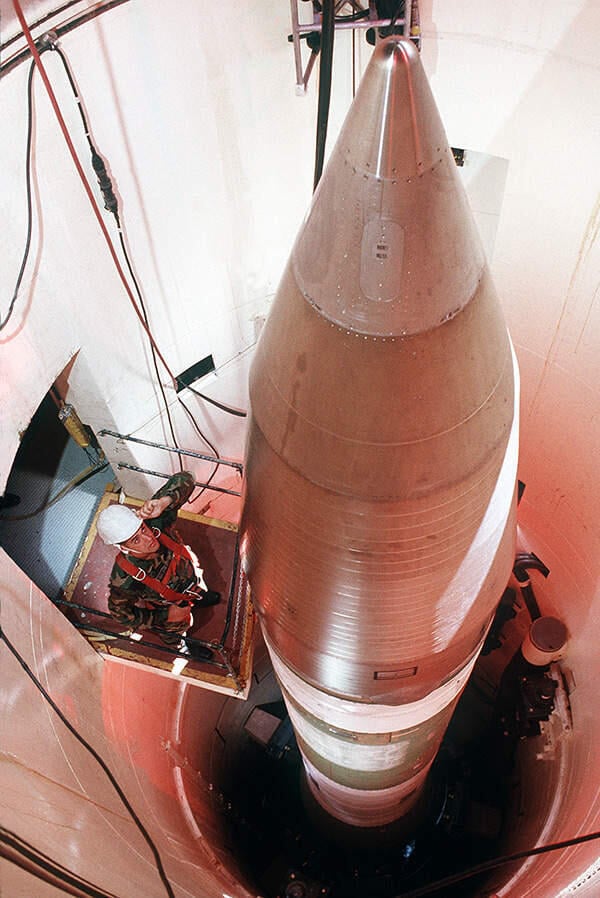
A Minuteman III missile in an underground launch silo in the United States. Will its warheads be replaced with multiple warheads?
(Photo: Department of WAR)
Beijing has refused to join the talks, describing demands to impose nuclear limits on it as unreasonable given the disparity between its arsenal and those of the two nuclear superpowers. Russia, for its part, has insisted that Britain and France, NATO’s other nuclear-armed states, also be included in negotiations on a new treaty. That demand has been rejected by both London and Paris.
New START is the final agreement still imposing any limits on the strategic nuclear weapons of the major powers. Another key treaty, which banned the deployment of intermediate-range ballistic missiles capable of carrying nuclear warheads, expired in 2019.
Barring a last-minute extension, the expiring treaty will usher in a new era for relations among the nuclear powers. It will mark the first time since the early 1970s that no treaty or agreement places any limits on their nuclear arsenals. Military analysts warn this could trigger a renewed arms race, with both the United States and Russia expanding their nuclear stockpiles. The concern is heightened by Trump’s statements last year suggesting a possible return to nuclear testing, something no country except North Korea has conducted in decades.
New START is the latest in a long line of agreements between Moscow and Washington aimed at reducing tensions and preventing crises like the 1962 Cuban Missile Crisis, when the world came closest to nuclear disaster. Since 1969, including after the collapse of the Soviet Union in 1991, the two sides have consistently held talks designed to build trust. The resulting agreements dramatically reduced their combined nuclear arsenals. In 1986, the two countries together possessed about 70,400 nuclear warheads. Today, that number stands at about 12,500.
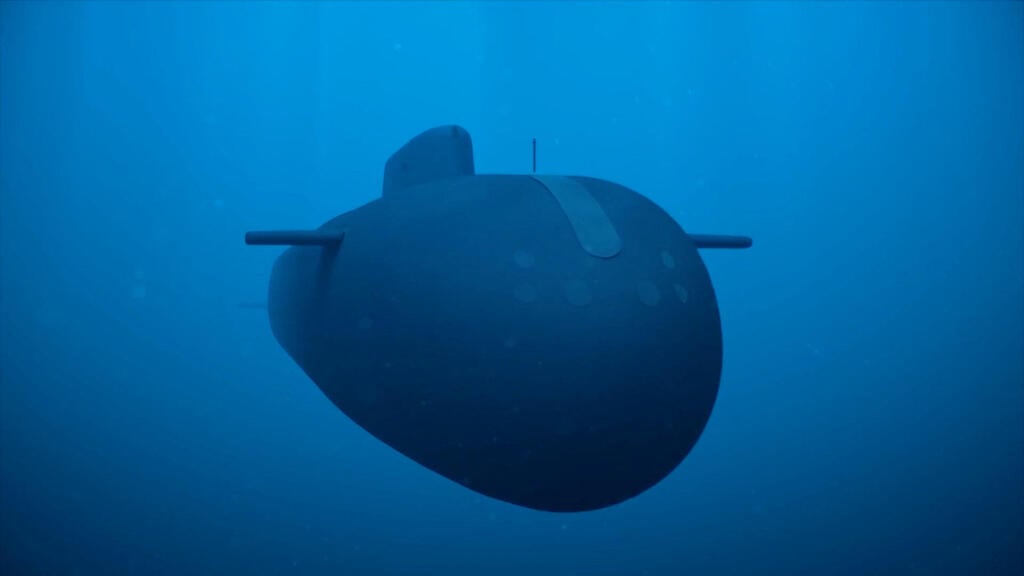
A Russian rendering of the nuclear-powered Poseidon torpedo. Russia is developing ‘super weapons’ not restricted under the treaty
(Photo: Russian Defence Ministry/Handout via Reuters)
John Wolfsthal of the Federation of American Scientists expressed surprise that Trump and Putin, despite their friendly relations, have failed to reach even a temporary extension of the treaty. “This was low-hanging fruit that the administration could have picked months ago,” he said.
Other experts argue that accepting Putin’s proposal for a one-year extension carries drawbacks. Among them is the fact that New START does not limit Russia’s development of so-called super weapons such as the Burevestnik nuclear-powered cruise missile and the Poseidon nuclear-powered torpedo, which Moscow claims are impossible to intercept.
Greg Weaver, a former senior Pentagon planner, said extending the treaty could also send the wrong signal to China by suggesting the United States would not expand its arsenal in response to China’s buildup. “That message would likely undermine efforts to bring China to the arms control table and signal that U.S. forces will remain constrained regardless of what China does,” he said.
Nikolai Sokov, a former member of Russian arms control negotiating teams who now works at the Vienna Center for Disarmament and Non-Proliferation, said reaching a new treaty in the current international climate would be extremely difficult. “This will drag on forever,” he told Reuters.
Sokov said one alternative could be a new agreement with more flexible warhead limits that take China’s nuclear expansion into account. A quicker solution, he added, would be for the powers to focus on confidence-building measures to reduce the risk of accidental nuclear war. Currently, only the United States and Russia maintain a 24-hour direct hotline. No European country, nor NATO headquarters, has an immediate direct communication channel with Moscow. “If the parties begin arms control negotiations in parallel, that would be great,” Sokov said. “But the next treaty will be very complex and will take time. The top priority must be reducing risk and building trust.”
For Russia, it would be easier, cheaper and faster
Vasily Kashin, director of the Center for Comprehensive European and International Studies in Moscow, said Russia is expected to closely monitor U.S. actions after the treaty expires and respond if Washington expands its nuclear arsenal. “If the Americans do not take drastic steps such as installing additional warheads, Russia will likely wait, watch and stay quiet,” he said.
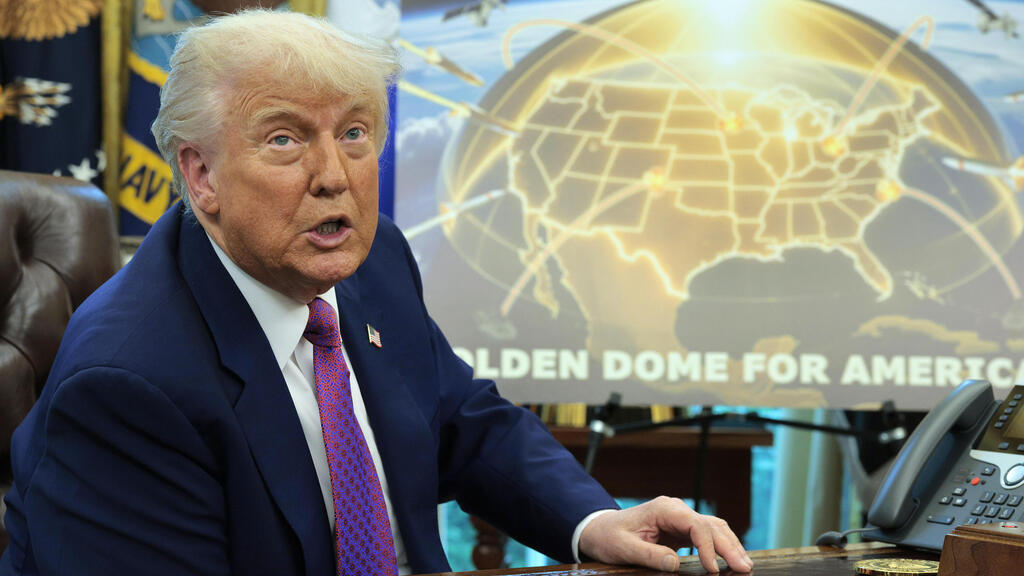
Trump stands beside a poster of hus ‘Golden Dome’ missile defense system vision
(Photo: Chip Somodevilla/Getty Images)
The New York Times has reported that the Pentagon has in recent years examined the possibility of expanding the U.S. nuclear arsenal by replacing current warheads on intercontinental ballistic missiles with multiple warheads. The technology, known as multiple independently targetable re-entry vehicles, or MIRVs, allows several nuclear warheads to be mounted on a single missile, which then separate and strike different targets.
The United States dismantled all such warheads over the past decade as part of efforts under the Obama administration to comply with New START. The last MIRV warhead was removed in 2014. According to the Times, the United States could now reinstall MIRVs, but doing so would be costly and time-consuming due to lost expertise. Some hawkish U.S. officials argue that the number of U.S. operational warheads should match the combined total of Russia and China, with MIRVs seen as the fastest way to achieve that.
Rose Gottemoeller, who led the U.S. negotiating team that produced New START, told the Times that Russia would be able to adapt far more easily than the United States to a world without nuclear limits.
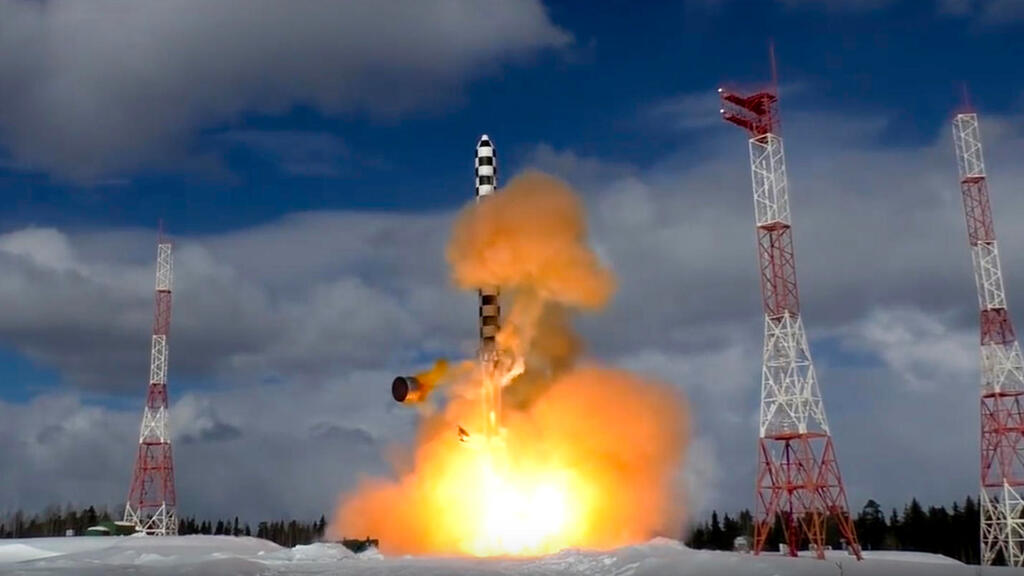
A launch of Russia’s Sarmat intercontinental ballistic missile in 2018
(Photo: AP, Russian Defense Ministry Press Service)
Russia never stopped using MIRV technology, she said, making the installation of multiple warheads easier, cheaper and faster for Moscow. “They could outpace us in a warhead upload campaign while we are still struggling to regain the technical capability to do this with our existing missiles,” Gottemoeller said.
The Times noted that restrictions like those imposed by New START “helped prevent the world from confronting the mountain of nuclear warheads built during the Cold War,” and warned that the final barrier to a return to that scenario may now be disappearing unless there is a last-minute reversal.