


After days of shifting positions in the office of U.S. President Donald Trump, and despite his latest conversation with Saudi Crown Prince Mohammed bin Salman, the president called off a series of planned airstrikes against the Houthis in Yemen at the last minute. According to The New York Times, citing senior U.S. officials, munitions had already been loaded onto fighter jets that were ready for takeoff when Trump announced the change in plans.
The president and crown prince spoke on Thursday about a week and a half ago, when bin Salman urged Trump to launch strikes and help Saudi Arabia in its campaign. Two U.S. officials told Axios at the time that the Trump administration was not inclined to take direct military action against the Houthi group.
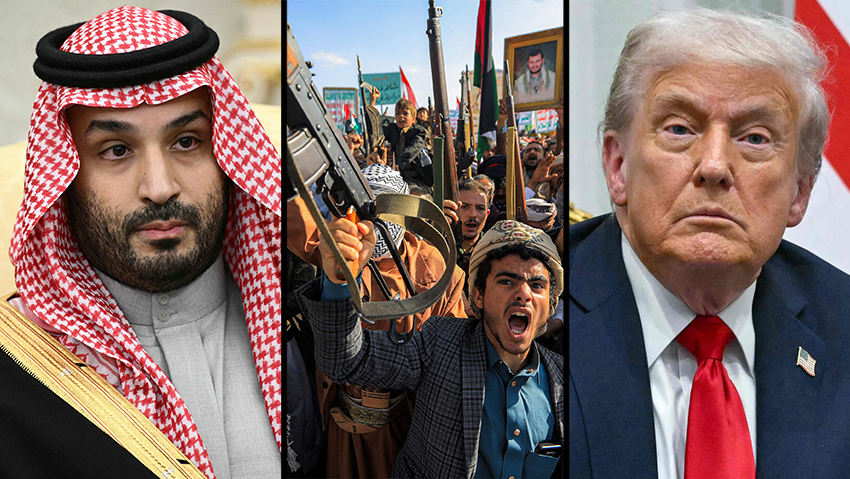
(Photo: Brendan SMIALOWSKI/AFP, SAUL LOEB/AFP, Mohammed HUWAIS / AFP)
Something apparently changed, however. According to The New York Times, fighter jets were preparing for an attack and the target list had already been approved. The newspaper reported that the conversation influenced Trump, who instructed the Pentagon to prepare for action before changing his mind again. The White House declined to comment, but a senior U.S. official stressed that Washington has a defense agreement with Saudi Arabia and remains committed to defending its allies.
The decision to cancel the attack, or at least delay it, was driven in part by concern in Washington that opening another front could further complicate the parallel conflict with Iran, which has also made little progress.
Trump said Sunday, in response to a question from Fox News reporter Trey Yingst, that he would consider meeting Iranian President Masoud Pezeshkian this week on the sidelines of the U.N. General Assembly in New York. He added that he was still weighing his options, suggested major developments were imminent and warned Iran against taking provocative action.
The Saudi request weighed heavily on Trump, who knows that Washington ultimately needs Riyadh’s help in confronting Iran. U.S. military officials who spoke to The New York Times on condition of anonymity said the United States could not manage without Saudi Arabia. They said Saudi officials had “shown a willingness” to use the leverage available to them against Washington if their ally did not cooperate in the campaign against the Houthis.
In May, for example, the officials said Saudi Arabia blocked a U.S. plan to escort commercial oil tankers through the Strait of Hormuz. The kingdom refused to allow the U.S. military to use its airspace.
Other officials said that if the United States joins the campaign, the move could be carried out alongside a ground offensive planned by forces loyal to Yemen’s internationally recognized government. Those forces, however, have yet to prove effective against the Houthis, and U.S. officials questioned the value of supporting what they described as a dysfunctional force that has repeatedly been defeated in fighting with the rebels.
Several U.S. military commanders also warned that a limited attack would not defeat the Houthis, who have already withstood nearly two months of sustained U.S. bombing in the past.
The developments come alongside a Reuters report that U.S. officials met early last week in Oman with Houthi representatives, several days after the Iran-backed militia seized a strategic stretch of coastline along the Red Sea in an offensive that defeated Saudi-backed forces of the Yemeni government.
According to the report, the Houthis told the United States at the meeting that they intended to refrain from attacking American vessels in the critical Bab el-Mandeb Strait, over which they had effectively taken control.
Reuters reported that the meeting, which was not publicly disclosed but was confirmed by three sources, took place the previous Sunday at the U.S. Embassy in the Omani capital, Muscat.
The Houthis told U.S. officials that they remained committed to the ceasefire reached with the United States in 2025 and therefore had no intention of attacking American vessels. One source, a Yemeni official, told Reuters that the group also said it would not attack Israeli ships or other commercial vessels, except those belonging to Saudi Arabia.