

Israel has conducted extensive monitoring of U.S. and allied personnel stationed at a new American headquarters in Kiryat Gat, the Guardian reported on Monday, citing sources familiar with disputes over both open and covert recordings of meetings held on the base.
The report said the scale of alleged intelligence gathering inside the Civil-Military Coordination Center, or CMCC, prompted the base’s U.S. commander, Lt. Gen. Patrick Frank, to summon an Israeli counterpart and tell him that “recording has to stop here.”
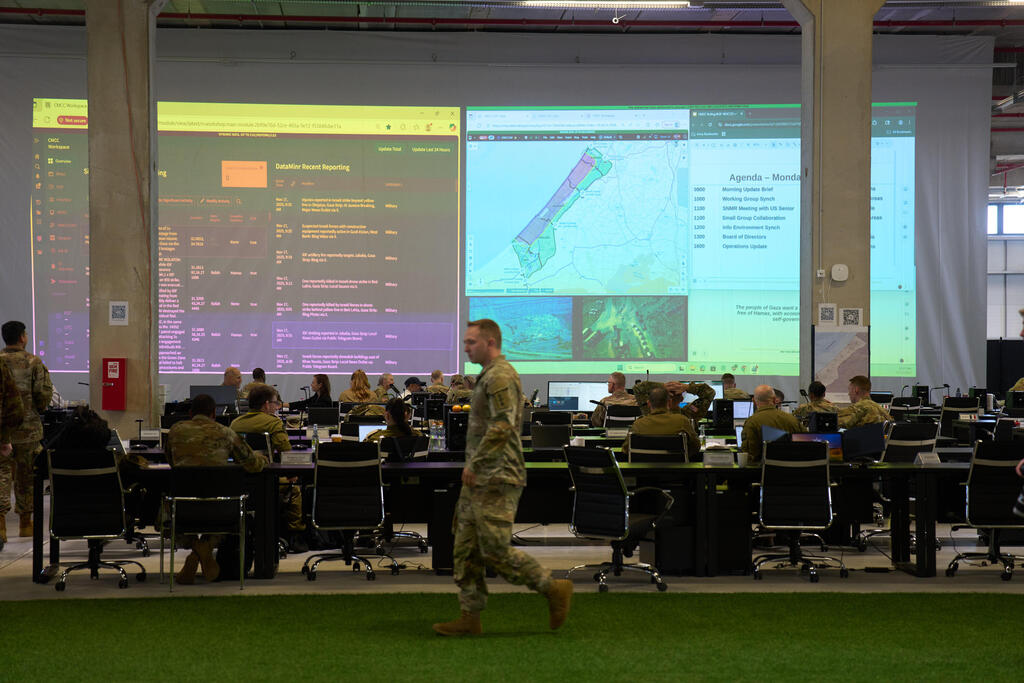
Staff members and visitors from other countries also raised concerns that Israel was recording conversations inside the facility, the report said, and some were cautioned against sharing sensitive information for fear it could be “collected and exploited.”
According to the Guardian, the U.S. military declined to comment on the alleged monitoring. The IDF also did not address Frank’s reported demand to end recordings but said discussions at the CMCC are not classified.
“The IDF documents and summarizes meetings in which it is present through protocols, as any professional organisation of this nature does in a transparent and agreed upon manner,” the army told the outlet. “The claim that the IDF is gathering intelligence on its partners in meetings which the IDF is an active participant is absurd.”
The U.S.-led headquarters was established in October to oversee the ceasefire, coordinate humanitarian aid and outline future plans for the Gaza Strip as part of President Donald Trump’s 20-point proposal for ending the war. Large printed versions of the plan reportedly hang throughout the building.

Humanitarian aid entering Gaza
(Photo: REUTERS/Stringer)
American troops deployed there were tasked with helping increase the flow of essential aid into Gaza under the ceasefire arrangements. Early reports suggested Israel had handed authority over incoming goods to the U.S. military, but two months into the ceasefire, a U.S. official said Israel still controls Gaza’s perimeter and what enters it. “We didn’t take over [aid],” the official told the Guardian. “It is an integration. It is hand in glove. They ([The Israelis] remain the hand, and the CMMC have become the glove over that hand.”
The American contingent includes logistics specialists experienced in disaster response and supply routing in hostile terrain. Many arrived determined to ramp up aid deliveries but soon found that Israeli restrictions on goods entering Gaza posed a greater obstacle than engineering challenges. Within weeks, several dozen personnel departed, the Guardian reported.
Diplomats told the outlet that discussions inside the CMCC were instrumental in convincing Israel to amend lists of “dual-use” items — materials Israel says could have military applications — that were banned or restricted from entering Gaza. The lists have included basic items such as tent poles and water-purification chemicals.
Dutch Foreign Minister David van Weel said he had been informed at the CMCC that one such restriction had been lifted following talks. Other everyday items, including pencils and paper, remained prohibited without explanation, according to the report.
Palestinians? Gazans
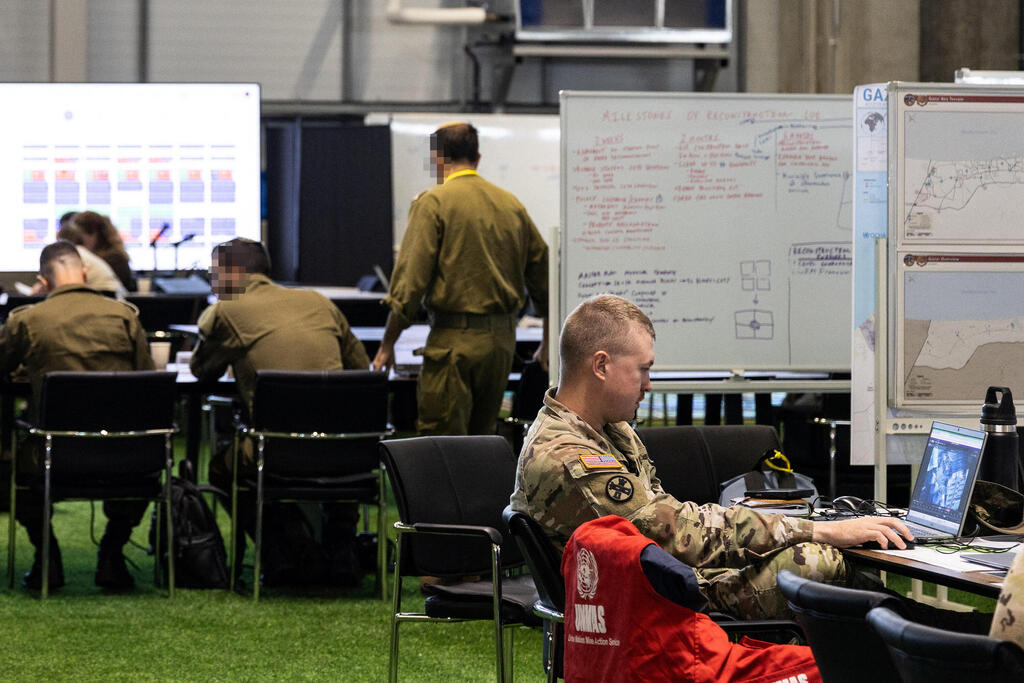
The CMCC brings together military planners from the United States, Israel and additional countries such as Britain and the United Arab Emirates. Diplomats posted in Israel and in areas under Palestinian Authority control, as well as aid organizations operating in Gaza, were also invited to take part in discussions on humanitarian relief and the future of the enclave.
(Photo: AP Photo/Ariel Schalit)
Trump’s plan acknowledges Palestinian aspirations for statehood and pledges them seats in a temporary governing body — but in practice, they are completely excluded from the deliberations taking place at the Kiryat Gat headquarters.
According to sources involved in or briefed on the discussions, even attempts to hold conversations with Palestinians via video call were repeatedly cut off by Israeli personnel. U.S. military planning documents seen by the Guardian avoid entirely the use of the words “Palestine” or “Palestinians,” referring to Gaza’s population simply as “Gazans.”
Prime Minister Benjamin Netanyahu has presented the CMCC as a strictly bilateral initiative, and in a statement following his visit to the base last month, he described the center as a “joint Israeli-American project.” He did not mention additional partners, and the official photos showed only Israelis and Americans. An IDF official said the visit took place outside the center’s operating hours for security reasons, and that the U.S. military determined who would be allowed to attend.
'A dystopian startup': Inside the headquarters
Before the CMCC was established, the multi-story building in Kiryat Gat’s industrial zone housed the Gaza Humanitarian Fund (GHF), which shut down after six months of activity. According to the Guardian, branded GHF supplies still sit in the basement. Israelis and Americans each have their own floor, and there are offices for key allied nations as well.
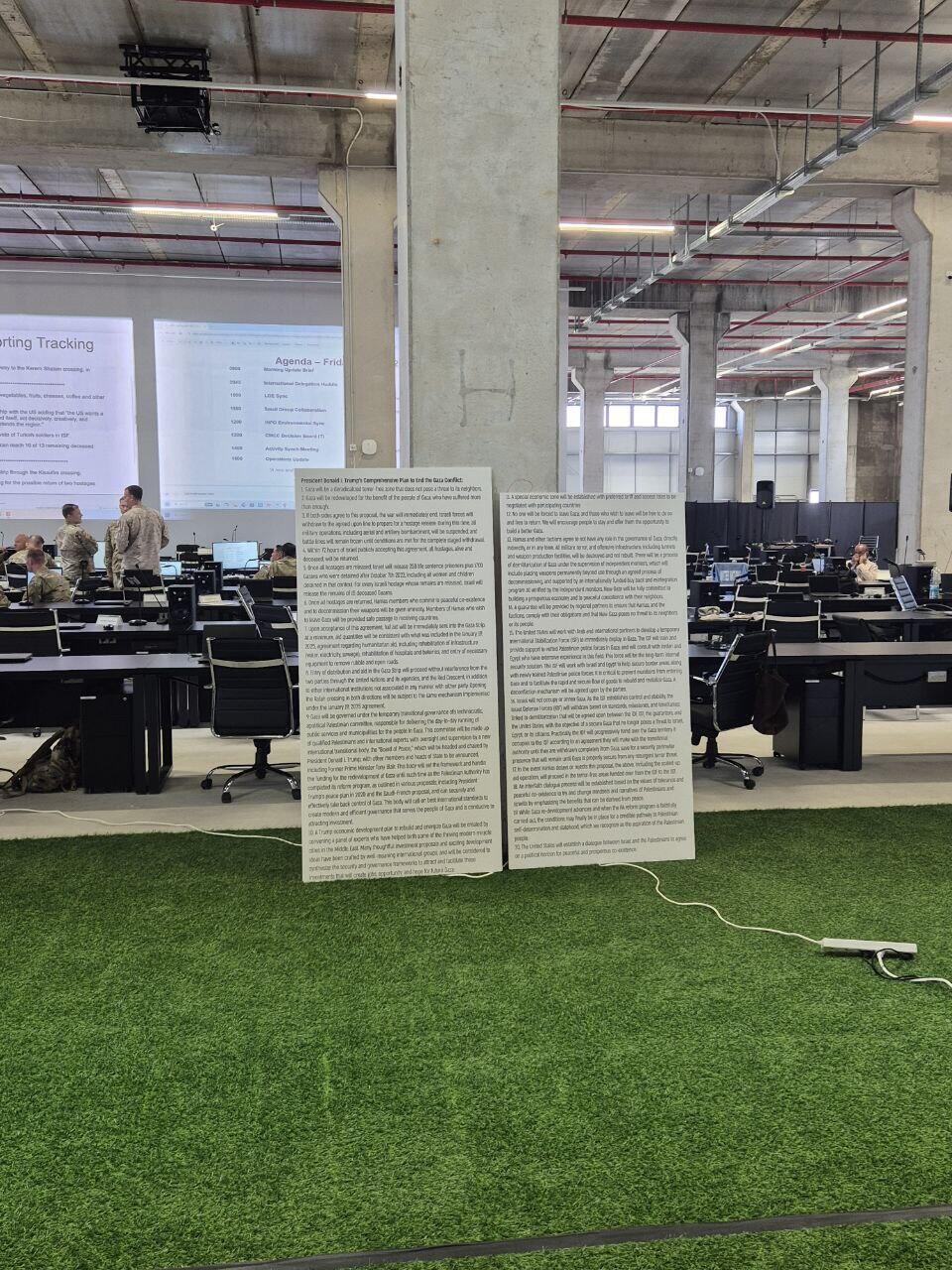
Large printed versions of Trump’s 20-point proposal hangs throughout the building
(Photo: Itamar Eichner)
Inside, the building reportedly resembles a “dystopian startup”: a massive windowless hall lined with synthetic grass, with clusters of whiteboards dividing the area into informal meeting spaces where soldiers, diplomats and aid workers mingle. American corporate jargon arrived with the personnel: Palestinians in Gaza are sometimes referred to as “end users,” and other casual — at times insensitive — nicknames are used by some teams.
For example, “Wellness Wednesdays” focused on rebuilding Gaza hospitals that have been repeatedly struck, and on schools that have not operated for two years. “Thirsty Thursdays” addressed public services.
According to the report, many diplomats and aid workers are “deeply wary” of spending time inside the CMCC. They fear the center may violate international law, exclude Palestinians from planning their own future, operate without a clear international mandate and blur the line between military activity and humanitarian work.
At the same time, they worry that withdrawing would leave discussions about Gaza’s future solely in the hands of Israel and newly arrived American planners with limited knowledge of the territory or the broader political context. “We are really unsure how much time and energy to invest,” one of them said. “But this is the only chance we have of [the Americans] listening to us.”
Implementing plans for Gaza? 'That’s political'
According to sources who spoke with the Guardian, the CMCC’s role may already be shrinking, as dozens of U.S. soldiers deployed there in October have returned to their bases after completing their official mission.
In practice, drafting abstract future plans for Gaza in a political vacuum — with Palestinians excluded — proved far easier than the negotiation efforts of past years. Still, it remains unclear how much of the planning will translate into real-world implementation.
Israel insists that the ceasefire will not move to Phase Two until Hamas is disarmed, and the United States and its allies have no plan for achieving what the IDF has been unable to accomplish after two years of war.
The American official who spoke with the outlet was asked for a timeline to implement the CMCC’s plans but declined to provide one. “The U.S. military is not at the heart of this,” the official said. “It falls more into the political world.”