

Tensions between Syria’s new government and the country’s Kurdish-led forces flared again this week, following violent clashes in the northern city of Aleppo. The confrontation, which broke out in neighborhoods controlled by the U.S.-backed Syrian Democratic Forces (SDF), has renewed concerns about the fragility of recent ceasefire attempts and the broader future of Kurdish-government relations in the war-torn country.
Fighting erupted late Monday between SDF fighters and forces aligned with Syria’s Ministry of Defense in the Sheikh Maqsoud and Ashrafieh neighborhoods. Syria’s state news agency SANA reported that one government security officer was killed and three others wounded in what it described as a Kurdish attack on military checkpoints in Sheikh Maqsoud. The agency also claimed the SDF shelled residential areas in Aleppo and that government troops had been deployed to secure the area.
Israeli flag displayed at a pro-Kurdish demonstration in the Kurdish-administered city of Qamishli, Syria


The SDF denied attacking government checkpoints, blaming the clashes on provocations by state forces. In a statement, the group accused Syrian troops of firing on civilians and attempting to enter residential neighborhoods with tanks and armored vehicles. “We hold the Damascus government fully and directly responsible for the ongoing suffocating siege and systematic violations against civilians,” the SDF said.
Later that night, SANA reported that a ceasefire had been reached, but signs pointed to only a temporary reprieve. On Tuesday, a delegation from the Kurdish autonomous administration in northern and eastern Syria, led by SDF commander Mazloum Abdi, arrived in Damascus for U.S.-brokered talks on possibly integrating the SDF into Syria’s Ministry of Defense.

According to AFP, Abdi met with Syrian President Ahmad al-Sharaa following the clashes. Qatari media reported that both sides agreed to hold additional meetings next week and that the tone of the talks was “positive,” signaling a possible shift toward reconciliation.
While Syria’s state media did not report details of the Abdi–al-Sharaa meeting, it did release images of al-Sharaa meeting with U.S. CENTCOM Commander Gen. Brad Cooper and U.S. Special Envoy for Syria Thomas Barrack. Syrian Foreign Minister Asaad al-Shaibani, Defense Minister Murhaf Abu Qasra and intelligence chief Hussein al-Salama were also present.

Cooper, US Special Envoy for Syria Thomas Barrack and al-Sharaa
According to SANA, the talks focused on recent developments in Syria, ways to support the political process, improve stability and implement the March 10 agreement between the Kurds and the new Syrian government, which calls for preserving Syria’s territorial integrity and sovereignty.
On Tuesday, Defense Minister Abu Qasra issued a statement confirming he had agreed with Abdi on a comprehensive ceasefire across all frontlines and military deployment zones in northern and northeastern Syria, with immediate effect.
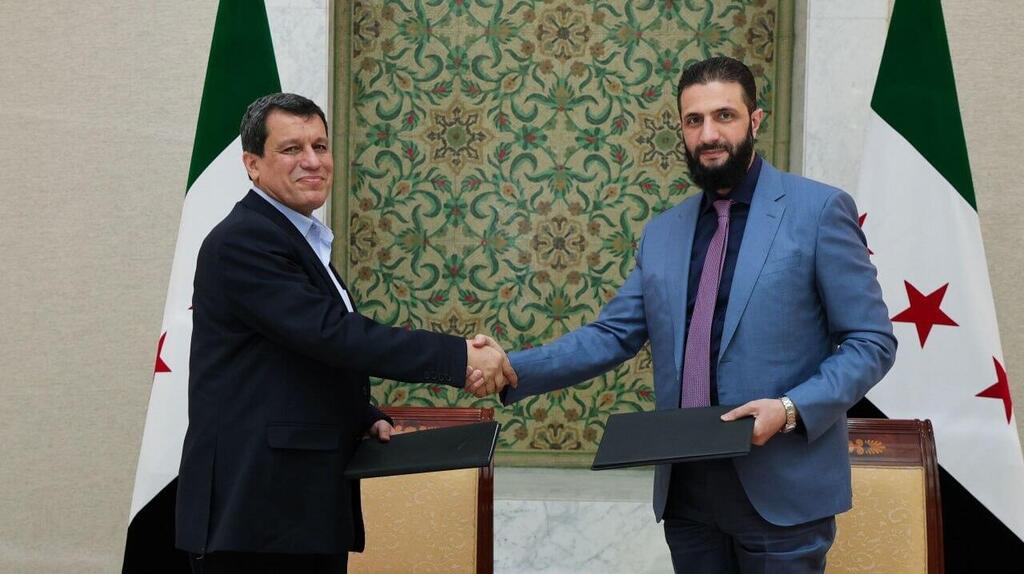
SDF commander Mazloum Abdi and al-Sharaa
Despite the ceasefire declaration, opposition-aligned Syrian media shared images said to show civilians displaced from Aleppo’s Ashrafieh neighborhood following the clashes. Pro-Kurdish demonstrations were also reported in the Kurdish-administered city of Qamishli, where, according to some reports, an Israeli flag was displayed — a symbolic act likely to inflame tensions with Damascus and its allies.
Turkish President Recep Tayyip Erdogan, whose government maintains a military presence in northern Syria and routinely targets Kurdish forces it views as terrorists, said Wednesday that “the Syrian Democratic Forces must fulfill their promises and integrate into the Syrian state.”