

The IDF urgently needs more combat soldiers, a senior military official told lawmakers Tuesday, as the government advances legislation promoting a civil service exemption path.
Brig. Gen. (res.) Shay Tayeb, head of the IDF Personnel Directorate’s Planning and Personnel Management Division, told the Knesset Foreign Affairs and Defense Committee that the military’s top priority is increasing the number of combat troops. He said the IDF requires additional manpower to form new brigades, maintain operational flexibility and reduce burnout among current soldiers.
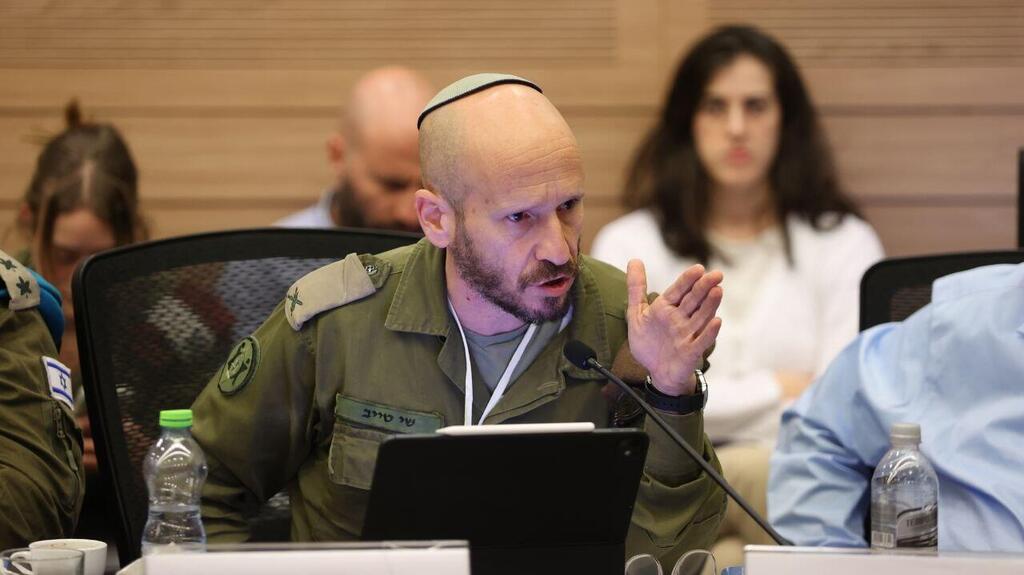
IDF Personnel Directorate’s Planning and Personnel Management Division head Brig.‑Gen. (res.) Shay Tayeb addresses Knesset committee
(Photo: Alex Kolomoisky)
Tayeb argued that civil service does not address these needs and should not be considered a substitute. He added that the IDF alone should determine who is suitable for combat roles, based on personal data and fitness, with age being a key factor in the recruitment process.
He also addressed the role of women in the military, noting that combat‑ready women are a “critical operational force,” whose numbers have grown from 500 to 5,000 over the past decade. Regarding Haredi conscripts, Tayeb rejected the claim that the IDF is unprepared to absorb large numbers — saying the army can offer solutions such as gender‑segregated units, even though “not everything is perfect and there is always room for improvement.”
Meanwhile, the committee’s chairman, Boaz Bismuth of the ruling Likud Party, has drafted a proposal that counts civil or civil‑security service in state agencies (such as the Shin Bet security service, Mossad, the Prison Service and the police) as fulfilling military service obligations. However, legal adviser to the committee, attorney Miri Frenkel‑Shor, wrote to members this week that expanding the recruitment targets to include civil‑security service does not meet Israel’s security needs and so should not be permitted under the quotas.
Haredim protest against the draft
(Video: Ido Erez, Yariv Katz)


“In particular,” she wrote, “the civil‑security alternative — available only to graduates of Haredi educational institutions — undermines equality. Civil‑national service is fundamentally different from military service, even if it involves security tasks. It is voluntary, significantly shorter than army service, does not include reserve duty, and does not meet current security needs that require an increased number of combat‑ready soldiers.”
Within the Haredi community, opposition to the measure continues to grow. A Haredi newspaper associated with the influential Ger Hasidic dynasty called the bill “the Draft‑Law Decree,” warning it sets a “dangerous precedent” that would allow the defense minister to revoke the status of yeshivot if numerical targets are not met. The editorial argued that the IDF does not truly intend to conscript Haredim.
Shlomo Valtzar, secretary of the Council of Torah Sages of Agudat Yisrael, the Hasidic branch of the ultra-Orthodox United Torah Judaism alliance, has been meeting with Haredi leaders in recent days to formulate a unified stance. So far, the Ger dynasty — represented by former housing minister Yitzchak Goldknopf — has been the most strident in opposing the legislation; yet recently Rabbi Yissachar Dov Rokeach, head of the Belz Hasidic dynasty, who had seemed inclined to support the bill, warned that there are serious problems and it is not clear his party’s representative, Knesset lawmaker Yisrael Eichler, will vote in favor.