

Amid Israel's continuing political deadlock, leaders of Gadi Eisenkot's bloc will meet Tuesday, a day before President Isaac Herzog begins consultations with political parties, to assess their options ahead of the decision on who will be tasked with forming the next government. Senior figures in the bloc say their immediate priority is what they describe as "taking control of the Knesset," beginning with replacing Speaker Amir Ohana, establishing the parliamentary Arrangements Committee, which oversees the Knesset's initial business, and repealing controversial legislation advanced by the outgoing coalition.
Beyond gaining control of parliament, which the bloc now considers its "most urgent task" ahead of the new Knesset's swearing-in, discussions are also underway over the parties' longer-term strategy. For now, each party leader has a different position and a different vision for how to use the time available to them.
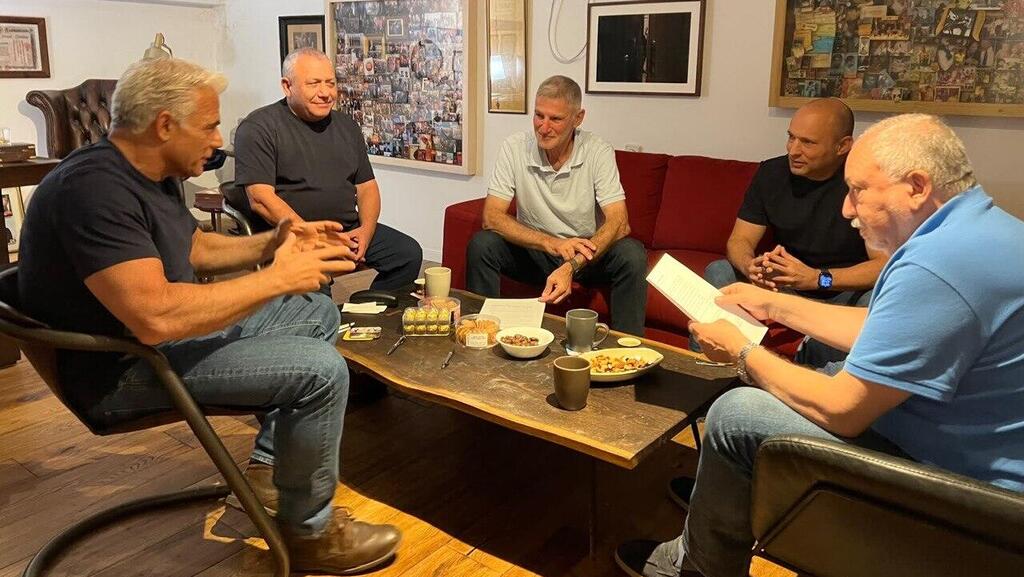
Leaders of Eisenkot's bloc at a meeting in Yair Lapid's home before the election. They are set to meet again amid disagreements over their next political steps
(Photo: Lihi Lapid)
Gadi Eisenkot, leader of the Yashar! party, is determined to pursue the formation of a minority government and has placed particular emphasis on courting the ultra-Orthodox parties. He has not publicly ruled out relying on the support of Arab parties, nor has he rejected the possibility of a unity government, although he remains concerned that Prime Minister Benjamin Netanyahu could once again maneuver his coalition partners into a politically advantageous position.
Avigdor Liberman, leader of Yisrael Beytenu, takes a different approach. As he reiterated Monday, he categorically rules out serving in a government with Netanyahu. However, he has left the door open to discussions about bringing ultra-Orthodox parties into a coalition, despite the unresolved military conscription issue that the next government would have to address.
Meanwhile, Democrats leader Yair Golan is strongly advocating a government supported by Ra'am, the Arab party, arguing that the unusually high turnout among Arab voters in the election cannot be ignored. Naftali Bennett, leader of the Together party, sides with Liberman in opposing any government that depends on the Arab parties. Bennett believes that if Eisenkot pursues such an arrangement, the government would inevitably collapse, paving the way for another election and allowing Netanyahu to return to power in a stronger position, potentially for a prolonged term.
The disagreements extend beyond the composition of the next government to the question of who should serve as Knesset speaker. Liberman and Bennett want Yair Lapid appointed to the post, while Eisenkot wants someone from his own party. The issue is particularly important to the Yashar! leader because the political arrangement he is considering would require the speaker to come from one of the parties involved. Once a speaker is elected, replacing that person would require a majority of 90 Knesset members. The position could also prove crucial if parliament is dissolved and Israel heads to another election, since the speaker would remain in office and the post would stay in the hands of the bloc seeking to replace Netanyahu.
At Tuesday's meeting, the party leaders are expected to discuss how to replace the Knesset speaker and the procedural steps required to do so. The move would require the signatures of 61 lawmakers from across the bloc.
Another issue concerns the preparatory work carried out by party representatives during the election campaign. Their teams held extensive discussions about legislation they could advance during the transitional period, but both Eisenkot and Liberman have reservations about some of the proposals. Eisenkot, for example, has expressed opposition to applying the so-called "defendant law," which would bar a politician facing criminal charges from serving as prime minister, retroactively. Liberman, meanwhile, has said he does not believe legislation establishing a state commission of inquiry could be passed during a caretaker government's term if Israel is forced into another election.