


President Isaac Herzog plans to summon representatives of each of the parties elected to Israel's new Knesset to the President's Residence beginning Wednesday, even before the parliament is sworn in, to begin the process of forming the next government.
Herzog is expected to hear each party's recommendation for who should be tasked with forming a coalition. Unlike previous elections, however, this time there is no clear government in sight. According to political assessments, Yashar! chairman Gadi Eisenkot is expected to receive the first mandate, ahead of Prime Minister Benjamin Netanyahu. Leaders of the anti-Netanyahu bloc are scheduled to meet Tuesday ahead of the consultations.
Gallery
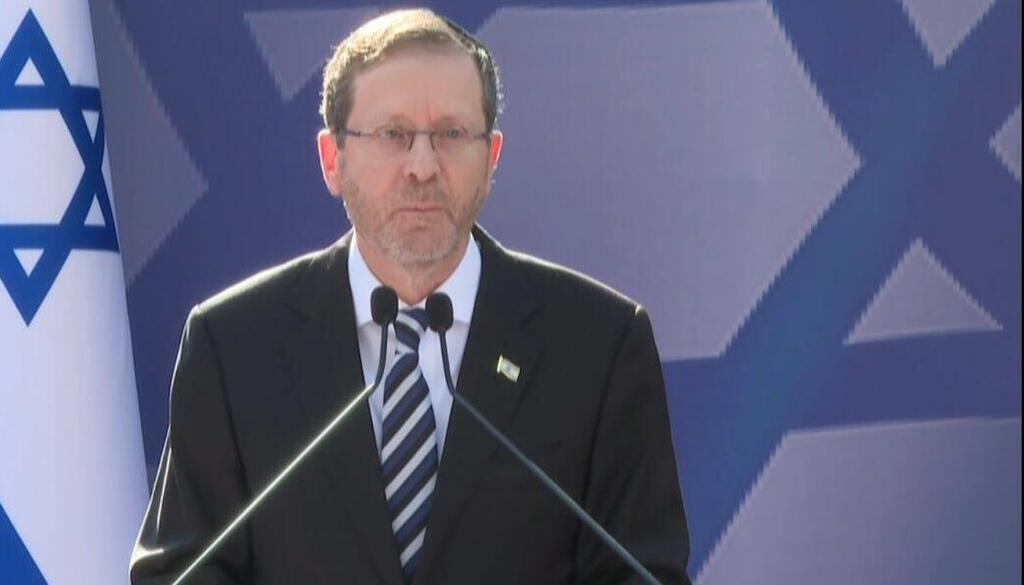
President Isaac Herzog is ready to consult with the parties
(Photo: Spokesperson for the president's office)
Herzog has decided to begin Wednesday's consultations with representatives of the smaller parties, proceeding in ascending order of parliamentary strength. The arrangement will give those parties less time to decide which candidate to recommend. "The decision is intended to allow for a broad examination of all the options on the table before the consultations with the larger factions take place, and to encourage fresh thinking," the president's office said in a statement.
The Religious Zionist-Identity party will be the first to arrive, at 5 p.m. Wednesday, followed by Shas at 6:15 p.m. Shas is highly likely to recommend Netanyahu. Yisrael Beytenu, which has already announced its support for Eisenkot, will meet Herzog at 7:15 p.m.
On Thursday, United Torah Judaism representatives will arrive at 8:30 a.m. The party is not expected to recommend either candidate. Otzma Yehudit will follow at 9:45 a.m., the Democrats at 11 a.m., Ra'am at 12:15 p.m. and the Joint List at 4:45 p.m.
Representatives of Naftali Bennett's Beyachad party, which also has declared its support for Eisenkot, are scheduled for 6 p.m., followed by Yashar! representatives at 7:15 p.m. Likud, the largest party in the new Knesset, will be the last to meet Herzog, at 8:30 p.m.
"The president seeks to hear the positions of all the factions and to examine whether there are additional directions or alternatives that could help build agreements and form a government," his office said. "This reflects the view that, at this time, it is important to exhaust every option, broaden the dialogue, and explore every path that may advance the process. The president also does not rule out an additional round of consultations if required."
Even before polling stations opened, Herzog repeatedly urged party leaders to set aside their differences and work toward a unity government, including during the ynet and "Yedioth Ahronoth" People of the Nation conference. He reiterated that appeal after the official election results were published, calling on party representatives to arrive at the consultations with "open minds and hearts."
Who will recommend Eisenkot, and who will back Netanyahu?
Beyachad chairman Naftali Bennett has already announced that he intends to recommend Eisenkot as the first candidate to form a government. Democrats chairman Yair Golan has made the same commitment.
After days of uncertainty surrounding Avigdor Liberman, particularly given his strong public opposition to forming a government with Arab or ultra-Orthodox parties, the Yisrael Beytenu chairman broke his silence Monday and announced that he, too, would recommend Eisenkot. Liberman's position is particularly significant because Eisenkot himself is considering and examining possible cooperation with both Arab and ultra-Orthodox parties, despite the political obstacles such an arrangement would present.
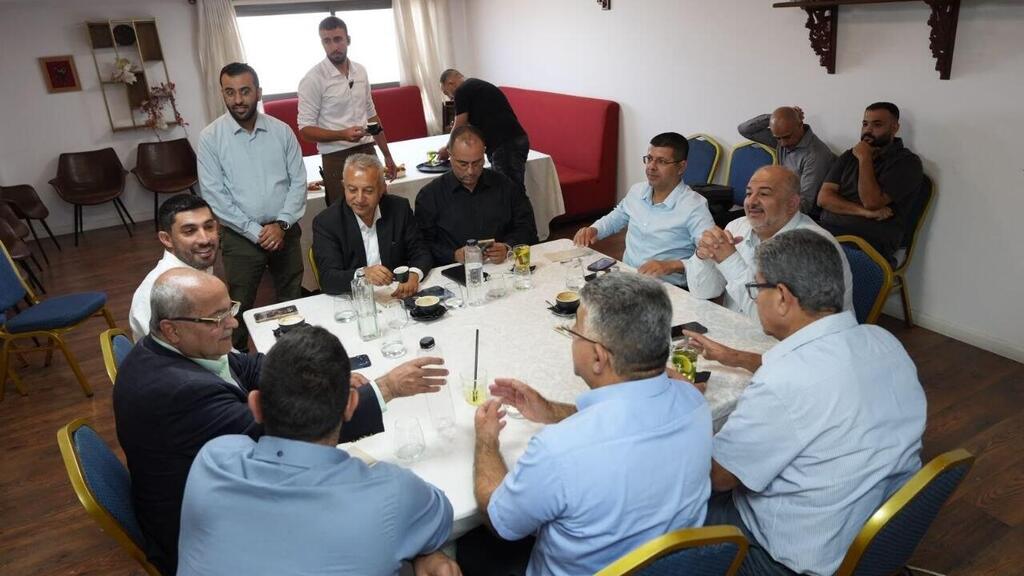
Leaders of the Ra'am and the Joint List in a meeting at a hotel in Nazareth: Their recommendation apparently will be coordinated
The two Arab parties also appear likely to recommend Eisenkot, and political assessments suggest their recommendations to the president will be coordinated. In their first meeting since the election, representatives of the Joint List and Ra'am gathered Monday at a hotel in Nazareth to strengthen coordination and explore possible political cooperation in the coming period.
Amjad Shbita, secretary-general of Hadash, which is part of the Joint List, called Eisenkot a "coward and a racist" in an interview Sunday with Saudi television network Al Arabiya. Nevertheless, he left open the possibility that his party would recommend Eisenkot to the president. "We are prepared to take any step that will bring down Netanyahu's government," Shbita said, echoing statements by Joint List chairman Yousef Jabareen and his deputy, Ahmad Tibi.
Among the ultra-Orthodox parties, Shas, which suffered a major election setback and fell from 11 Knesset seats to just six, is expected to recommend Netanyahu. The prime minister, who had been concerned that Shas might instead align itself with Eisenkot, issued a statement of support Monday for party chairman Aryeh Deri. "The left is prepared to promise the ultra-Orthodox the moon and the stars, in hypocrisy that cries out to heaven," Netanyahu said. "Deri and Shas are important partners of mine and of the right-wing bloc."
United Torah Judaism, meanwhile, remains undecided and has not ruled out recommending neither candidate. The party's primary concern is securing favorable legislation exempting ultra-Orthodox men from military service, making its eventual choice dependent in part on which candidate offers a better prospect of advancing its demands.
Avraham Justman, United Torah Judaism's representative on the Central Elections Committee and the party's legal adviser, said Monday in an interview with Radio Jerusalem that the party was not ruling out cooperation with Arab parties. "United Torah Judaism made it clear before the election that it was available to both blocs," he said. "United Torah Judaism belongs to the Torah bloc. There is also the question of numerical feasibility. Right now, it appears that the change bloc has more room to maneuver."
Justman added that the party had long since stopped treating broader nationalist questions as its central political concern. "Of course, there's the issue of the war, but that is already a matter of consensus, so the party can focus on the issues that specifically concern it," he said. "In that respect, ultra-Orthodox Jews and Arabs can get along very well. Both are minorities, and both have minority needs, which sometimes even overlap."
Netanyahu's bloc is concerned about the possibility of ultra-Orthodox and Arab parties joining forces behind Eisenkot. For now, the only leaders regarded as firmly committed to Netanyahu are Religious Zionist party chairman Bezalel Smotrich and Otzma Yehudit chairman Itamar Ben-Gvir, both of whom are highly likely to recommend the incumbent prime minister.
How Israel's next government will be formed
Herzog is expected to begin consulting party representatives Wednesday, with the process continuing Thursday and potentially extending into Friday. Under Israeli law, the president has seven days to complete consultations, make his decision and assign the mandate to form a government, meaning the deadline is November 11. He may act before that deadline.
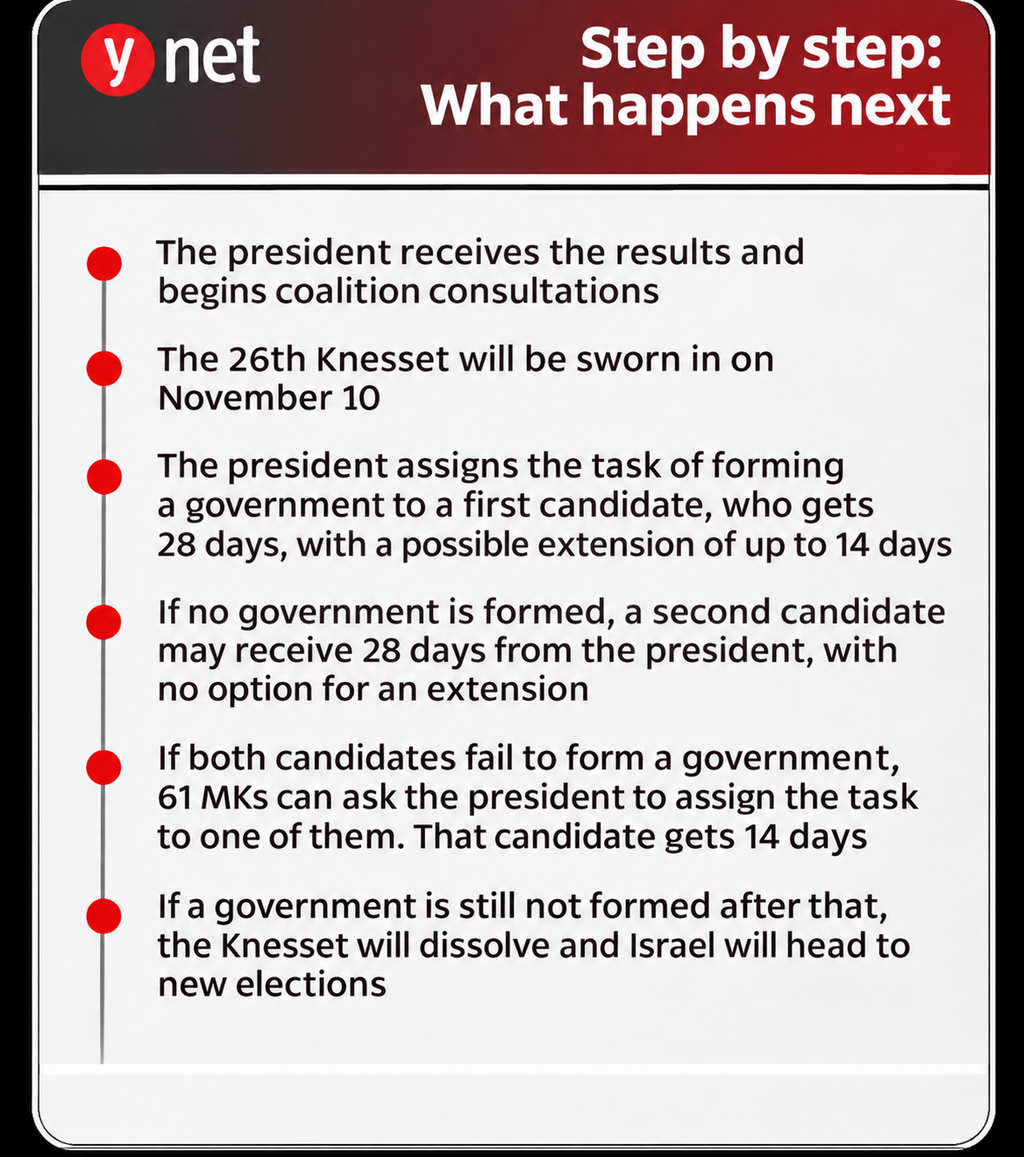
The president traditionally assigns the task to the Knesset member he believes has the greatest chance of forming a government, usually the candidate with the largest number of recommendations.
Under the current political calculations, that candidate is Eisenkot. Even if he does not secure 67 recommendations, he is expected to receive more than Netanyahu, who is projected to receive 46. United Torah Judaism is expected to remain undecided.
The candidate receiving the first mandate has 28 days to form a government. The president may extend that period by up to 14 additional days. If the first candidate fails, Herzog can choose between two options. He may assign the task to another Knesset member, most likely the leader of the opposing bloc, who would then have 28 days to form a government without the possibility of an extension.
Alternatively, the president may announce that he sees no viable possibility of forming a government. That declaration would trigger a 21-day period during which at least 61 Knesset members could submit a written request asking the president to assign the task to a specific lawmaker. If such a request is made, that candidate would receive 14 days to establish a coalition.
If no government is formed through any of these procedures, the Knesset will automatically dissolve and Israel will head to another election.
For now, the focus is on the recommendations Herzog will receive Wednesday and Thursday. Although Eisenkot appears positioned to secure the first mandate, that would be only the beginning of a potentially difficult coalition-building process, with no clear governing majority yet in sight.