

It is unclear what Netanyahu thought of the “Forrest Gump” label bestowed on him by former Prime Minister Naftali Bennett. There is every reason to assume it did not truly bother him. If being portrayed as a hapless, weak and powerless figure, as Bennett described him, someone swept into events he was barely connected to, is what might spare him a state commission of inquiry, then so be it. “Hey, I’m a nebach.”
It is not that he would have wanted that. He would have preferred that we see in the document not a response to the state comptroller, but a portrait of leadership. Not details, but an accumulated impression. He would have wanted readers to see a responsible, measured, engaged prime minister who acted according to the professional intelligence presented to him, and for whom the failure did not stem from his own decisions.
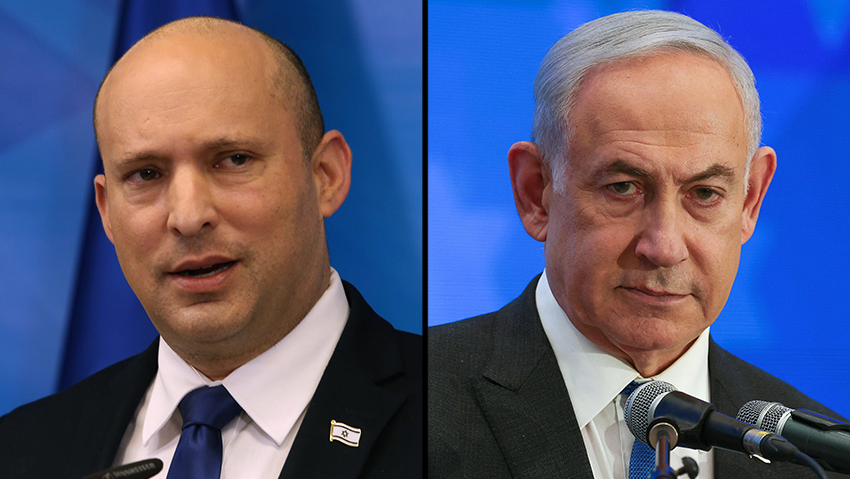
Naftali Bennett and Benjamin Netanyahu
(Photo: Ronen Zvulun/ Reuters, Amit Shabi)
He would have wanted us to see numerous meetings, extensive discussions, conversations with security chiefs, quotations, dates and context. A man immersed in the arena, not a detached politician. His message was that if there was a mistake, it was the system’s mistake, not that of one individual. He would have wanted readers to finish the document feeling that this was not a negligent debacle, but a disaster that befell a functioning system. In practice, many came away with the opposite impression. More defense than leadership, more explanation than correction.
If Netanyahu hoped the many redacted sections would resemble a Rorschach test, in which each reader sees something different, he was mistaken. Everyone saw the same thing: nothing at all. A clumsy attempt to marshal decades of discussions preceding that day, selective quotations from security officials without context and efforts to explain the chain of events, including claims about a so-called conception that, according to people familiar with the material, are rife with falsehoods and inaccuracies. What the document does not contain is an apology, contrition, self-blame, doubt or even a human moment.
If Netanyahu hoped that the many redacted sections in the document would resemble a Rorschach test, in which each person sees something different, he was mistaken. Everyone saw the same thing: nothing at all
If anyone bowed his head in embarrassment this week, it was Forrest Gump. “Netanyahu is me?” the earnest young man might ask himself. The beloved, innocent cinematic character, devoid of political cunning, uninterested in power and guided by a simple internal code of loyalty, love and perseverance. What does he have to do with this?
What indeed does he have to do with Israel’s sophisticated, manipulative, mendacious and cynical prime minister, who constantly seeks to control the narrative, is acutely aware of power and its preservation, has spent decades at the center of the stage and has consistently avoided taking responsibility for his actions, blaming everyone but himself and citing falsehoods and inaccuracies from materials to which only he has access? A man whose internal code is one of disloyalty, hatred and incitement.
Bennett believes the document offers a window into the prime minister’s deeper conception of leadership. That in drafting and publishing it, Netanyahu ultimately produced the harshest indictment against himself. If the criticism from both right and left is any indication, Bennett is correct. No one embraced Netanyahu’s tone of grievance, which angered security chiefs, some of whom appeared in television studios and others who reportedly began contemplating whether to publicly present their own version of events. In other words, it was a boomerang. The prime minister shot himself in the foot.
Why Forrest?
Why did Bennett choose Forrest Gump? It seems he was careful not to alienate his target audience, undecided right-wing voters, some of whom still align with Benny Gantz or straddle the fence between Netanyahu and Gadi Eisenkot. Attacking Netanyahu as a liar, a despicable figure devoid of leadership, would not shift votes. But describing him as passive, tired, lacking leadership and cowardly might. Disappointed Likud voters, Bennett likely tells himself, do not hate Netanyahu. They are simply tired of him. So thank you, Bibi, we will take it from here.
Bennett may be right. Had he chosen a different cinematic figure, such as Michael Corleone in “The Godfather” or Frank Underwood in “House of Cards,” ruthless and sophisticated men who aggressively shape history rather than stumble into it, he might have missed the mark. Even Chauncey Gardiner in “Being There,” the simple, naive man who speaks in gardening clichés while the political elite interpret his words as philosophical depth, would not have sufficed.
Bennett sought a metaphor that sticks. Perhaps he found one, perhaps not. Still, he was right about the document, as were many others. What occurred here was nothing less than a breathtakingly brazen attempt to obscure from the Israeli public the greatest failure in the state’s history, what today we would call gaslighting. A situation in which someone tries to make others doubt what they think, feel or remember. In other words, to manipulate someone’s reality so that they err or question themselves.
Netanyahu does this while ignoring the October 7 massacre, dragging along his followers and mouthpieces. It was evident this week during a Knesset Education, Culture and Sports Committee discussion on merging a private member’s bill and a government bill concerning remembrance and commemoration of the October 7 massacre. The Prime Minister’s Office representative, Yoel Elbaz, asked, nearly pleaded, that the word “massacre” be removed from the title of the law. “It was not only a massacre,” said MK Ariel Kellner. “It was also a massacre.” Thank you very much, at least it was “also.”
 Sima KadmonPhoto: Avigail Uzi
As if that were not enough, Culture and Sports Minister Miki Zohar resurfaced in an interview with Kan Bet radio and expressed support for removing the word “massacre” from the legislation. To the minister, the term “massacre” smacked of victimhood. Israel is a strong country, he said. The days when one could massacre the State of Israel no longer exist. One can harm Israeli citizens, he said, one can murder, but one can no longer massacre the Jewish people. Well, Miki, as culture minister you may attack an Israeli film you dislike, even if you have not seen it, or cut funding for ceremonies and prizes. What you cannot do is tell us what happened here on October 7.
What happened here was a massacre.