

When evening fell and we had already grasped the scale of terror engulfing the family, we asked whether the corner of the house where we had chosen to sit was safe. There is no shame in admitting fear. It is a natural instinct that exists in all of us to some degree and prompts us, among other things, to take precautions when danger is sensed. And in the home of Omia Hussein, the local council engineer of the Galilee village of Deir Hanna, vigilance is essential. Especially after full magazines were emptied at him — automatic fire and handgun shots, again and again and again.
When we arrived at his home last week, we found two large signs hanging on the facade of the three-story building. “I am a public servant, not an enemy. Violence is a red line,” read the first. The second declared: “I carry out my duties according to the law. I will not surrender to threats and extortion.”
Gallery
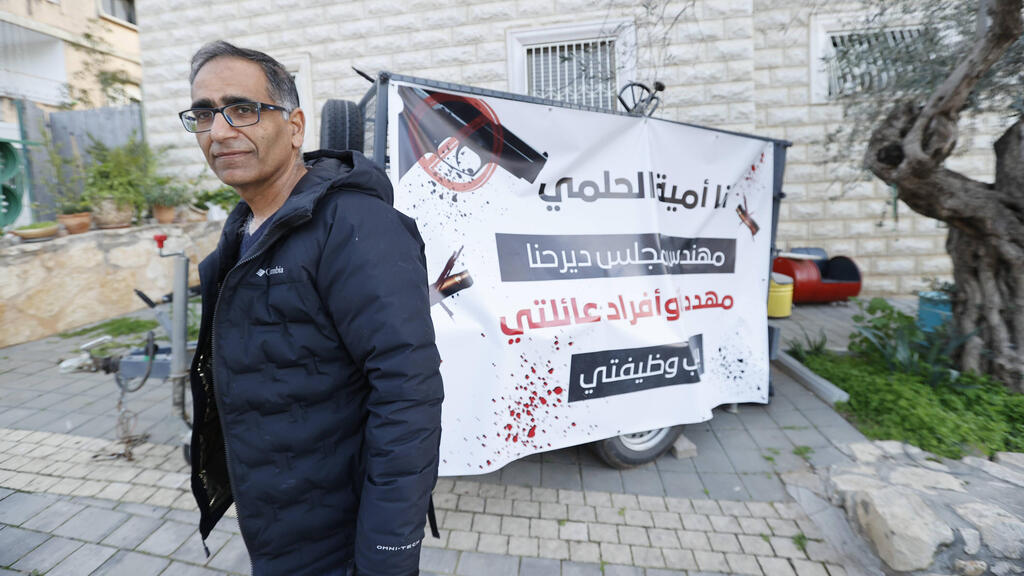
Local council engineer of the Galilee village of Deir Hanna, Omia Hussein, outside the front of his house
(Photo: Gadi Cabello)
This is the message Hussein wants to send to those who are extorting him. Perhaps the signs are also meant to instill confidence in himself and his family. In any case, the security cameras tell a different story. We counted 10 of them covering every corner and stretch of street, including the sidewalk across the road. In addition, an armed guard sits in a booth in the yard, and there is also a personal security guard who led us not even into Hussein’s home but into the neighboring house, where he and his wife and children have temporarily moved in an attempt to confuse their attackers.
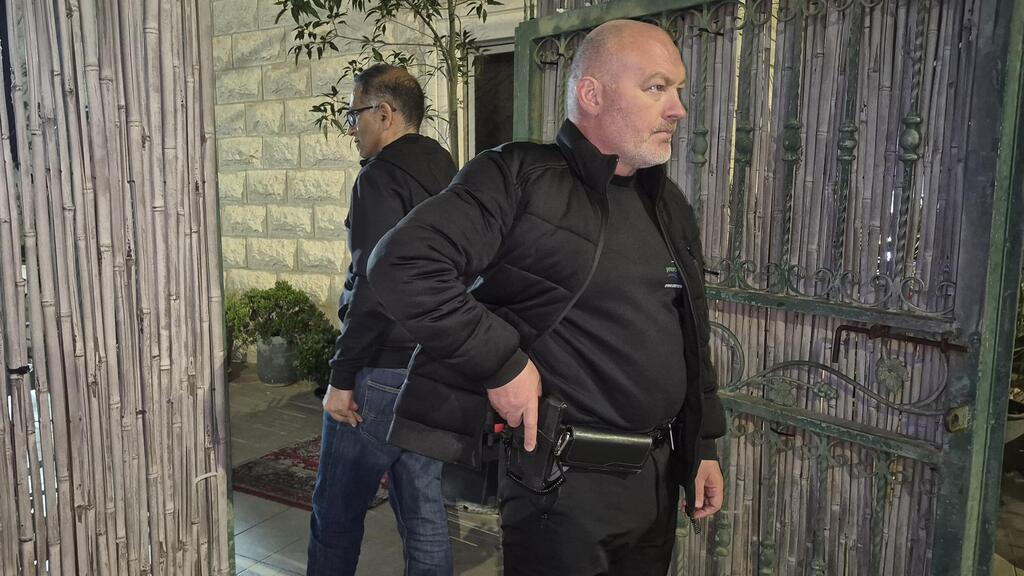
Security guard outside the home of Omia Hussein
(Photo: Hassan Shaalan)
When we asked our question in a worried tone, his wife Suhair reassured us, pointing toward the living room. “There, in that part of the house, you’re safe. Where the large window faces the street — don’t sit there. That’s dangerous.”
The friend who delivered the message
Deir Hanna is not a large village. It is surrounded by olive groves planted as far back as Roman times, immersed in beautiful nature and overlooking a small valley whose road leads to Arraba and Sakhnin. The nearby hilltop community of Hararit looks down on it from above.
As we listened to the unimaginable ordeal the council engineer’s family has been enduring, another killing took place not far away, in Kafr Kanna: Saleh Jaber was murdered. In the time since this article was written, five more have been killed — bringing the total to 44 victims in Arab society since the beginning of the year, as of Thursday morning.
With five murders in less than 24 hours this week, 2026 already appears set to be another deadly year. The Northern District leads in homicide rates: 19 of 39 murders occurred there. It also led in 2025, with 96 of 255 murders. Beyond the glaring failure of National Security Minister Itamar Ben-Gvir, who sets police policy, this is an intolerable reality for more than 20% of the country’s citizens — a daily existence of fear and dread, with the real sense that at any moment you could be the next victim; a reality in which criminals rule and protection payments are factored into the economic calculations of every business and even private individuals. A reality in which local government is coerced into operating according to criminals’ dictates. And if not — look at the facade of Engineer Hussein’s house. It is riddled with bullet holes like a sieve.
The notice in Hebrew
Hussein has held his position since 2012. He sits at the crossroads of all decisions related to construction, development and infrastructure. He oversees long-term strategic plans and monitors planning and execution of projects — mainly public buildings — many of them multimillion-dollar tenders with enormous economic potential.
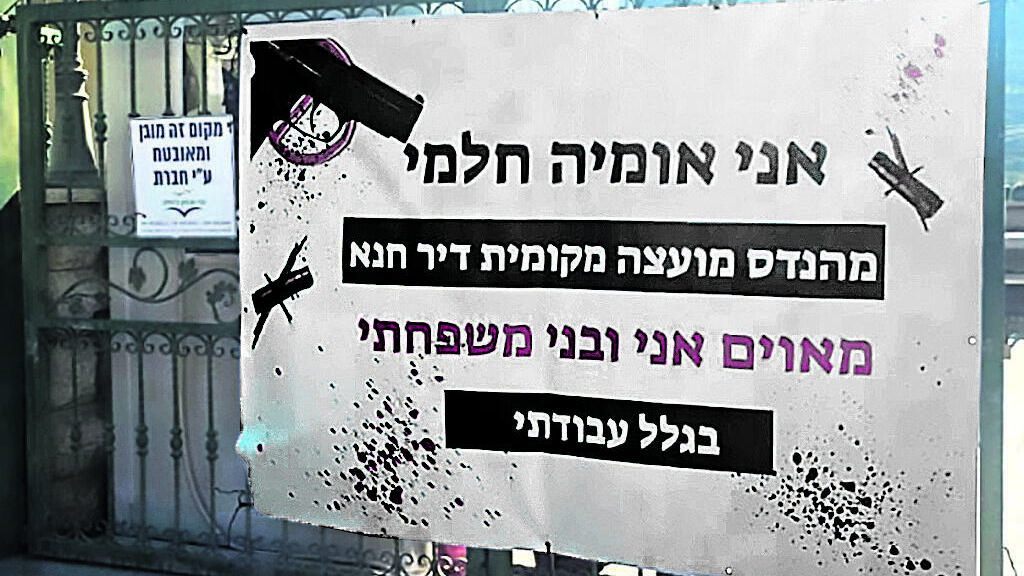
A sign outside Omia Hussein's house in which he explains that he is a public servant and his family is being threatened
“For years,” he says, “not all my decisions were to people’s liking, but even if they didn’t like them, they accepted them. In the last two years that has changed. Influential figures in my extended family began disliking my decisions.”
Some background is required. In Deir Hanna there are two large families: Khatib and Hussein. In every council election, a campaign unfolds that can spill into violence, with each family fielding its own candidate. In the 2024 mayoral election, Saeed Hussein, a distant relative of the council engineer, was elected. That did not grant him industrial quiet at work. On the contrary.
“Those same figures in my extended family claimed my decisions harmed them financially,” he continues. “What guides me are proper administrative rules and the public interest. That didn’t stop them from sending me a message through someone I can say is also a friend. It was on November 17. He came to my office at the council and said, ‘They asked me to tell you that you need to resign by the 30th of the month.’ I was silent for a moment and then asked, ‘And if I don’t leave?’ He said their tone was very aggressive and that if I didn’t resign, it wouldn’t be good. He’s a nice guy, I told you, even a friend — he’s just the messenger. They told him, ‘Whether you like it or not, this is the message you must deliver.’”
The public is invited to settle scores
The Sicilian mafia would send a severed horse’s head as a warning. In Deir Hanna, the threat arrives with a friend. Perhaps that is why Hussein never considered resigning.
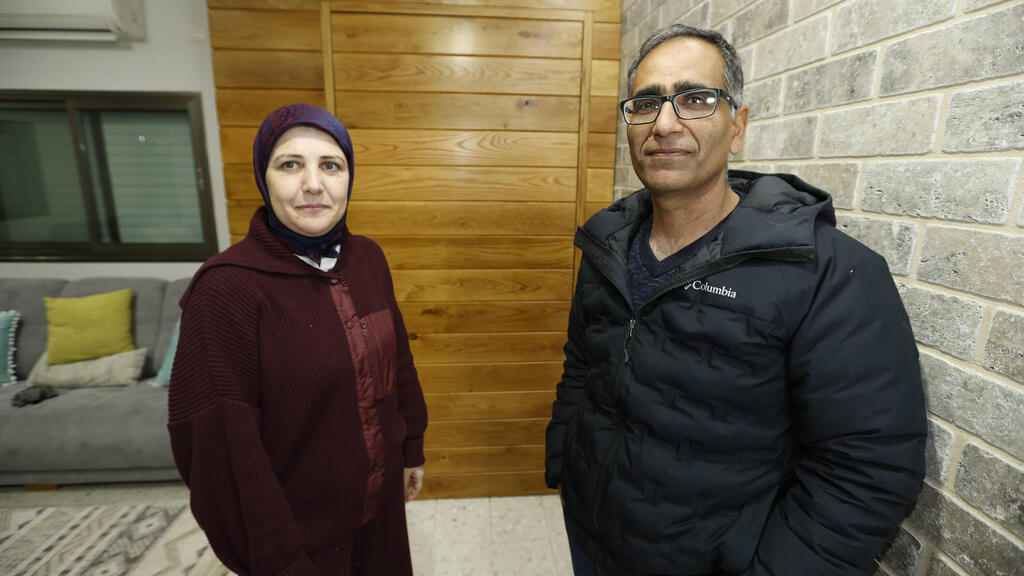
Omia Hussein and his wife, Suhair
(Photo: Gadi Cabello)
“I shared the threat with my wife and my three brothers and said I didn’t want to resign,” he says. “They supported me. They said, ‘We’re with you.’ On the last day of November, a public notice was circulated in the village by the extended Hussein family announcing they were removing their responsibility for me, that from now on they would not protect me, and that anyone with a score to settle with me or with the council’s engineering department could approach me in any way they saw fit. That didn’t deter me either. The next day, December 1, I went to work as usual. My family has a large egg-laying chicken coop in the village’s agricultural area, and that same day they set it on fire. The damage was about half a million shekels. At that point the threats became action, and I turned to the police. That was my first approach to them. Of course I told them everything.”
Including the background and names?
“I can’t go into details because the matter is under investigation. I can only say there are people who don’t want me to adhere to procedures. I stayed home for two weeks because it dawned on me that I was under serious threat. I estimated who was threatening me and tried through mediators to calm things down. They conveyed a message that from their perspective I am an obstacle and there is only one solution — that I resign.”
At this stage you didn’t seriously consider resigning?
“On the contrary. On December 14, I announced I would return to work the next day. A few hours later, at 1 a.m., they opened automatic fire at our house. That was the first shooting. Insane. We all jumped up in panic. We couldn’t get back to sleep, and when morning came I changed clothes and went to work. A week later — another shooting at the house. By then we were living in a nightmare, barely sleeping. The police arrive, collect shell casings from the road outside and tell me, ‘Come to the station in the morning to give a statement.’ And that’s it. They leave. We stay alone.”
Hussein and his wife scroll through their phone calendars to verify the dates of each shooting at their home or coop. Their phones resemble an operations log from a unit under fire on the front line. The cumulative ammunition used here could supply a live-fire infantry exercise.
“All the while we’re under fire,” Hussein adds, “people come to our home, supposedly to see how we are, and later I realize they’re actually checking where we’ve installed cameras and what angles they cover, to pass the information to our attackers.”
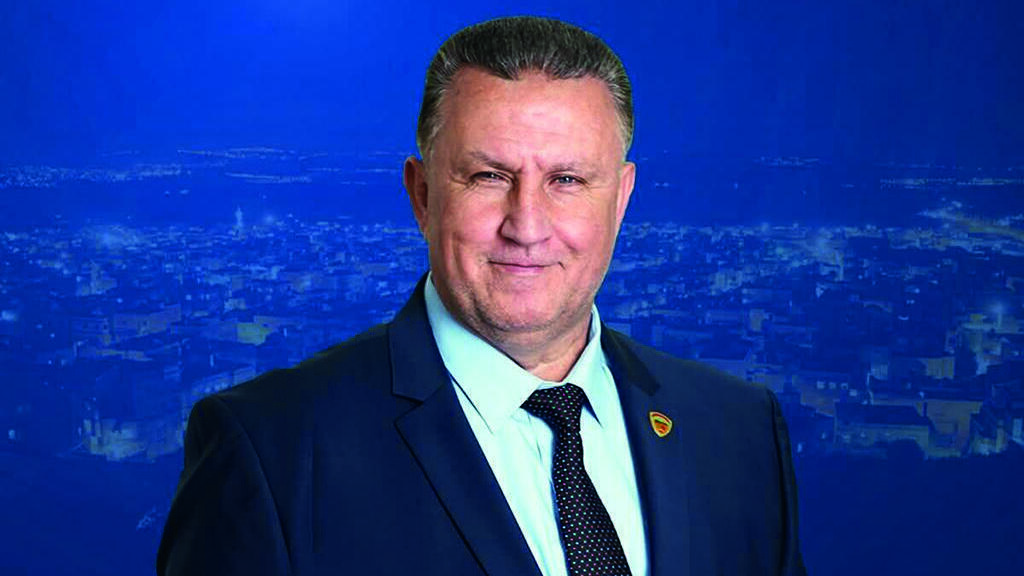
Ali Zeidan, head of the local council of Kafr Manda in the Galilee, is also under threat
We called Ali Zeidan, head of the local council of Kafr Manda in the Galilee, who has also been classified as under a level 6 threat — the most severe. The life he describes, like Hussein’s, is no life. An armed guard stands at his home entrance, and a bodyguard accompanies him everywhere.
“It’s all because I went all out against organized crime groups trying to extort protection money from business owners in the village,” he says. “I urged our residents not to give in to criminals. I promised anyone extorted that all the village’s residents would stand behind them. And indeed, when criminals came to extort wealthy people in the village, we ambushed them and the crowd beat them. Their car was burned. They fled but police chased them and shot them in the legs. They were arrested and indicted. That was a year and a half ago, and I’ve been under threat ever since. But I’m not afraid. I even declared that anyone from Kafr Manda who cooperates with protection rackets will be expelled and socially and economically boycotted.”
What is the police response?
“The police need more resources and manpower. A TikTok video was posted saying they would harm me and my family and that nothing would protect me — not the police, not the state, no one. But I don’t count them. The problem is the children. I have nine — thank God — the oldest is 35, a doctor, and the youngest is 12, in sixth grade. Write that I’m very vigilant and that I believe there is a God in heaven who protects us,” he says.
Rawiya Handaklo, head of Ilaf — the Center for Security in Arab Society, says the shootings and threats against public servants in Arab communities pose not only a direct threat to their lives and families but also undermine public service and discourage good people from entering it.
“The case of Omia Hussein in Deir Hanna may seem extreme,” she says, “but that extreme is the reality of Arab society. This is a story that should horrify anyone who cares about democracy.”
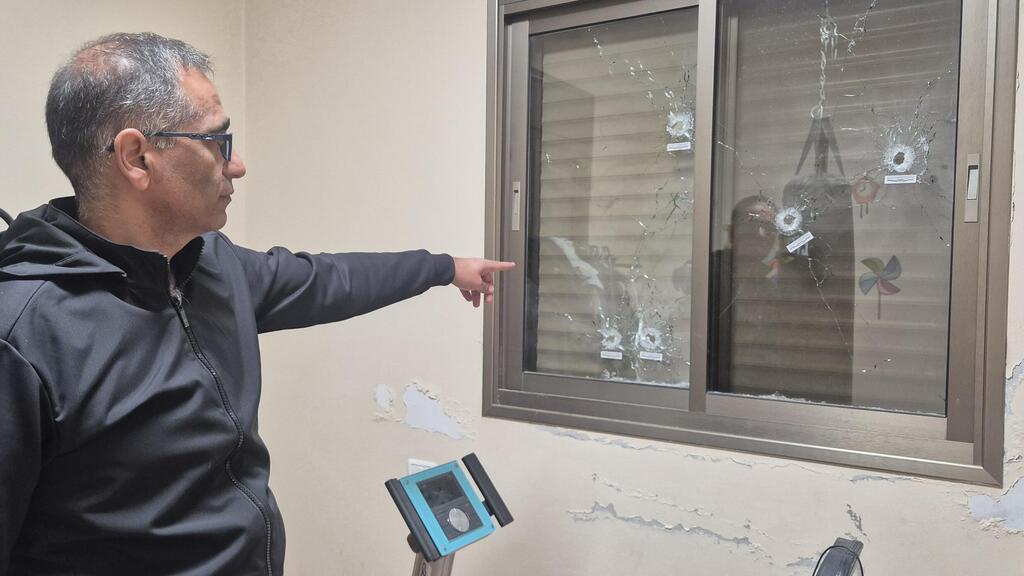
Evidence of gunshots
(Photo: Hassan Shaalan)
One can only imagine how the public, police and broader media would react if this were the engineer of a Jewish municipality. Hussein is aware of that, and beyond the anxiety he already endures, it depresses him deeply.
“I don’t know whether the police are doing their maximum,” he says. “Let’s think together how they would act if I were the city engineer of Haifa or Zichron Yaakov. We sleep with our eyes open. I hate the night, I fear the night — it’s a nightmare for me. I just want to sleep but keep thinking when the next shots will come.”
His wife Suhair, principal of a school for gifted students in Kabul, says they are exhausted — “from the tension, from the fatigue, from the constant fear that accompanies us all day, everywhere.”
Hussein adds: “I barely sleep. My brothers and I guard the house in shifts. The police can’t put a stop to this, and it doesn’t stop.”
You mean the shooting?
“They’ve moved to threats. Now they say, ‘You don’t want to resign? Then pay.’ They want money not only from me but from the entire family. They sent a message to Suhair’s family in Kafr Kanna that if they come to visit us, they’ll return home in body bags. They warned my uncles from Haifa not to visit. They want my brother Haitham to pay five million shekels. From Suhair’s father — who came anyway — they want one million. From my two uncles in Haifa — also one million each. I’m telling you, it’s an insane nightmare. Total madness. If I were Jewish, there would have long since been arrests and indictments.”
What will you do? How long can you go on like this?
“No state authority has my back. A threatened council engineer cannot withstand such pressure alone. I’m not Superman. Soldiers under fire in war sometimes panic and run. I feel like I’m in a war. They’re shooting at me, at my family — but unlike soldiers at the front, where can I run? Should I leave my home? My village? My job? Who will come in my place — a rubber stamp? That’s it? Is there no law left in this country?”
The police responded: “We view such incidents with severity. Upon receiving reports of these cases, investigations were opened and all necessary actions are being carried out to uncover the truth and bring those involved to justice.”