


A former University of Arkansas professor who praised Iran's late supreme leader Ali Khamenei, called for Israel to be dismantled and shared a social media post calling for violence against "Zionists" is now asking a federal court to strike down an Arkansas law designed to combat antisemitism, arguing that it was used to justify her dismissal.
Dr. Shirin Saeidi, an Iranian-born political science professor who previously directed the university's King Fahd Center for Middle East Studies, alleges in a lawsuit filed this week that the law was used to punish her for her views on Israel. She is seeking reinstatement and financial compensation.
In a post on X, Saeidi described Israel as "a terrorist and genocidal state that must be dismantled by international forces."
In another post, she praised Khamenei, who was killed in late February at the beginning of Operation Roaring Lion, describing him as the leader who "kept Iran intact during the Israeli attack." She added: "May God protect you and the Iranian people from the Israeli regime."
The dean of her college wrote to Saeidi that her personal social media posts undermined the credibility of the center she headed and its ability to serve Jewish and Israeli students.
The controversy was not limited to her comments about Israel. Saeidi had previously used official university letterhead in a submission to a Swedish court concerning Hamid Nouri, a former Iranian prison official sentenced to life imprisonment for his involvement in the mass executions of political prisoners in 1988.
According to the Swedish court's ruling, Nouri brought prisoners before a panel that sentenced them to death and escorted them to the execution site. The university reprimanded Saeidi for using its name without authorization.
Nouri was released in 2024 as part of a prisoner exchange in which Iran returned two detained Swedish citizens. Saeidi's academic work at the University of Cambridge, where she earned a doctorate in politics and international studies, is also facing renewed scrutiny.
Several former female political prisoners have alleged that their testimony was misrepresented in her research. One says she never met Saeidi, despite being identified as an interview subject. Saeidi rejects the allegations, maintaining that her research documents human rights abuses committed by the Iranian regime.
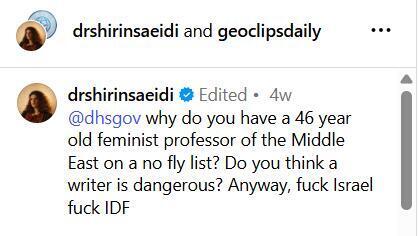
(Photo: Instagram)
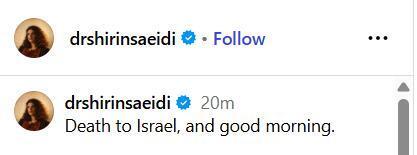
(Photo: Instagram)
In December 2025, Saeidi shared a post urging someone to "thrust the dagger from Doha into the throats of the Zionists, so that all of them howl," accompanied by smiling emojis and the hashtag #FreePalestine. Saeidi maintained that she had not intended to encourage violence. She pointed to other statements in which she condemned attacks on Jews or Muslims because of the actions of their respective states.
The university rejected that explanation, arguing that Saeidi had not made clear in the repost itself that she opposed the call to attack "Zionists." The incident prompted proceedings to dismiss her from her tenured faculty position, in addition to her removal as director of the Middle East studies center.
The controversy also drew reactions beyond the campus. U.S. Ambassador to Israel Mike Huckabee, a native of Arkansas, said at the time that although the decision to dismiss Saeidi belonged exclusively to the university, someone who praised Khamenei might be better suited for a "one-way ticket to Tehran."
Arkansas Gov. Sarah Huckabee Sanders, the ambassador's daughter, signed the antisemitism law that Saeidi is now seeking to overturn.
One detail complicates the university's position: An internal faculty review concluded that Saeidi had not violated the institution's antisemitism policy. A faculty committee reviewing her dismissal unanimously recommended reinstatement, finding that even offensive statements do not necessarily justify firing a tenured professor. However, University of Arkansas System President Jay Silveria rejected the recommendation in March.
Silveria expressed concern that the institution could lose public funding if its response to antisemitism was considered inadequate. The university system's Board of Trustees subsequently upheld her dismissal in May. Saeidi described the loss of her tenured position as an "academic death penalty."
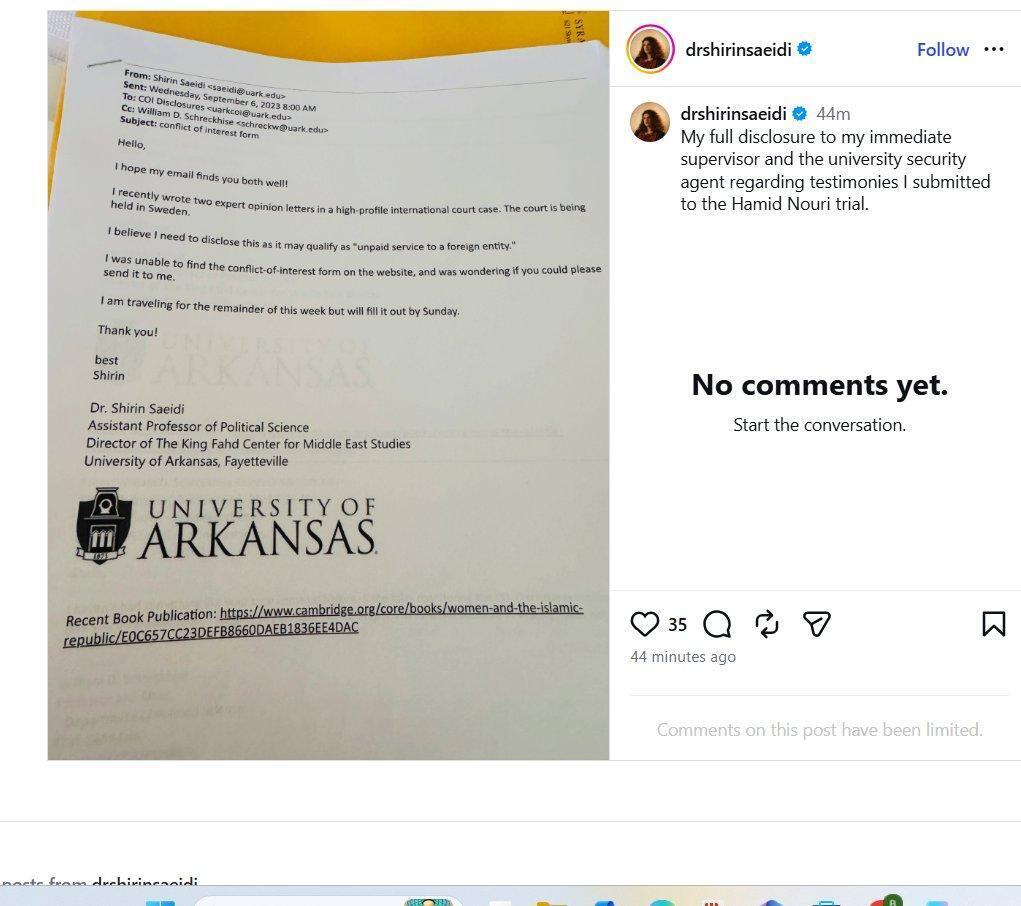
The lawsuit filed by Saeidi
(Photo: Instagram)
The Arkansas law, enacted in 2025, requires educational institutions to adopt the International Holocaust Remembrance Alliance's working definition of antisemitism, including examples addressing criticism of Israel, and to respond to complaints of discrimination and harassment. It also encourages state lawmakers to consider reducing funding to institutions that fail to address complaints adequately.
Saeidi argues that the definition is unconstitutionally vague and effectively makes opinions about Israel grounds for disciplinary action. The law, however, explicitly states that criticism of Israel comparable to criticism directed at any other country does not constitute antisemitism. It also specifies that constitutional free speech protections must not be infringed.
In her lawsuit, Saeidi alleges that her dismissal resulted from a coordinated campaign involving university officials, politicians, journalists, social media users and a group of Iranian exiles opposed to the regime in Tehran.
She previously described the campaign against her as having been taken from the "Zionist lobby playbook." The Iranian exile group is headed by Lawdan Bazargan, whose brother was murdered during the 1988 massacre of political prisoners in Iran.
Bazargan denies that there was any secret coordination to secure Saeidi's dismissal. She says members of her organization raised their concerns publicly and that university officials made their own decisions. Among the defendants named in the 88-page lawsuit are Republican Arkansas state Sen. Dan Sullivan and journalist Benjamin Weinthal, who published investigations into Saeidi. Weinthal said he stands by his reporting.