

Since last week, at the height of the Iranian people’s demonstrations against the Islamic Republic, a symbolic video was reshared on X and subsequently across other social media platforms, drawing widespread attention.
The video shows a young woman lighting her cigarette by setting fire to an image of Ali Khamenei, the leader of the Islamic Republic. Following the circulation of this video, and later a photograph from it, Iranian women were the first to replicate the act. The footage quickly went viral, and images of Iranian women lighting their cigarettes with the flames of Khamenei’s burning portrait rapidly turned into a global trend.
Iranian girls lighting cigarette


Each day, dozens and then hundreds of similar images were published, eventually capturing the attention of the media. Numerous news websites and print outlets covered the story, and television networks broadcast it. Digital artists also produced new images and videos inspired by the original act, including AI-generated animations depicting Khamenei as terrified by the repeated burning of his image, as well as unreal world magazine covers featuring the scene.
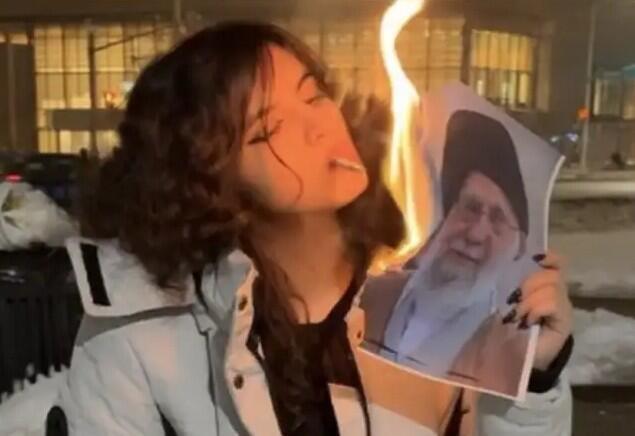
At a time when the internet in Iran was completely cut off, the repeated circulation of this image became a symbol of resistance and spread across the world. Women in France, Israel, Ukraine, and Turkey joined the trend, and some even adapted it by burning images of other authoritarian leaders, including Vladimir Putin. Ultimately, the trend reached the U.S. Congress, where Claudia Tenney and Tim Sheehy, members of the House and Senate, also joined in.
This global trend was launched by Melia, a 23-year-old student who recently moved to Canada. She is active on X, where she describes herself as a Radical Feminist, and says she also took part in Iran’s 2022 “Woman, Life, Freedom” protest movement.
In an interview with me, Melia says she was inspired by an old image of a woman lighting her cigarette by burning the photograph of a dictator, which led her to recreate the act. She says the response was overwhelming.
According to Melia, following the enthusiastic reaction from Iranian women and the reposting of the image on X—along with similar images of herself—a French news outlet published the story. This was followed by widespread coverage by other media outlets and celebrities. Melia says that resharing the video on social media was particularly important to her, as someone who has been fighting for freedom for several years, because it helped draw global attention to the revolution in Iran.
The growing attention to the video and its replication on X coincided with an unprecedented massacre of protesters by the Islamic Republic, the deadliest in contemporary Iranian history, on Thursday, Friday, Saturday, and Sunday. These were the days when opponents of the Islamic Republic, including Reza Pahlavi, labour unions, women’s rights activists, and other opposition groups, had called for strikes and demonstrations. The government responded by cutting off the internet as well as mobile and landline telephone services, while opening fire on thousands of people in the streets of Tehran, Karaj, and dozens of other cities across Iran.
Eyewitnesses say the intention of military and security forces confronting the massive crowds was not to disperse them, but to kill as many people as possible.
Melia says that despite the large number of casualties, many young people inside and outside Iran continue to insist on carrying on the struggle. She also participated in the 2022 movement, widely known as the Mahsa Revolution, whose central slogan was “Woman, Life, Freedom”, which swept the country after Mahsa Amini died in police custody for allegedly violating mandatory hijab rules. Melia says that since then, fear has been eliminated.
She explains that as a continuation of that movement, people in the recent protests—referred to as the “National Revolution”—are openly chanting for the overthrow of the Islamic Republic and the destruction of Khamenei’s rule. Melia notes that although the 2022 protest movement was suppressed, social conditions and especially the enforcement of mandatory hijab have fundamentally changed. In practice, harsh criticism of the ruling system on social media became normalized, and many Iranian women in different cities removed the compulsory hijab after decades of enforcement. Despite confrontations with police and Basij forces, they refused to return to the pre-2022 status quo or submit again to Islamic dress codes.
Iranian security forces
Melia says the video demonstrates the depth of the Iranian people’s hatred toward a regime that commits crimes against humanity. She adds that her desire is to live in freedom, prosperity, equality, and security, under conditions in which human dignity is respected.
Melia says she is happy that so many people around the world have identified with her act. Many Iranian women living abroad have also repeated the gesture, lighting their cigarettes with burning images of Khamenei during their daily protests outside Iranian embassies. One of these women—who herself had previously been imprisoned in Iran—wrote in a post on X alongside a similar photo:
“I had quit smoking for a long time, but now I smoke only this one cigarette, because it tastes like Revolution.”