


Israel’s election campaign is already a battle over ideology, voters, candidates, alliances and leadership. But as the deadline for submitting party lists approaches, another contest is unfolding almost entirely out of public view: the race for the letters that will appear on ballot slips.
In Israel, those letters are more than a technical detail. They are one of the most recognizable parts of a party’s identity on Election Day. Likud has long been associated with “Mahal” (מחל), Shas with “Shas” (שס), United Torah Judaism with gimel (ג') and Yisrael Beytenu with lamed (ל'). This time, several new parties and alliances are entering the race, all of them looking for a ballot designation in an already crowded political alphabet.
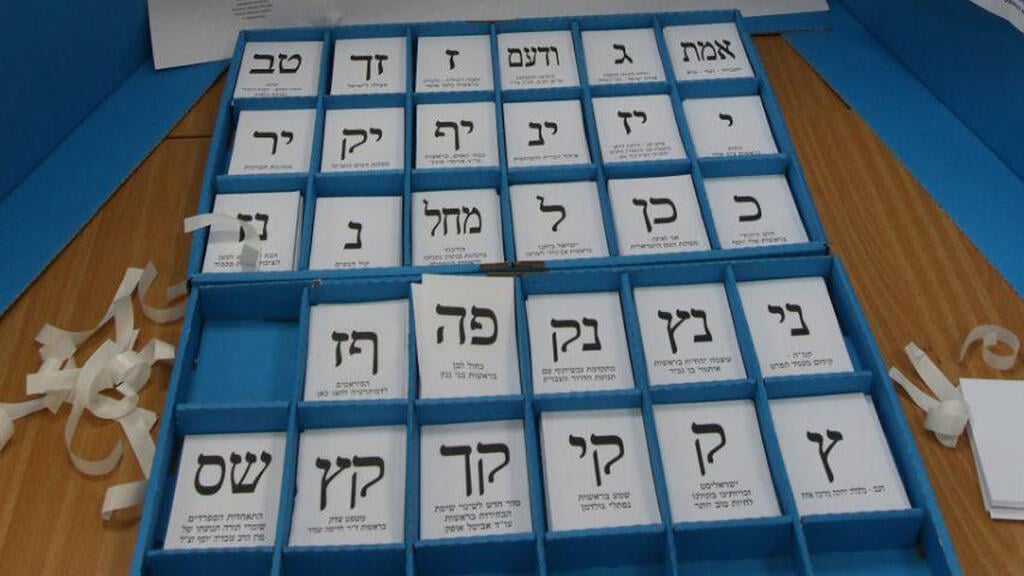
Party letters on ballot slips during the 2020 election
(Photo: Avi Moalem)
Under election law and Central Elections Committee rules, parties represented in the outgoing Knesset receive priority over the letters or combinations they used in the previous election. A new list that wants to use a designation already claimed by an existing faction needs written consent from the party that holds the right to it. This year, the rules were expanded to allow parties to use combinations of up to three letters rather than only one or two, partly in anticipation of a larger number of competing lists.
The letters already taken
A Central Elections Committee document shows that many of the most familiar ballot designations are effectively reserved. Among them are “Emet” (אמת), expected to be used by the Democrats; gimel (ג') for United Torah Judaism; “Peh” (פה) for Yesh Atid; “Mahal” (מחל) for Likud; “Shas” (שס) for Shas; “Vam” (ום) for Hadash-Ta’al; “Ken” (כן) for Blue and White; tet (ט') for Religious Zionism; and lamed (ל') for Yisrael Beytenu.
Yesh Atid is running this time as part of the new Beyachad alliance led by Naftali Bennett and is expected to register under new letters rather than retain “Peh” (פה). The combination historically associated with Meretz also no longer enjoys the same priority it once had because Meretz failed to enter the Knesset in the previous election. “Emet” (אמת), previously associated with Labor, remains protected through the rights now held by the Democrats.
That leaves only a relatively narrow group of letters currently available: bet (ב'), dalet (ד'), zayin (ז'), yud (י'), nun (נ'), tzadi (צ'), kuf (ק'), final kaf (ך), final peh (ף) and final tzadi (ץ).
On paper, that may sound like a reasonable selection. In practice, some are far more attractive than others. Political parties want a ballot symbol that is short, memorable and easy to repeat in campaign advertising. Within weeks, the chosen letters will appear on posters, television spots, social media and the familiar election-day message: “At the ballot box, vote…”
Bennett, Eisenkot and others need new symbols
The pressure is greatest on the new parties and alliances. Gadi Eisenkot’s Yashar, Ofer Winter’s Amcha Yisrael, Bennett’s Beyachad and other new lists must all choose letters or combinations of their own. Otzma Yehudit and Noam also need to settle on ballot designations after running in the previous election as part of the Religious Zionism slate under tet (ט').
Several new parties declined to tell Ynet which letters they are seeking because revealing a preferred letter in advance could allow a rival to register first or try to block its use. In a campaign where several new lists are searching at the same time for something short, recognizable and marketable, even a single letter can become a political asset.
Why getting in line matters
That is where the filing deadline becomes more interesting. Representatives arriving at the Knesset for early registration will receive a number determining their place in line for formally submitting their lists, and that order can matter when two parties want the same letter and neither has an existing legal claim to it.
The principle is straightforward: after the rights of incumbent parties are protected, the list that files first gets priority over an available ballot designation. In other words, arriving earlier can mean getting the better letter.
Early registration opens Sunday at 5 p.m. On Monday, formal submission of party lists will begin at 1 p.m. and continue until 5 p.m. Tuesday is the final day, when parties can begin arriving at 4 p.m. and submit their lists until 10 p.m. Central Elections Committee Chairman Noam Sohlberg may extend the deadline until midnight, the absolute cutoff.
By then, the big political questions will not be limited to who merged with whom or which candidates made the slate. Some parties may also discover that one of their first campaign battles was over something much smaller: a few remaining letters of the Hebrew alphabet.