

No quick dispatch of disease investigators. No televised news conference to inform the public. No timely health alerts to doctors.
Amid a hantavirus outbreak involving Americans and drawing global headlines, the Centers for Disease Control and Prevention has been uncharacteristically absent, according to several public health experts.
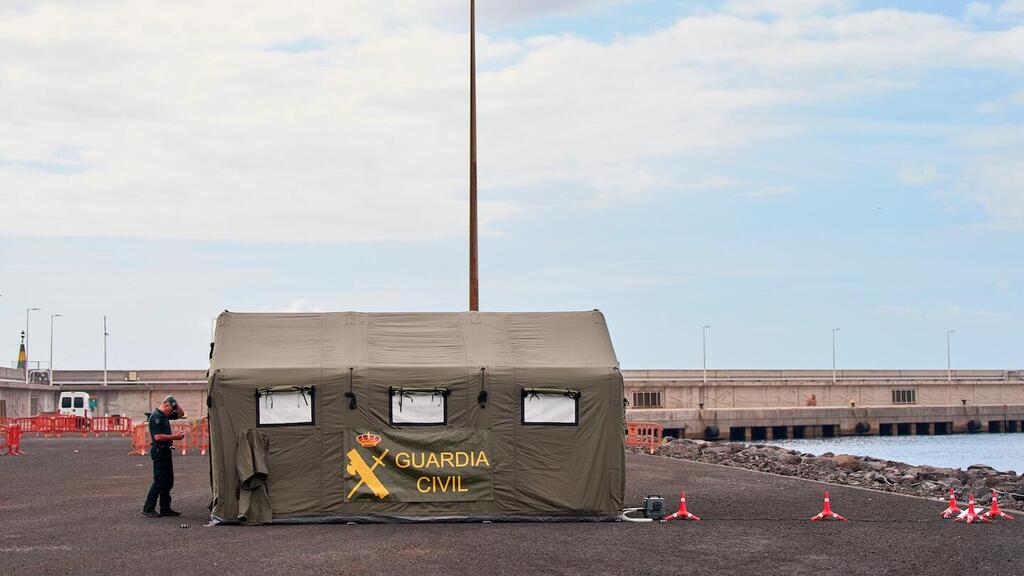
A Spanish Civil Guard officer inspects the area where passengers from the MV Hondius cruise ship are expected to arrive at the port of Granadilla in Tenerife, Canary Islands, Spain, Saturday, May 9, 2026
(Photo: AP Photo/Manu Fernandez)
“We seem to have things under very good control,” President Donald Trump told reporters Friday evening.
Experts say the outbreak aboard a cruise ship has not spiraled largely because hantavirus, unlike COVID-19, measles or the flu, does not spread easily. So far, health officials in other countries, not the United States, have taken the lead.
“The CDC is not even a player,” said Lawrence Gostin, an international public health expert at Georgetown University. “I’ve never seen that before.”
CDC action accelerated only late Friday. Health officials confirmed they were sending a team to Spain’s Canary Islands, where the ship was expected to arrive early Sunday local time, to meet the Americans onboard. A second team was to go to Offutt Air Force Base in Nebraska as part of a plan to evacuate American passengers to a University of Nebraska quarantine center for evaluation and monitoring.
The agency also issued its first health alert to U.S. doctors, warning them of the possibility of imported cases.
At its first briefing, held Saturday by telephone for invited reporters only, officials pledged transparency but said the speakers could not be identified by name under rules set by aides to Health Secretary Robert F. Kennedy Jr. They did not directly answer whether the American passengers would be free to leave the university medical facility.
Some experts said the CDC’s diminished role reflects a broader weakening of the agency’s standing in global and domestic public health.
The outbreak is “a sentinel event” that shows “how well the country is prepared for a disease threat. And right now, I’m very sorry to say that we are not prepared,” said Dr. Jeanne Marrazzo, chief executive officer of the Infectious Diseases Society of America.
The outbreak began early last month, when a 70-year-old Dutch man developed a feverish illness on a cruise traveling from Argentina to Antarctica and islands in the South Atlantic. He died less than a week later. Others became sick, including his wife and a German woman, who also died.
Hantavirus was first identified as the cause of illness in one case on May 2. The World Health Organization soon declared the situation an outbreak. About two dozen Americans were on the ship, including roughly seven who disembarked last month and 17 who remained onboard.
For decades, the CDC worked closely with the WHO in such situations, providing staff and expertise to investigate outbreaks, help control them and explain risks to the public. This time, the WHO has taken center stage, including issuing the risk assessment that said the outbreak is not a pandemic threat.
“I don’t think this is a giant threat to the United States,” said Jennifer Nuzzo, director of Brown University’s Pandemic Center. But the response, she said, “just shows how empty and vapid the CDC is right now.”
The situation follows 16 tumultuous months in which the Trump administration withdrew from the WHO, at times restricted CDC scientists from communicating with international counterparts and moved to build its own international public health network through one-on-one agreements with individual countries.
The administration has also laid off thousands of CDC scientists and public health professionals, including members of the agency’s ship sanitation program.
Kennedy has said he is working to “restore the CDC’s focus on infectious disease, invest in innovation, and rebuild trust through integrity and transparency.”
The CDC has not been entirely silent. On Wednesday, it issued a brief statement saying the risk to the American public was “extremely low” and described the U.S. government as “the world’s leader in global health security.”
Nuzzo criticized the statement, saying: “Not only was that not helpful, it actually does damage because a core principle of public health communications is humility.”
The CDC’s acting director, Dr. Jay Bhattacharya, wrote on social media that the agency was coordinating with federal agencies and international authorities. WHO officials said the CDC has shared technical information.
But federal health officials have largely declined interview requests. Bhattacharya’s first on-camera appearance came Saturday morning on Fox News, where he told Americans: “Please don’t worry.” He also misstated some details, saying two passengers in their 80s died after contracting the virus while bird-watching in Argentina. The travelers were a 70-year-old Dutch man and his 69-year-old wife, and while Argentine officials consider a bird-watching outing a possible source of infection, that has not been established.
Some experts compared the response to the CDC’s role during the 2020 Diamond Princess outbreak, when the cruise ship docked in Japan became one of the first major COVID-19 outbreaks outside China. The CDC sent personnel, helped evacuate Americans, ran quarantines, shared genetic data, coordinated with the WHO and Japan, held public briefings and rapidly published reports that became key references on cruise ship transmission.
The Diamond Princess response was criticized and did not stop COVID-19 from spreading globally. But experts say the CDC was highly visible and active.
“The CDC was right on top of it,” Gostin said. This time, he said, the agency’s work has been delayed and subdued.
Instead of working through the WHO with nearly all nations, the Trump administration has pursued bilateral health agreements with individual countries. About 30 are currently in place.
“You can’t possibly cover a global health crisis by doing one-on-one deals with countries here and there,” Gostin said.