

After terrorists attacked IDF forces in Rafah on Sunday, the military believes similar incidents are likely to recur in the coming months across Gaza’s Israeli-controlled enclaves — the areas between the former border fence and the new internal “yellow line” marking Israel’s pullback.
Dozens of square kilometers in these zones have been flattened in recent months, yet beneath the rubble, Hamas tunnels remain. When Israeli forces arrive to locate and demolish them as part of the ceasefire terms, the terrorists trapped inside fight for their lives. That was the case in two recent incidents in Khan Yunis and Rafah, which drew little media attention amid the release of Israeli hostages.
IDF strikes Hamas targets in Gaz
(Video: IDF)


The events were seen as the first significant ceasefire violations, though swift IDF response prevented casualties. Some of the terrorists were killed, others fled — and commanders in the field knew from the start that the ceasefire would not hold perfectly. In recent days, the IDF has routinely fired warning shots to keep Palestinians away as it builds new defensive positions along the yellow line.
Drawing the yellow line
The Defense Ministry has begun physically marking the so-called “yellow line” — a notional new boundary within Gaza — by placing yellow border stones similar to those used along Israel’s borders with Lebanon and Syria. Defense Minister Israel Katz reportedly ordered the move to create a visible separation line through the ruins, even though the map itself remains unpublished.

In practice, the yellow line leaves Israel controlling less than half of Gaza’s territory, despite earlier statements. Should negotiations for the second phase of the long-term arrangement collapse, those yellow markers could soon become a permanent border — first as a simple barrier, then a high-tech fence — effectively shrinking Gaza and expanding Israel’s western Negev.
Such a move could pave the way for potential Israeli settlements to reemerge in the evacuated northern and southern Gaza areas, from the former Nisanit ridge to the outskirts of what used to be Gush Katif. Those two land segments now sit on the “Israeli side” of the yellow line, possibly explaining why far-right ministers Bezalel Smotrich and Itamar Ben-Gvir have remained in the coalition despite the release of hundreds of Palestinian prisoners.
Hamas rebuilds and re-arms
A scenario in which Hamas truly gives up its remaining offensive weapons — several dozen rockets, RPGs, and heavy explosives — still seems distant. In recent weeks, Israel has reportedly supplied local clans with weapons in exchange for intelligence cooperation against Hamas, but the group has also managed to replenish some of its stockpile.
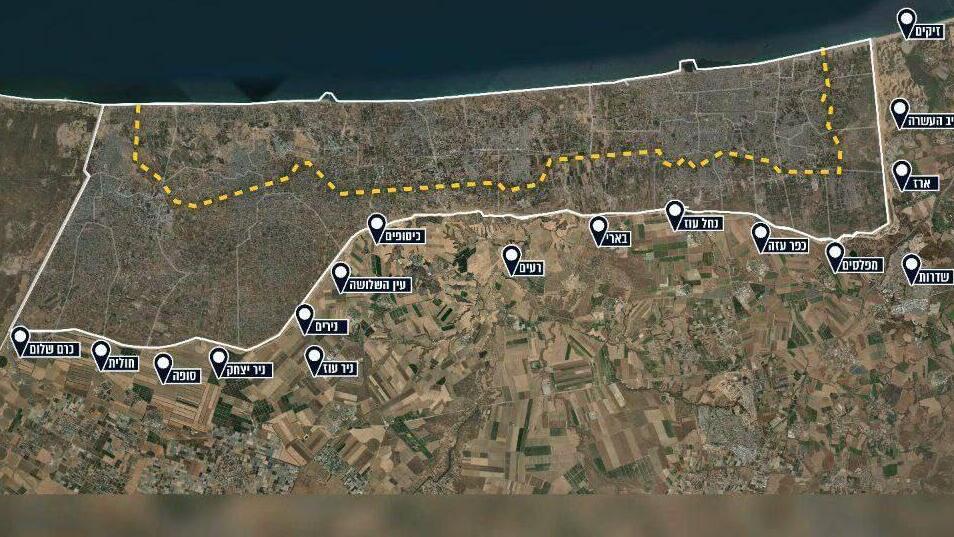
The yellow line in Gaza
(Photo: IDF)
Hamas is now rebuilding its defenses around major underground bases, particularly in Gaza City and western Khan Yunis. The IDF, anticipating future clashes, is fortifying its posts along the yellow line with higher earth berms, barbed wire, and surveillance systems. Engineers believe several terror tunnels near those posts remain undiscovered, and reports of daily movement and attempted ambushes persist. For now, the “yellow line” looks less like a stable frontier — and more like a gray one.
A fragile calm under Trump’s watch
For now, defense officials assess that each day the ceasefire holds, the chance of a full-scale war renewal decreases. Still, the Southern Command, military intelligence, and Shin Bet have refreshed their “target bank” — hundreds of new sites across Gaza that remain unstruck since the halt of Operation Gideon Chariots II.
If negotiations over a broader deal stall, the IDF is preparing for limited airstrikes on those targets, escalating in proportion to the severity of future incidents like the one in Rafah.
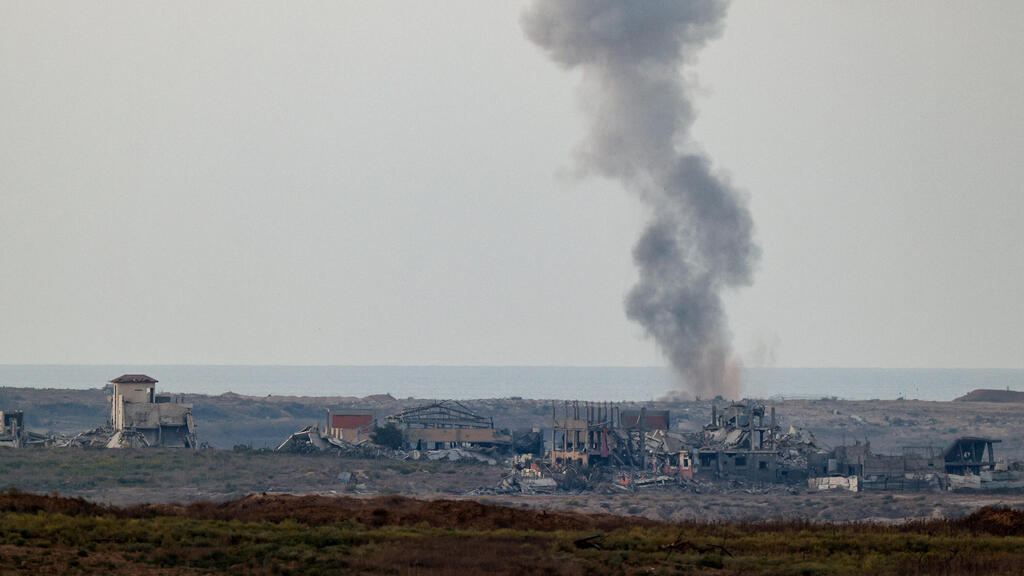
The Gaza Strip
(Photo: Reuters/Amir Cohen)
Should a major violation occur — not just a skirmish with isolated terrorists — the army is also preparing for short, limited ground operations beyond the yellow line to signal a stronger deterrent message to Hamas. Such brigade- or division-level raids could last several days, similar to past limited operations like “Summer Rains” in 2006, when Hamas was far weaker and lacked today’s vast tunnel network.
However, any such response will require approval — or at least tacit consent — from U.S. President Donald Trump, who has been directly involved in overseeing the ceasefire and Israel’s commitments to mediators in Qatar, Turkey, and Egypt.
Hamas, meanwhile, is using its most effective defense: civilians. Within a week of the ceasefire, roughly 250,000 Palestinians had returned to Gaza City, with Israel’s consent, adding to the 200,000 who never left. The movement complicates Israel’s ability to act militarily in densely populated areas, giving Hamas additional protection for its surviving underground strongholds.