


Large signs reading “A year has passed and Haimanot has not returned” still hang near the absorption center on Tsahal Street in Safed. On Wednesday, her family will mark two years since she vanished, walking past the signs each day as they cling to hope. They say her smiling eyes seem to urge them not to give up.
“It’s two years of suffering that cannot be described,” her mother, Benchi, said at the entrance to the absorption center. “Any human being can understand the pain of a parent who does not know where his daughter is.”
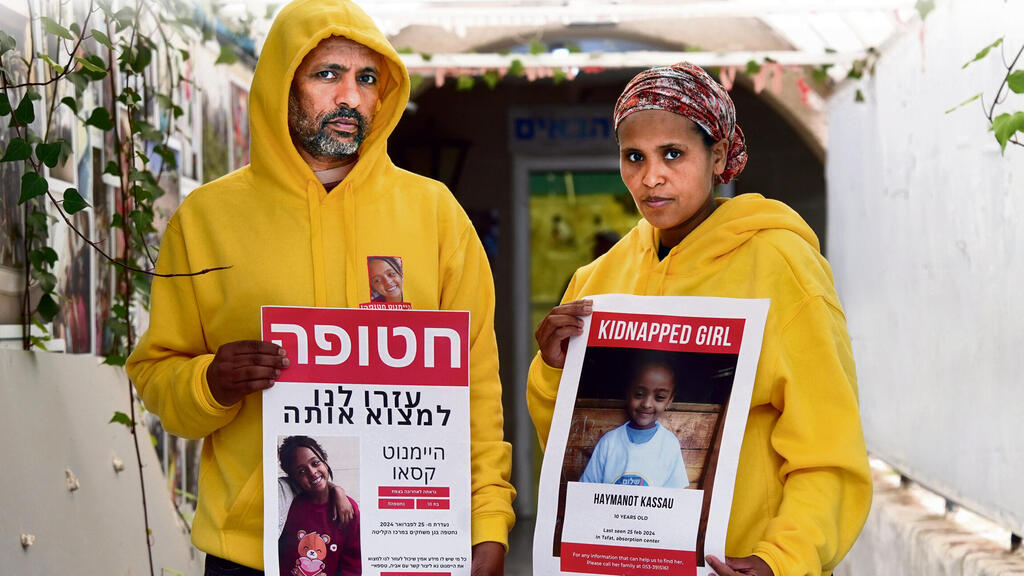
The center once housed 700 immigrants from Ethiopia, its hallways filled with the scent of traditional spices and the sounds of children. Most residents have since moved to permanent housing, and the building has become a kind of ghost town after the Jewish Agency closed it, saying most Ethiopian Jews had completed their immigration process.
Inside the quiet complex of shuttered buildings and abandoned apartments sit Tesfaye and Benchi Kassau with their children. They are waiting for Haimanot, who is supposed to celebrate her bat mitzvah in about two months. On Feb. 25, 2024, she left their apartment to distribute election flyers with friends and disappeared as if she had never existed. Her family hopes she will suddenly reappear one day, searching for them. They say they will be there to welcome her.
‘We do not lose hope’
At noon Wednesday, exactly two years later, members of the Kassau family will march from Jerusalem’s Chords Bridge to the Ministry of Aliyah and Integration. They say they want to cry out on behalf of a family that feels the state has given up on their daughter.
“We have no new information,” Tesfaye said in a dry voice, as his 20-year-old daughter Yaros translated from Amharic. Yaros has moved to Jerusalem to try to build a life, but her heart remains in the corridors of the Safed absorption center. Her parents say she “grew up very quickly.”
The parents are demanding that the Shin Bet security service take over the case. “Two years have passed and nothing has changed, except that the investigation was transferred from one unit to another,” they said.
The scope of the search has been unprecedented. Thousands of police officers, soldiers, rescue personnel and volunteers combed caves, pits and abandoned apartments within miles of the site. Police deployed special units, canine teams, drones and helicopters, saying there is no professional tool in Israel or abroad that was not used in the effort to find Haimanot.
Mystics and fortune-tellers also tried to help, seeking a 350,000 shekel reward offered for decisive information. The investigation, which began with the northern district major crimes unit, was recently transferred to the Lahav 433 national crime unit under the direction of Police Commissioner Danny Levy, in what officials described as an effort to bring “fresh eyes.” So far, it remains at a complete standstill.
“We do not let thoughts of losing hope enter our minds,” Tesfaye Kassau said. “We will keep fighting until we bring her back. We believe in God and we do not give up.”
Footage from the alleged attempted abduction in Beersheba
(Video: Used in accordance with Section 27A of the Copyright Law)


In early January, the family met for the first time with Prime Minister Benjamin Netanyahu at his office in Jerusalem. According to a statement from his office, Netanyahu promised the state would “turn over every stone” and said he would address the matter personally. Tesfaye said he asked that the Shin Bet use its technological capabilities and assume responsibility for the investigation.
“We understood he could not answer that day and we did not expect an immediate response,” Tesfaye said. “But nearly two months have passed and we have received no answer. No one has contacted us.”
Missing or abducted?
Last December, there appeared to be a possible lead. A 63-year-old former Safed resident was arrested in Beersheba after he was recorded attempting to abduct an 11-year-old girl who turned out to be the sister of one of Haimanot’s friends. Police examined whether the man, who was acquainted with the Kassau family, was connected to Haimanot’s disappearance, but found no evidence.
“In terms of results, we have failed,” a senior police officer acknowledged recently in a Knesset discussion. In a case file thousands of pages long, investigators still do not have a single lead explaining how a girl entered a building covered by cameras and documentation — and never came out.
Haimanot’s family believes that if she were officially recognized as an abductee, the handling of her case would be different. Security officials say there is no distinction in resources or tools used, whether she is defined as abducted or missing, and that there is no evidence she was kidnapped.
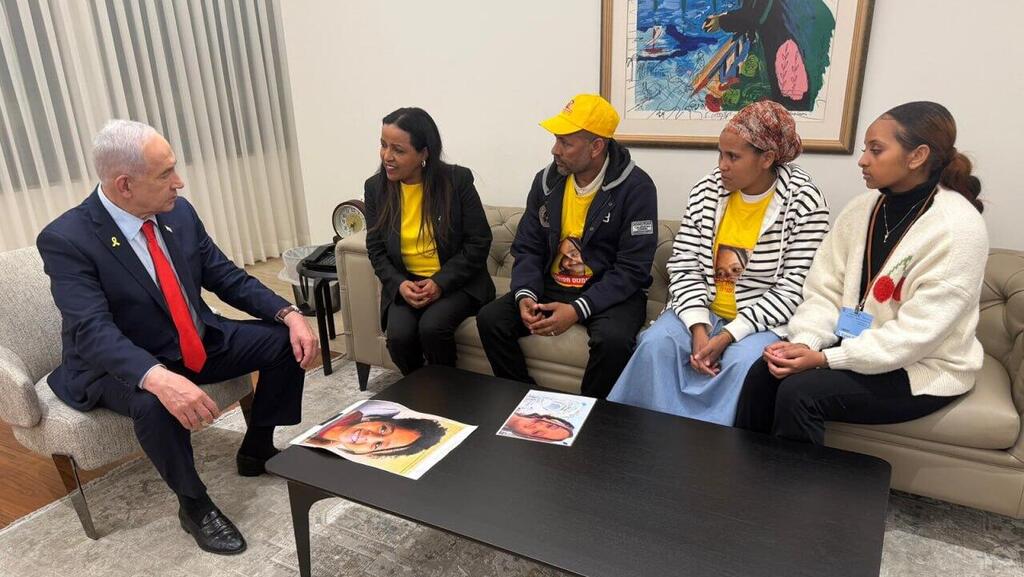
Haimanot’s family with Netanyahu
(Photo: Prime Minister’s Office)
Under Israeli law, the Shin Bet’s authority is limited to preventing security threats and harm to the state. The disappearance of a child, however tragic, is considered a criminal-civilian matter, and the agency is legally barred from intervening. Tesfaye rejects that explanation. He says he sees a country capable of reaching anywhere in the world and carrying out precise strikes deep inside Iran, yet unable to find a girl who vanished in the heart of a Galilee city.
In October, the Kassau family watched live broadcasts of Israeli hostages returning from Hamas tunnels in Gaza. They were moved to tears, thinking of their own “captive.”
“It was joyful and emotional to see them return,” Benchi said. “But it is not the same. They were taken to an enemy state and Haimanot is here, inside the country. I believe she will return too and we will rejoice like those families. I ask people to keep praying and to light a Shabbat candle for Haimanot. Do not forget her.”
‘She entered the building and never came out’
A few meters from the absorption center, Tomer Pado runs a small warehouse selling traditional Ethiopian food products. He sees Tesfaye every morning.
“We feel despair,” Pado said. “That girl walks into that building and does not come out,” he said, pointing to the peeling complex. “It took time for police to understand she was abducted. It took time to send helicopters. This father came here out of Zionism, and in the end he loses his daughter here. We feel that if she were a child of a different color, she would have been found already.”
Pado said his 8-year-old daughter drew a picture at school this week. A national service volunteer noticed the figure’s unusually large eyes and asked why. The girl replied simply, “I drew big eyes so maybe she can find Haimanot.” The volunteer burst into tears.
In recent months, the family, together with volunteers from Israel’s Ethiopian community, has been working to establish a nonprofit organization to focus on search efforts and mobilize public support.
“I feel that for two years we have done everything we can and made no progress,” Tesfaye said. “It is painful for us to give interviews and go out in public. We need the people of Israel with us, to share on social media and remind everyone that Haimanot has disappeared.”