

Israeli lawmaker Zvi Sukkot, who was filmed smashing a monument in a Palestinian village while accompanied by an IDF force that the military said was unaware of his intentions, said Wednesday that Foreign Minister Gideon Sa’ar and the IDF spokesman were responsible for the international fallout, not his actions.
Sukkot, a member of the far-right Religious Zionism party, insisted that the incident had caused Israel no damage. “I haven’t found a single public figure anywhere in the world who condemned this,” he said.
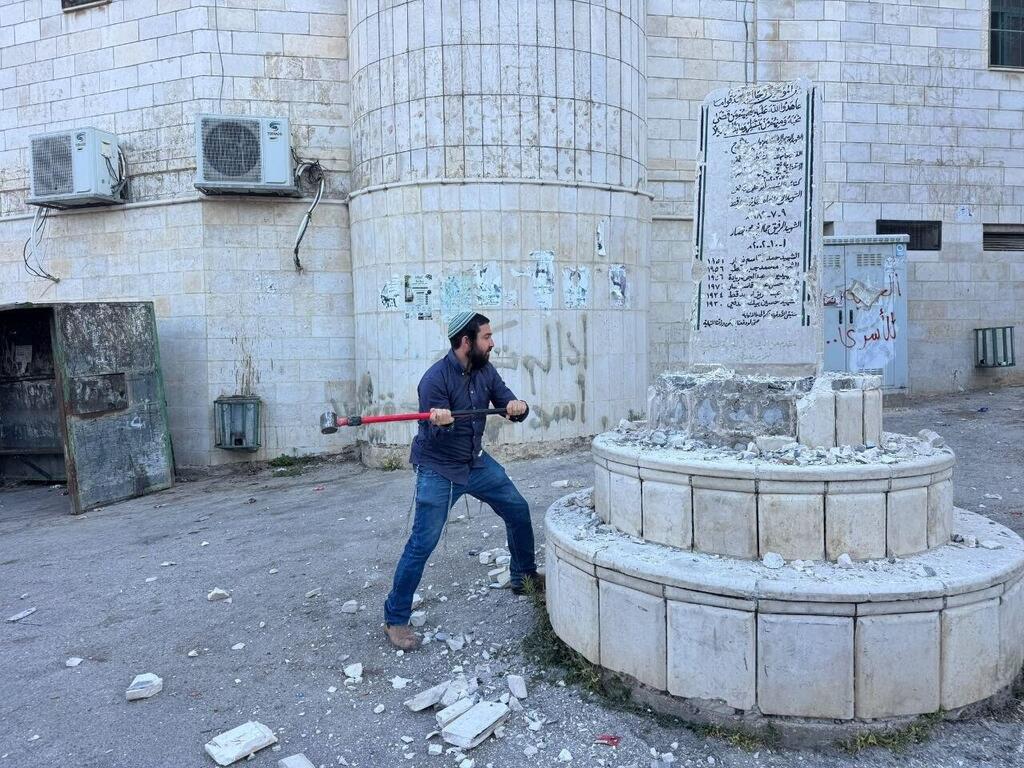
Footage of Sukkot did, however, make international headlines and was carried by major global media outlets.
Asked in an interview with the Israeli radio station Kol Barama about coverage in Germany’s Der Spiegel, Sukkot said: “It says there that the foreign minister condemned it.”
Asked whether he regretted what he had done, he replied: “Regret? What is there for me to regret? It is a monument to people who murdered Jews. Every minute it stands there is incitement to terrorism.”
The footage was also posted on CNN’s TikTok account, where it had been viewed more than 700,000 times at the time of publication.
French newspaper Le Monde also covered the incident, reporting that Sukkot had tried to destroy a monument to Palestinian “martyrs” in the village of Madama, near Nablus, in the West Bank, saying that those commemorated were “terrorists.” The report noted that the act was condemned by both the military and political officials. The head of Madama village said the monument commemorated those killed during the intifada.
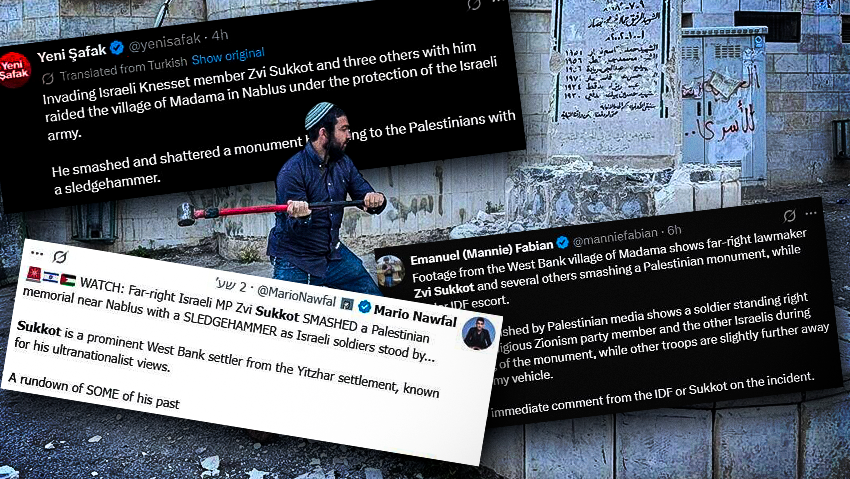
Footage of Sukkot gains traction on social media
(Photo: X)
The footage began spreading widely on Tuesday, drawing hundreds of thousands of views on X alone and significantly more across other social media platforms.
Israeli Foreign Ministry officials said the incident, together with settler violence in the West Bank, was damaging Israel diplomatically by putting the issue back on the international agenda. “This is a nail in the coffin of Israeli legitimacy in the West Bank,” the Foreign Ministry said.
Officials warned that the ministry had so far managed to contain calls for sanctions targeting settlements, but said the actions of National Security Minister Itamar Ben-Gvir and Sukkot could increase pressure on Israel to act against violent elements.
They also pointed to recent comments by U.S. Ambassador to Israel Mike Huckabee, who used the phrase “remove the Israeli terrorists,” as a sign that Washington was paying closer attention to developments in the West Bank. The IDF also sought a sharper official response to Sukkot’s actions.
A security official warned that “the West Bank is sitting on smoldering coals and could erupt at any moment.” Officials said the potential “match” that could ignite the area was not limited to nationalist violence and could emerge from several different sources.
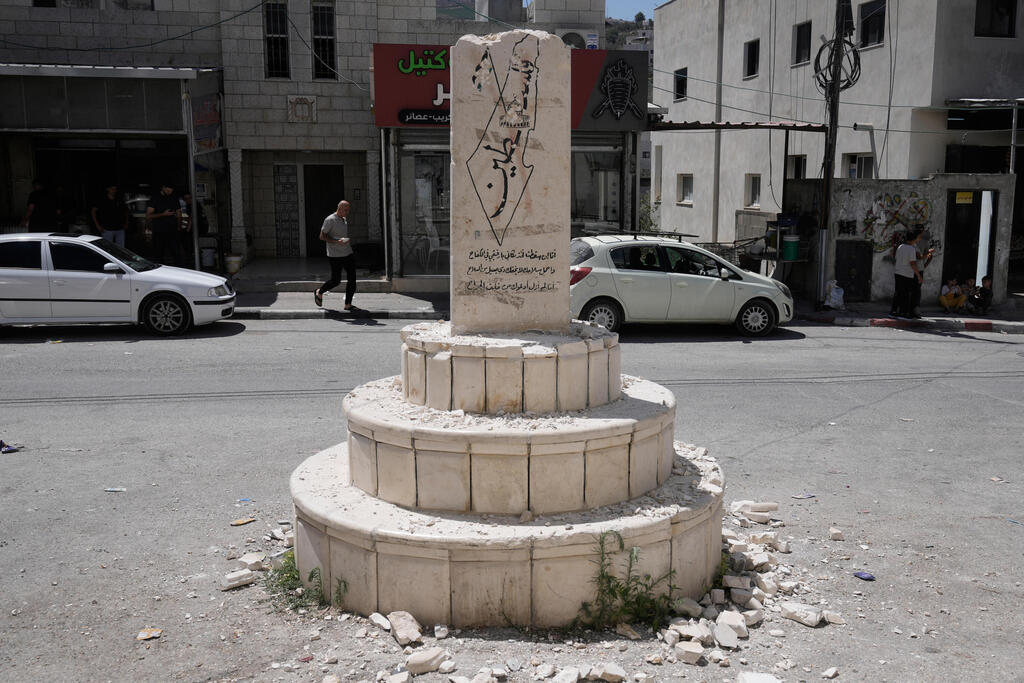
The monument in the village of Madama
(Photo: AP Photo/Majdi Mohammed)
Recent events in the West Bank have also sharpened concerns over governance in the territory. While the government remains heavily involved in developments there, critics say senior officials have largely avoided speaking out against nationalist violence that is destabilizing the situation.
The IDF said that demolishing monuments of this kind is something it carries out from time to time, and that the monument Sukkot attacked had itself been slated for removal. But the army said the task was not a priority because forces were focused on operational missions including arresting terrorists, seizing weapons and securing numerous Israeli outposts and communities.
The IDF currently has 24 battalions deployed in the West Bank, some of them also assigned to protect settlers at various locations.
International reports on the incident emphasized that Sukkot acted while accompanied by IDF troops and described him as a far-right lawmaker. Sukkot said he had previously demanded that the military remove such monuments but that they had remained standing.
The IDF strongly rejected his account, saying those involved had acted “deceptively and manipulatively, without authority and in complete violation of the approved framework.” “Troops in the sector were diverted for the mission and unnecessarily placed at risk,” the military said.
Sukkot had asked about a month earlier to tour these and other Palestinian villages in coordination with the Knesset security officer and the IDF. The visit was scheduled for Tuesday morning and approved several days in advance.
When he arrived, he saw the monument and began smashing it with a hammer. The IDF said it had no prior knowledge of his intention and had not authorized him to damage the site. Sukkot also faced criticism from members of both the opposition and coalition. Even inside his own Religious Zionism party, there was unease, though not necessarily over the act itself.
“Is this move coordinated with the campaign? Is there some deep strategy here that I’m completely missing, or have we simply decided to commit political suicide? I’m genuinely asking,” lawmaker Ohad Tal wrote in an internal party group.
Religious Zionism leader Bezalel Smotrich, by contrast, did not distance himself from Sukkot’s actions and appeared to defend the underlying goal. “The State of Israel should have dismantled long ago the terror monument glorifying the despicable terrorist responsible for the murder of four Jews and the wounding of 20 innocent Israelis,” Smotrich wrote.
“There are dozens more terror monuments like it across the West Bank that should be demolished today by the IDF, and by the IDF alone.” Smotrich said what troubled him instead was what he called the opposition bloc’s rush to condemn Sukkot.