


With the World Cup nearing its end and tensions across the Gulf and wider Middle East at their highest level in months, the IDF is preparing for the possibility that the country could be drawn into the fighting between the United States and Iran, including scenarios involving renewed escalation along the northern border with Lebanon.
While much of the world is trying to return to normal, Israel’s defense establishment remains on heightened alert behind the scenes. The intensifying confrontation between Washington and Tehran, repeated exchanges of fire and Iranian attacks on Gulf countries and Jordan have placed the IDF — particularly the air force and Military Intelligence Directorate — at their highest level of readiness.
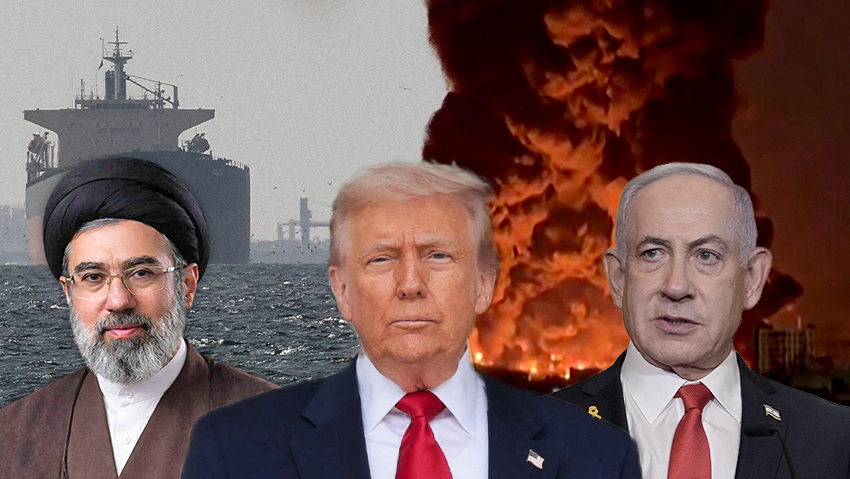
Iranian Supreme Leader Mojtaba Khamenei, US President Donald Trump, Prime Minister Benjamin Netanyahu
(Photo: AFP/SOURCE: UGC / UNKNOWN, REUTERS/Jessica Koscielniak/Stringer, Oliver CONTRERAS/AFP)
The central question now occupying the military’s General Staff is not whether a broader campaign could erupt, but when it might happen and how Israel would enter it.
Preparations cover both offensive operations and air defense, based on the assumption that any Israeli involvement would trigger extensive missile fire at population centers and critical infrastructure across the country.
Security officials said the end of the global soccer tournament could remove one of the few remaining factors discouraging regional actors from escalating, increasing the likelihood of a wider conflict.
For the IDF, the high operational tempo is not new. The elevated readiness has continued since the end of Operation Roaring Lion earlier this year. But unlike last year's 12-day war with Iran, codenamed Operation Rising Lion, the current confrontation is being led clearly by the administration in Washington.
That means the United States is expected to set the pace, timing and terms of any Israeli entry into combat.
Recent fighting has shown that a confrontation with Iran could last anywhere from a single day to 40 days, Israeli officials said. But the strategic dilemma in Jerusalem remains unchanged: when to act, how to act and how far to go.
Any such move, officials stressed, would have to be fully coordinated with the White House.
One of the main concerns within the security establishment is miscalculation.
Officials are considering a scenario in which Iran detects unusual activity at Israeli Air Force bases and intelligence facilities, mistakenly interprets the preparations as signs of an imminent Israeli strike and launches a preemptive attack of its own.
“The continuation of the exchanges between Washington and Tehran, and the fact that the Iranians are operating without restraint in the Gulf, increase the likelihood that Israel will be forced to enter the operational arena very soon,” a senior security official said Sunday.
Alongside the risks, Israeli officials also see a strategic opportunity.
Security officials believe Israel has a clear interest in “finishing the job” by inflicting severe damage on Iran’s nuclear program. But they acknowledge that such an operation would carry immediate costs on other fronts and for Israel’s civilian population.
The military assumes that any escalation with Iran would have a direct and immediate effect on southern Lebanon.
On the northern front, a proposed pilot arrangement is moving slowly, if at all. The IDF has made clear it has no intention of withdrawing from positions it currently holds until a monitoring and enforcement mechanism is established that meets Israel’s security requirements.
Further inside southern Lebanon, particularly around the strategic Ali Taher ridge, Israeli officials say significant terrorist infrastructure remains intact. They also say armed terrorists are effectively confined within that sector, creating what they describe as a potential “ticking time bomb.”
Should a major confrontation with Iran begin, intelligence and operational attention from the Military Intelligence Directorate and the air force would inevitably shift from Lebanon toward the more distant eastern theater.
That could create gaps in Israel’s ability to carry out major operations along the northern border.
Israeli officials ultimately say the key decision rests in Washington.
Israel’s entry into the conflict depends almost entirely on U.S. strategic interests and timing, they said. Once Washington determines the conditions are right, the order could be given.
Until then, Israel is expected to remain in a prolonged state of heightened alert, with the military closely monitoring every piece of intelligence emerging from Iran, the Gulf and the northern front.