

Israel’s population growth has slowed to its lowest rate since the country’s founding in 1948, raising concerns among experts and prompting calls for national introspection.
According to a report released Wednesday by the Taub Center for Social Policy Studies in Israel, the country’s population grew by just 0.9% in 2023—marking the first time in decades that the growth rate has fallen below 1%. Since 1950, the annual growth rate had consistently remained at or above 1.5%, with only two minor exceptions.

The slowdown is attributed to a combination of factors: a rise in the number of deaths, a sustained decline in fertility rates, and a growing number of Israelis emigrating, which has outpaced new immigration.
In an interview with ynet, Hebrew University demographer Prof. Sergio DellaPergola described the data as a wake-up call. “Unfortunately, many people are asking whether this is the Israel they dreamed of, whether this is the place for them and their families to begin a new life,” he said. “We need deep self-reflection on the processes taking place here.”
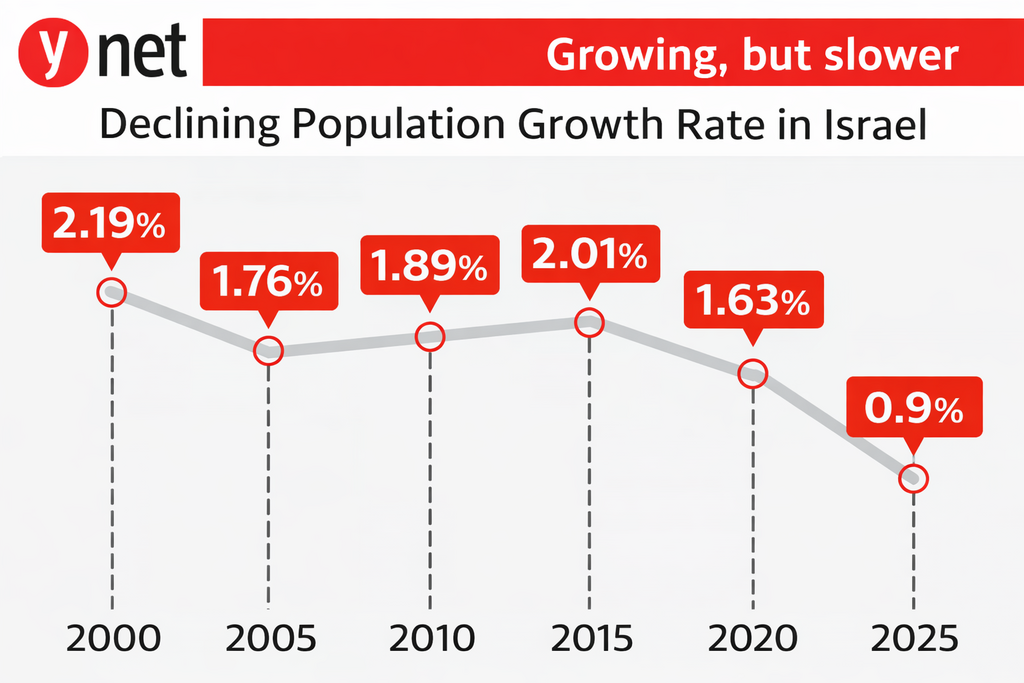
Prof. DellaPergola noted that while the current growth rate might not seem alarming by international standards—many countries see zero or negative growth—it is unusually low for Israel. He pointed in particular to the country’s negative migration balance. “We must ask what we expect for Israel’s future,” he said. “The net migration figure now stands at about 30,000 people leaving the country.”
Some argue that emigration can bring eventual benefits, such as citizens gaining education abroad before returning. Prof. DellaPergola acknowledged this, noting that “over the last 100 years, this has happened only four times. Usually, it signals a crisis.” He linked the current wave of departures to two main factors: the ongoing war, which has not yet reached a formal conclusion, and economic uncertainty. “While Israel’s economic indicators are not particularly poor, uncertainty is high,” he said.
Prof. DellaPergola also highlighted a sharp drop in aliyah, especially from Russia and Ukraine. Immigration from Western countries has slightly increased, but remains marginal. “The economic factor now plays a much stronger role in decisions by Jews abroad and their families about whether to move here,” he said. “Coming to Israel today feels like something of an adventure.”