


Prime Minister Benjamin Netanyahu on Wednesday publicly thanked U.S. President Donald Trump for his support amid his ongoing corruption trial, after Trump urged President Isaac Herzog to grant Netanyahu a pardon.
"Thank you, President Trump, for your incredible support," Netanyahu wrote in English on X, formerly Twitter. As usual, you get right to the point and call it like it is. I look forward to continuing our partnership to bolster security and expand peace."
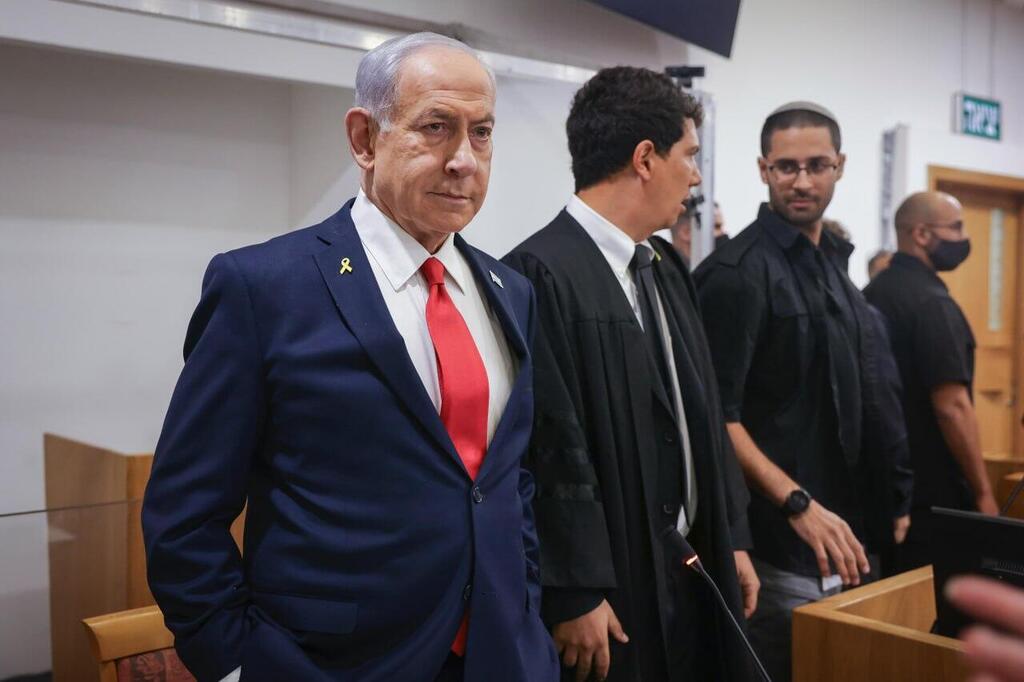
Though Netanyahu has repeatedly claimed he is eager to prove his innocence in court — saying he has “waited eight years for the opportunity” — he has not distanced himself from growing calls among his allies to cancel the trial, nor from Trump’s intervention.
Speaking during his testimony at the Tel Aviv District Court on Wednesday, Netanyahu referred indirectly to Trump’s request for a pardon, saying, “World leaders are astonished, and I’m not exaggerating.” In recent hearings, the prime minister has raised his voice at prosecutors and dismissed the case as “absurd,” appearing to echo Trump’s own framing of the charges as a politically motivated witch hunt.
The trial — often delayed — resumed this week with Netanyahu again criticizing the legal process, particularly questions about luxury gifts he allegedly received from billionaire associates. According to the indictment, Netanyahu and his wife Sara accepted cigars, champagne and other goods worth 690,000 shekels (about $215,000).
Despite his courtroom statements about wanting to “debunk the baseless accusations,” Netanyahu has made multiple attempts to postpone or cancel hearings, citing diplomatic obligations. This week, the court accepted a defense request to cancel a scheduled session, citing Netanyahu’s "urgent diplomatic meetings" and a required Knesset appearance. The prosecution did not object.
Last month, the court reinforced its intention to accelerate the slow-moving trial, increasing hearings to four times a week. Judges noted the case has been ongoing for more than five years, and warned again that the pace of the defense phase remains too slow.
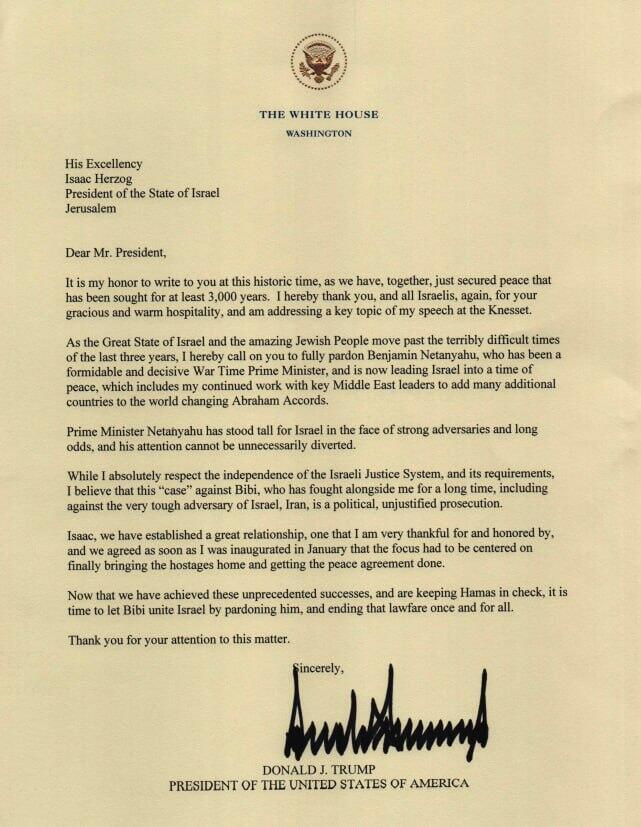
A letter penned by US President Donald Trump urging his Israeli counterpart, Isaac Herzog, to grant Prime Minister Benjamin Netanyahu a pardon in his ongoing graft trial
(Photo: The Office of the President of Israel)
In prior appearances, Netanyahu has argued that his workload is overwhelming, outlining a 20-hour day in which he works until 4 a.m. “I hold the hardest job in the world,” he told the court, “but I make more than the usual effort.” Nonetheless, hearings have continued to be postponed, even as judges stress the need to advance the proceedings.
Netanyahu is standing trial in three cases involving charges of bribery, fraud and breach of trust. He denies all wrongdoing.
After the last election, Netanyahu told the High Court of Justice he would have no problem continuing to serve while standing trial on corruption charges. The court ultimately ruled there was no legal obstacle to his dual role. But since then, with hearings frequently postponed, the court has had to summon additional witnesses in parallel to maintain momentum in the lengthy proceedings.
At the same time, figures close to Netanyahu have been working to halt the trial and clear him of charges. After Netanyahu began testifying in December, President Herzog was asked whether he would consider granting a pardon. Herzog responded cautiously, saying it would be inappropriate to discuss the matter publicly while the trial was ongoing. Still, he noted that he would weigh any formal request according to his "conscience and basic principles,” adding that such a move was "not currently on the table."
Roughly six months later, Trump began calling for the trial to be scrapped or for Netanyahu to be pardoned. In a post on Truth Social in June, Trump called the case “politically motivated” and mocked it for being about “cigars, a Bugs Bunny doll, and numerous other unfair charges.” The message, shared after a war with Iran, included a pledge: “It was the United States of America that saved Israel, and now it is going to be the United States of America that saves Bibi Netanyahu,” using Netanyahu's nickname.
US President Donald Trump urges his Israeli counterpart, Isaac Herzog, to grant Prime Minister Benjamin Netanyahu a pardon in his ongoing graft trial during a Knesset address last month
(Video: Knesset Channel)


The campaign reached a peak during Trump’s visit to Israel last month, following the signing of the Gaza ceasefire agreement. In a dramatic moment during a speech in the Knesset, Trump went off-script and turned to Herzog and said, “I have an idea. Mr. President, why don't you give him a pardon?” The surprise remark left Herzog visibly stunned, while Netanyahu smiled from his seat. Lawmakers from both coalition and opposition benches rose to applaud.
Speaking to reporters afterward aboard Air Force One, Trump claimed the remark was spontaneous but hinted it had been considered in advance. “I actually told [Netanyahu] I didn't want to bring up the pardon,” Trump said. “But it was just the perfect spot. It was good timing, wouldn't use say it?” He added that he was swayed by the applause Netanyahu received in the chamber: “If he didn't get a good hand, they wouldn't have done that."
Trump admitted the comment was “a little risqué,” acknowledging that the issue was a “pretty sore subject in Israel,” but reiterated his stance: “Cigars and champagne—who even cares? He’s one of the best leaders during a time of war.” In a subsequent interview on CBS’s 60 Minutes, Trump again criticized the trial as unfair, adding: “We’ll step in to help him.”
Days after Trump’s visit, political efforts to end the trial intensified. When the Tel Aviv District Court resumed hearings following a recess, several Likud ministers and Knesset members showed up to the courtroom in what appeared to be a coordinated display of support, calling for an end to what they called “this absurd trial.” Justice Minister Yariv Levin, though absent from the hearing, issued a statement claiming the trial “should never have begun,” and voiced support for a bill by Likud MK Ariel Kallner that would empower the defense minister to halt or delay a prime minister’s trial “for national security reasons.”
That same day, Ynet learned that Environmental Protection Minister Idit Silman had drafted a letter—reportedly inspired by Trump’s Knesset speech—urging President Herzog to stop the trial. The letter, circulated among Likud ministers for signatures, called on Herzog to “exercise his authority” to suspend the proceedings.
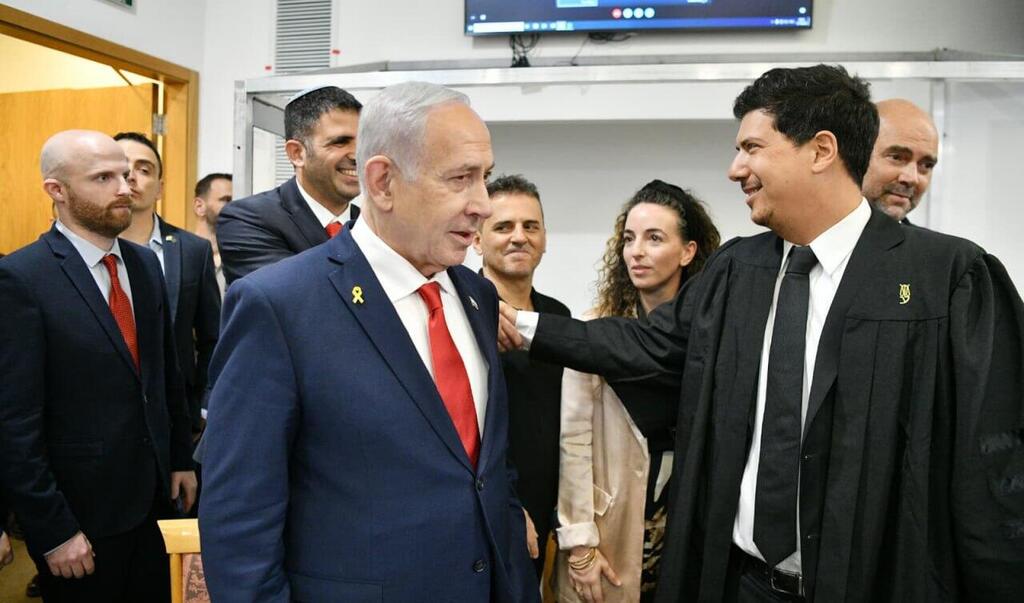
Netanyahu in court
(Photo: Reuven Castro)
A week later, public broadcaster Kan reported that Sara Netanyahu had personally lobbied Likud ministers to sign the letter. “This is the right moment—President Trump asked too. It’s important to us,” she was quoted as saying. “These cases are made up anyway—let’s end this.” The report said Netanyahu’s aides were involved in crafting the letter, and party officials confirmed that his advisers encouraged ministers to publicly back calls for cancelling the trial.
At the end of last month, the Ministerial Committee for Legislation considered two controversial bills—one of them proposing to allow the Knesset’s House Committee to suspend a trial against a prime minister or minister if deemed necessary. That bill, introduced by Otzma Yehudit MK Limor Son Har-Melech, would pause court proceedings immediately upon such a decision. Attorney General Gali Baharav-Miara strongly condemned the proposal, calling it “a personal bill aimed at shielding the prime minister from justice” and warning it represented “a threat to democratic norms.”
Still, the committee chose to advance a separate bill on the agenda that could hinder former prime minister Naftali Bennett from launching a new political campaign. As for the trial delay legislation, it was pulled from the agenda at Netanyahu’s request, conveyed through Cabinet Secretary Yossi Fuchs, with Netanyahu saying he did not wish the proposal to apply to himself.
Outside the political arena, prominent voices have also urged an end to Netanyahu’s trial. Former Supreme Court Chief Justice Aharon Barak, a frequent defender of compromise, said this week that “time is running out” to reach a resolution.
At a legal conference marking 30 years since a landmark ruling that expanded the top court's judicial purview, Barak said: “I may be seen as extreme by the public, but I’m a man of compromise. As of today, a plea deal must still be pursued.”
He added that Netanyahu should be approached directly and urged “to lead by example in healing the nation’s divisions—not just speak about it.” Barak warned that Israel is sliding “down a slippery slope toward illiberal democracy” and suggested that a plea deal may be the only way to prevent further erosion before the next elections.