

U.S. President Donald Trump said Thursday that Iran had contacted Washington and was "desperate" to reach a deal, even as he questioned whether Tehran could be trusted and warned that any attack on American targets would draw a far heavier U.S. response.
“Iran called a little while ago,” Trump told reporters aboard Air Force One. “They want to make a deal so badly.”
Footage of the strikes in Bushehr and Chabahar


“I just don’t know if they are worthy of making a deal,” he added. “I don’t know if they are going to honor a deal, that’s the problem.”
Asked why Iran would attack commercial ships if it wants an agreement, as he claimed, Trump said: “They’re sort of crazy. They’re a little bit out of control, but they want to make a deal — badly.”
Trump also warned Iran against attacking U.S. targets.
“Every time they hit us we’re going to hit them twentyfold,” he said. He added that he did not know whether the sides were heading toward a full resumption of hostilities.
Iran’s Revolutionary Guard Corps claimed overnight Thursday that it had attacked four U.S. military bases in Kuwait and Bahrain, in response to American strikes in Bandar Abbas and Sirik near the Strait of Hormuz, as well as near Bushehr airport in southern Iran.
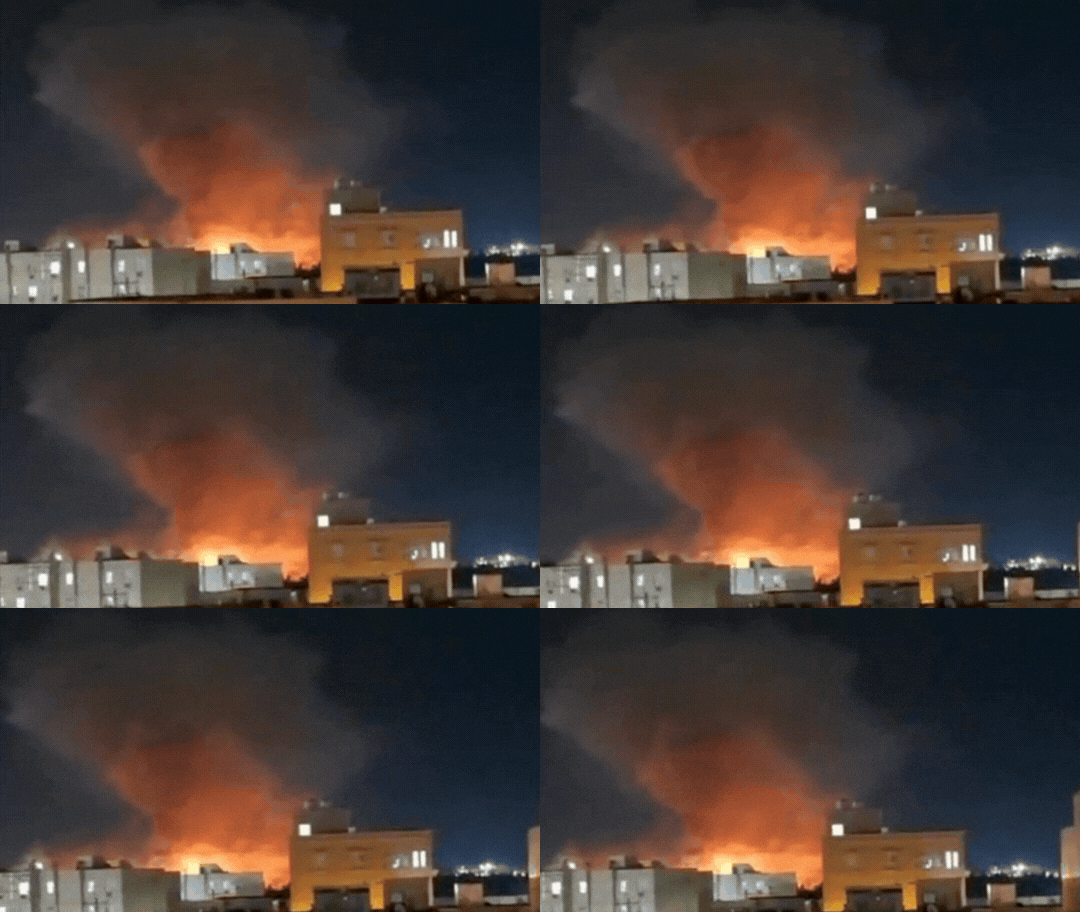
The strikes came after Trump threatened for the second consecutive night that the United States would “hit Iran hard tonight.” Iranian Deputy Foreign Minister Kazem Gharibabadi said earlier that the American actions “will not go unanswered.”
A short time later, the U.S. military confirmed it was carrying out strikes in the Islamic Republic.
“At the direction of the Commander in Chief, U.S. Central Command forces have started conducting additional strikes against Iran to further degrade their ability to threaten freedom of navigation in the Strait of Hormuz,” CENTCOM said. “The United States is holding Iran accountable for recent unjustified aggression against commercial shipping and civilian crews freely navigating a vital international waterway.”
At around 3:35 a.m., sirens sounded in Bahrain and early alerts were issued in Qatar before later being canceled. AP initially reported that the alerts were triggered by additional U.S. strikes in Iran, not an Iranian response, but shortly afterward warnings were also activated in Kuwait. “We are confronting hostile Iranian drones and missiles,” Kuwait’s Defense Ministry said.
Iranian media reported explosions in the Bandar Abbas area, Sirik, Bushehr, Chabahar and Konarak. Iranian state television also reported an attack on a railway bridge in northwestern Iran.

US strikes in Bushehr
Iranian Deputy Foreign Minister Kazem Gharibabadi warned earlier that the American actions “will not go unanswered,” while officials in Tehran fired back after a day of combative statements from Trump, who called Iran’s leadership “scum,” “crazy” and “sick people.”
“We should pity the American people with this foolish president of theirs,” said senior Iranian official Mohammad Mokhber, an adviser to Iran’s supreme leader.
Following the previous night’s exchange of attacks, in which Iran said eight of its soldiers were killed in U.S. strikes, Mokhber declared that “the regime in the Strait of Hormuz will remain Iranian forever.”
“Those who incited and carried out the killing of our loved ones will be severely punished,” he said.
Iranian officials responded throughout the evening not only to Trump’s threats, but also to his tone.
“Addressing the Iranian nation in insulting language does not diminish its greatness,” Foreign Minister Abbas Araghchi wrote on X. “Iranians are known for their courtesy, culture and moral values. We do not answer rudeness with rudeness, but with action: fearlessly and courageously.”
Gharibabadi said Trump’s remarks were “not a sign of strength but an admission of the failure of a policy that for years has relied on force, sanctions and threats.”
“The criminal Trump must be addressed in his own language,” he said. “It appears that he understands the language of power best.”
Trump used similar wording during his evening news conference, saying of the Iranians: “We’re speaking their language.”
US President Donald Trump warned earlier that the United States would 'hit Iran hard tonight' for the second consecutive night
Although Trump said he considered the ceasefire over and warned of strikes on Iran for a second straight night, he later appeared to lower the temperature. Speaking at a news conference after the NATO summit in Ankara, Trump said he “doesn’t think” the war with Iran “is going to start again.”
Still, he warned: “Anything that happens is going to be over very quickly, and we’ll only make it safer, including for oil.”
Pakistan’s Foreign Ministry urged restraint Wednesday evening, warning that “renewed conflict is in no one’s interest.”
“We call on all parties to exercise restraint and avoid any action that could undermine regional peace and stability,” the ministry said. “There is no alternative to continued dialogue, communication and diplomacy to achieve peace in the region. We call on all parties to fulfill their commitments under the Islamabad memorandum of understanding.”
Earlier, an Iranian source claimed that Tehran had adopted a new strategy following the strikes.
“After every attack, Hormuz will be completely closed,” the source told Iran’s Press TV. “We will strike at least twice as many enemy targets as the number of targets hit.”
The source added that Iran would not allow the establishment of new routes outside its arrangements under the Islamabad memorandum of understanding.
Trump: I’m not sure I want to make a deal
“Every threat will receive a strong response,” the source said. “Iran makes no distinction between the United States and its regional partners.”
Trump’s threats, the source said, “will gain him nothing, but he will certainly lose the strait and the talks on the final agreement.”
Meanwhile, Iranian media reported that Araghchi spoke by phone with Qatari Prime Minister and Foreign Minister Mohammed bin Abdulrahman Al Thani. The two discussed regional developments and the latest events in the Strait of Hormuz. According to the report, both sides stressed “the importance of using diplomatic channels to advance regional issues and prevent further escalation.”
The Iranian military said Wednesday evening that eight of its air force and navy personnel were killed in U.S. strikes in Bandar Abbas and Bushehr.
“The army emphasizes that it will resist the enemy until its last breath and announces that it will avenge their blood,” the statement said.
Overnight, the U.S. military struck more than 80 targets across Iran, including air defense systems, radar sites, command-and-control networks and more than 60 vessels belonging to Iran’s Revolutionary Guard Corps. Iran responded with strikes against targets in Bahrain and Kuwait, claiming it had hit “85 American military targets.”
The escalation began after Iran attacked three commercial vessels in the Strait of Hormuz, claiming they had traveled through a route it did not approve. Washington viewed the move as a violation of the memorandum of understanding and responded with extensive strikes, while Tehran continues to insist on recognition of its authority over managing traffic through the strait.