

Amid ongoing budget battles between the Finance and Defense ministries, Israel has missed its final opportunity to order 12 Boeing Apache attack helicopters from the United States for the Israeli Air Force. The planned purchase followed one of the key lessons Israel drew from Hamas' surprise attack on the morning of October 7, 2023, three years ago: the need to improve the Air Force's response time in similar scenarios.
The helicopters were expected to cost approximately $1 billion, but no funding source was found for $288 million of the deal, despite lengthy discussions over the past year between the Defense Ministry, the Finance Ministry and the National Security Council, which operates under the Prime Minister's Office. "The Americans gave us three extensions to resolve the issue, and we still failed to meet the final deadline," a senior defense official told Calcalist.
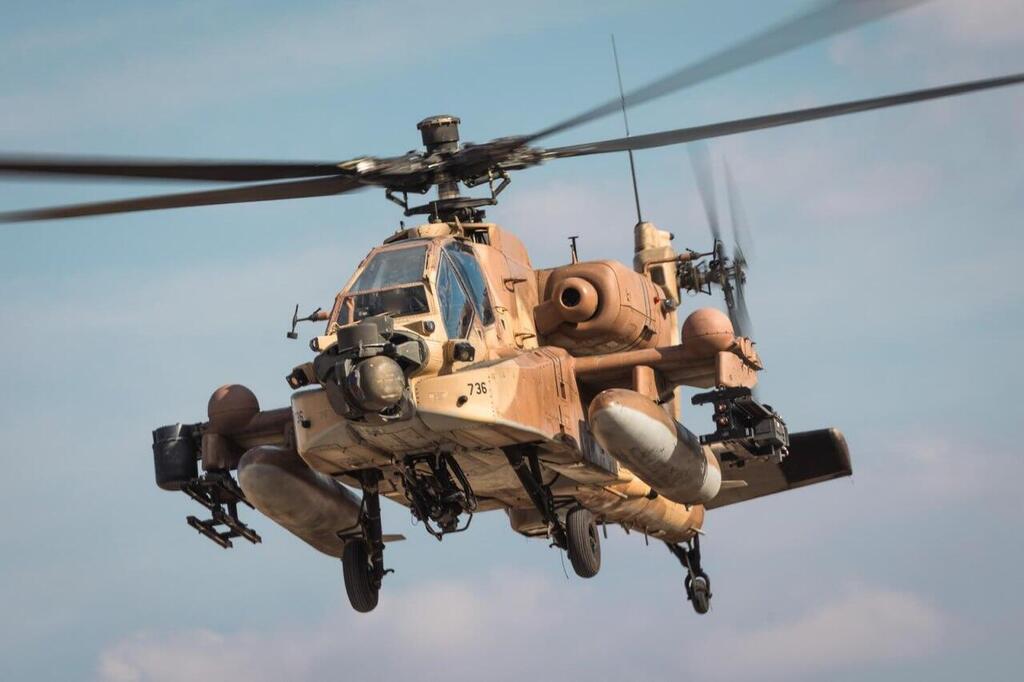
Apache attack helicopter
(Photo: IDF Spokesperson's Unit)
According to the senior official, beyond the failed attack helicopter deal, other urgent Israeli military procurement plans in the U.S. are in serious jeopardy because of the Finance Ministry's failure to make decisions and secure funding. These include an order for two additional Boeing KC-46 aerial refueling aircraft for the Air Force, on top of the six Israel has already ordered, and the purchase of six additional CH-53K transport helicopters from Lockheed Martin-Sikorsky, increasing the order from 12 to 18.
The threat to these deals stemming from the prolonged budget dispute between the Finance and Defense ministries has been apparent for months. One of the defense establishment's main concerns was that Israel would lose production slots, resulting in delays of several years in deliveries to Israel and significant price increases.
"Israel doesn't purchase these aircraft directly from American manufacturers but through government-to-government deals, known as G2G agreements. The U.S. Defense Department was waiting for us to make a decision before placing an order with Boeing for dozens of Apache helicopters, including the 12 intended for us. After receiving three extensions and already holding them up, try explaining to the Americans what the limitations of the budget numerator are. We've found ourselves in a very embarrassing situation," a senior defense official told Calcalist.
Funding for these deals was supposed to come from an additional 350 billion to 400 billion shekels ($107 billion to $123 billion) allocated to the base defense budget under a multiyear framework running from 2027 through 2040. However, the allocations were not approved on the grounds that they exceeded the limits of the budget numerator, a fiscal mechanism that assesses the impact of government decisions on future state budgets and ensures that funding sources are available.
"We tried to save the Apache deal until the very last moment, but the Finance Ministry took the matter to the Justice Ministry and torpedoed it, symbolically and ironically, on the third anniversary of the October 7 massacre. We've found ourselves in an intolerable situation, especially since the Americans will think twice next time before agreeing to our requests to extend order deadlines," a defense official told Calcalist.
Finance Ministry officials, however, disputed that account.
"The Ministerial Committee on Defense Procurement approved the purchase deal based on the framework proposed by the defense establishment, and the Finance Ministry prepared to fund it accordingly. Shortly afterward, the defense establishment changed the framework, contrary to its commitments and the approval it had received from the ministerial committee," the officials said.
The Finance Ministry also argued that "deviating from the agreed framework violates the budgetary limits established by law, which is not permissible."
The Defense and Finance ministries have been locked in a prolonged and unprecedented dispute over funding for the defense budget. Because of these disagreements, the Defense Ministry has been unable to secure funding for orders worth more than 17 billion ($5.2 billion) shekels that it placed with major Israeli defense contractors Rafael, Elbit Systems and Israel Aerospace Industries.
The IDF and Defense Ministry maintain that an additional budget allocation of approximately 40 billion shekels ($12.3 billion) will be needed by the end of 2026, bringing the total defense budget to 183 billion shekels ($56.3 billion).