

Dimer Health, a clinician-led, AI-native transitional care medicine company focused on the high-risk period after hospital discharge, said it has raised $13.5 million in Series A financing led by Israeli venture builder Team8 and Bill Ackman’s Table Management.
The round also included participation from existing investors Silver Circle and Israeli investor TechAviv, and brings the company’s total funding to nearly $20 million. Dimer said the new capital will support a national expansion of its post-discharge clinical service line, which now operates across eight U.S. states.
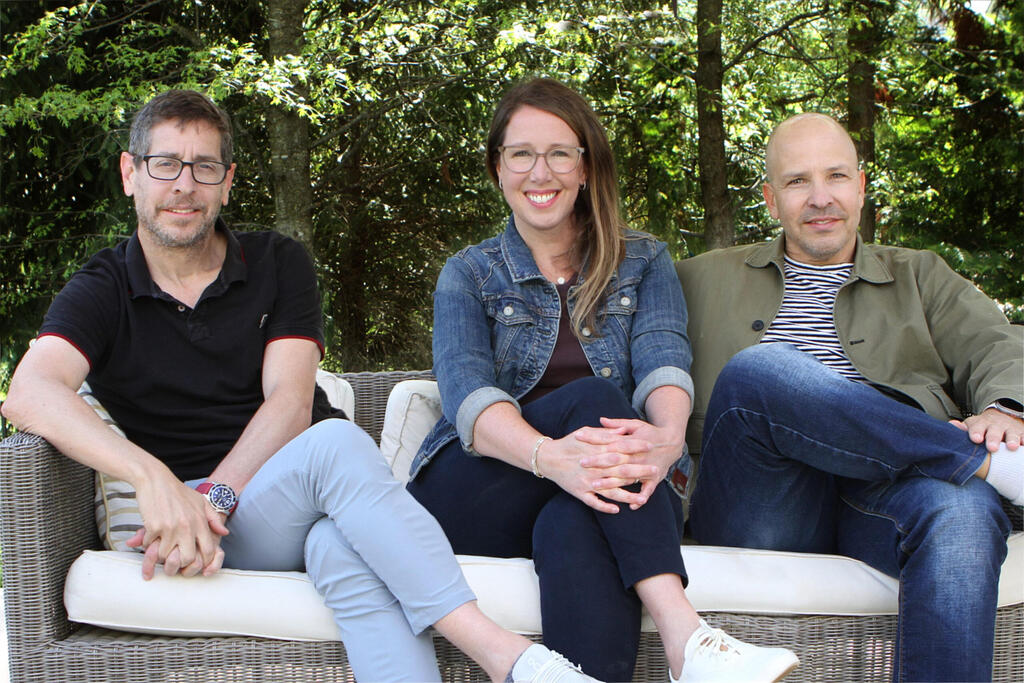
Dimer co-founders Gidon Coussin, Caroline Hodge and Sarig Reichert
(Photo: Jai Catalano)
The company was founded in 2023 by CEO Caroline Hodge together with Israeli entrepreneurs Gidon Coussin and Sarig Reichert.
Hodge spent 18 years in emergency medicine and has also experienced the vulnerabilities of post-discharge care firsthand as a stage 3 cancer patient, the company said. Coussin, Dimer’s chief strategy officer, is a serial entrepreneur and co-founder of Boxee, which was acquired by Samsung. After that acquisition, he moved into health care, gaining clinical experience as an EMT, paramedic and emergency department provider, and later earned a doctorate in medical science focused on the use of artificial intelligence in post-discharge care. Reichert, the company’s head of product and engineering, is also a serial entrepreneur and former Wix executive, where he built and led two product divisions that grew to hundreds of millions of dollars in revenue.
Dimer said it is building clinical infrastructure aimed at one of the most costly and often overlooked gaps in the U.S. health care system: the weeks immediately after a patient leaves the hospital.
While hospital care has modernized, the company said, the 30-day period after discharge has not. Nearly half of hospital readmissions occur within the first 14 days after discharge, which Dimer described as the most clinically vulnerable stage of recovery. Patients often wait weeks for follow-up care, leaving what the company called a critical gap in oversight during the period when they are most at risk.
Those breakdowns in care transitions contribute to an estimated $52 billion to $62 billion in annual readmission costs across the U.S. health care system, according to the company.
Dimer said it was founded to address that gap with a clinical model built specifically for the post-discharge window. Its platform combines what it calls an AI-powered front door with a physician-led transitional care practice designed for patients recovering at home.
The company’s proprietary clinical AI system, AiME, was developed by clinicians and is based on physician-validated protocols, Dimer said. The platform engages patients in real time and interprets symptoms in the context of a patient’s medical history, medications and coexisting conditions. The system is designed to detect emerging risk signals continuously and escalate patients to a dedicated clinician, or “Transitionist,” when medical intervention is needed.
Dimer said each Transitionist, a licensed clinician, oversees a patient’s episode of care from discharge through recovery, providing structured and accountable support that extends beyond traditional telehealth.
The company said it now operates across eight states and has early adoption partners spanning 28 facilities as well as a leading regional payor. Working with health systems and payors, Dimer said its platform has delivered up to a 67% reduction in unnecessary readmissions, maintained a Net Promoter Score above 90 and posted 30% quarter-over-quarter revenue growth for four straight quarters.
The Series A funding will be used to expand Dimer’s Transitionist model, further develop AiME’s predictive and workflow automation capabilities, deepen partnerships with health systems and payors, and launch new tools aimed at modernizing legacy discharge processes around more connected, patient-centered care.
“We’ve spent decades building systems for moments inside the hospital, but almost none for what happens after,” Coussin said. “As a clinician, I’ve seen how quickly patients can deteriorate without the right support. Dimer is changing that by bringing continuous, accountable care into the home and making recovery a managed clinical experience.”
Sarit Firon, managing partner at Team8, said some of health care’s biggest failures occur in the days after patients leave the hospital.
“Dimer Health is addressing that gap with a clinically rigorous, AI-enabled model that improves outcomes when patients are most vulnerable,” Firon said. “We invested because Dimer is building the infrastructure for post-discharge care, and the team has already validated the model through disciplined execution and measurable impact.”