


The Houthis in Yemen are moving closer to full control of one of the world’s most important maritime chokepoints, a development that could deepen the economic crisis at Israel’s Eilat Port, which has been struggling to recover for nearly three years.
In recent days, the Houthis have taken control of the city of Mokha and additional areas along Yemen’s Red Sea coast, while also consolidating their hold on Perim Island in the heart of the Bab el-Mandeb Strait. According to international reports, the advance gives the group an unprecedented foothold around the strategic passage and increases its ability to disrupt global shipping.
Gallery

Houthi supporters rally in Sanaa, Yemen, on August 25 to mark the birthday of the Prophet Muhammad
(Photo: AP Photo/Osamah Abdulrahman)
Bab el-Mandeb connects the Gulf of Aden with the Red Sea, from where ships continue north toward the Suez Canal and the Mediterranean. It is a major route for goods and energy moving from Asia to Europe, while the alternatives are significantly longer and more expensive. When shipping companies fear using the route, vessels are diverted around Africa via the Cape of Good Hope, adding days at sea, fuel costs, higher insurance premiums and other operating expenses that are ultimately passed on to consumers.
The global disruption has not yet been fully felt in Israel, but officials at Eilat Port fear another severe blow. The southern port was hit almost immediately when Houthi attacks intensified in late 2023, prompting shipping companies to avoid the Red Sea. The Houthis also seized a vessel that had been heading toward the port.
Since then, vehicle imports, once one of Eilat Port’s main sources of business, have largely shifted to the ports of Haifa and Ashdod. The crisis has been described as the worst in the port’s history, with annual revenue that once stood at about 240 million shekels falling to almost zero. The government attempted to introduce subsidy plans to offset shipping companies’ additional costs, but the program did not move forward as planned, while the Transportation and Finance ministries have said they do not currently intend to extend the operators’ concession.
‘We are deeply concerned’
At Eilat Port, officials are watching the latest developments in Yemen with growing alarm and say the prospect of restoring regular operations is becoming increasingly remote.
“We are in a campaign involving Iran and the shipping route,” port officials said. “A shipping route to the State of Israel has never been closed, and when attempts were made in the past to close the route to Eilat, Israel went to war. This is not only Eilat’s problem.”
To cope with the near-total shutdown, the port previously created its own bypass route through neighboring Aqaba in Jordan. The initiative allowed vehicles to be brought into Israel several months ago, but only at about 15% to 20% of the volume that would normally arrive through Eilat. To persuade ships to come despite the security risks, the port was forced to offer discounts of as much as 90% on certain fees.
The port’s internal figures show how severe the decline has become. Since March, activity has fallen sharply, with the port handling an average of just one ship a month carrying about 4,700 vehicles, apart from one exceptional month in which two vessels arrived. The limited traffic generates no real profit and contributes little to overall revenue; its main purpose today is to cover basic salary costs and keep employees on the payroll, including about 100 direct workers and another 20 security and cleaning staff employed directly by the port.
With the shutdown expected to continue for at least three years, according to port estimates, Eilat needs a long-term government safety net. Port officials are demanding that the government extend their operating rights by another decade to compensate for accumulated losses and are calling for a much more active national response.
“The State of Israel needs to focus on the Houthis in order to reopen the shipping route and needs to be part of the global coalition fighting this,” they said.
The greatest concern now is that the new situation in Yemen could eliminate even the small amount of activity that remains. “It may be that under the new conditions even the limited activity we have today will no longer be possible,” a port official said. “I’m not sleeping well at night. We are deeply concerned.”
Against that backdrop, senior officials responsible for Israel’s maritime infrastructure say the crisis should also be treated as an opportunity to rethink the country’s long-term transport strategy.
Hezi Halaouia, chairman of the Israel Ports Company, said the situation highlights the need for land-based alternatives. “The blockade at Bab el-Mandeb underscores the national need for strategic redundancy and for the development of alternative trade corridors and land bridges,” he said. “At a time when global shipping routes are being extended around Africa, the damage to Eilat Port requires us not only to protect and preserve the existing asset, but to think long term about connecting the port to the national transport and rail network.”
Halaouia said the impact of insecurity in the Red Sea reaches directly into household costs and the broader resilience of the Israeli economy. “Ports do not operate in a vacuum. They are the main artery of the entire supply chain, and when more than 98% of Israel’s trade depends on the sea, every disruption in the maritime arena has a direct impact on the cost of living, raw materials and the economic resilience of the economy.”
“True maritime resilience is measured by the ability to guarantee continuity of national trade even under global threats, and Eilat must remain an integral part of that equation,” he added.
Insurers refuse to take the risk
The growing Houthi presence around Bab el-Mandeb may not amount to a complete and hermetic closure of all global shipping, but it has pushed uncertainty to new levels and left the international community with few effective options.
Prof. Joshua Krasna, an expert on Gulf states and geoeconomics and director of the Forum for Regional Cooperation at Tel Aviv University’s Dayan Center, said Yemen poses a particularly difficult challenge because of the lack of any clear deterrent mechanism.
“The world does not know how to deal with this, and the question is how to translate it into a positive result on the ground,” he said. “In Yemen, there are no targets like the ones you have in Lebanon or Iran, where you strike and hit something that matters. Because it is not an advanced state, those strikes do not deter them.”
For Israel, the result is that its southern gateway, which was meant to serve as a strategic alternative to the Mediterranean ports, will continue struggling for economic survival in one of the world’s most threatened maritime regions. Other Israeli ports may also face higher operating costs as ships are forced onto longer routes.
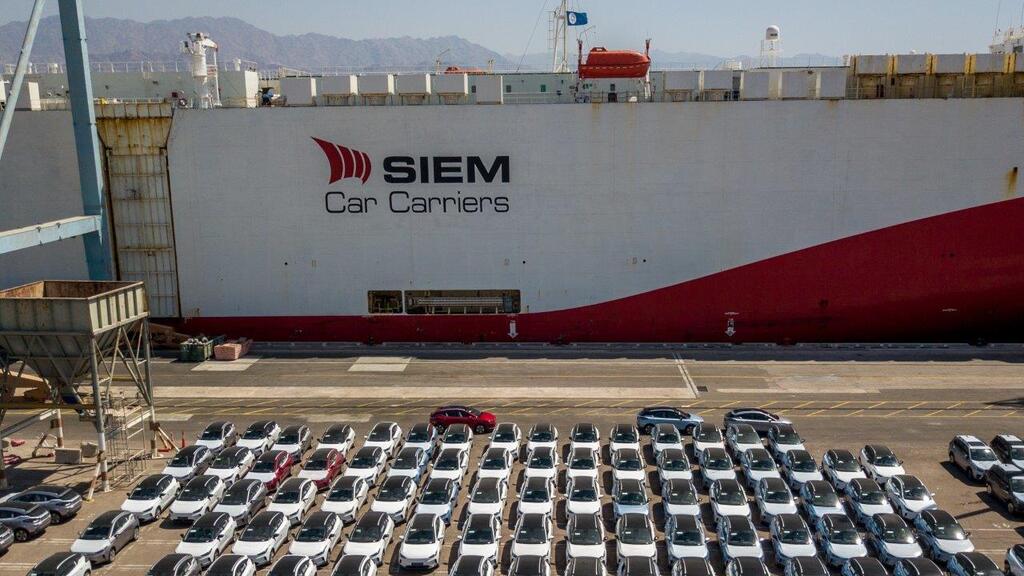
Cars at Eilat Port
“In July, the Houthis began firing at ships in Bab el-Mandeb and even hit two Saudi vessels, which caused the Saudis to reroute all their oil exports along a route twice as long,” Krasna said. “That obviously makes maritime trade in the region significantly more expensive.”
According to Krasna, the decisive factor is often not the shipping companies themselves but their insurers, which are unwilling to accept the risks involved in sending vessels through Bab el-Mandeb and the Red Sea. As a result, for roughly two months, about a third of the trade that had previously moved through the area effectively disappeared.
He described the Houthis’ latest military operation, aimed at taking control of the entire coastal zone and culminating in the capture of Mokha Port, as a dramatic development that changes the strategic picture. The Houthis have also begun launching missiles and drones at cities in Saudi Arabia, a step he said had not been seen during earlier stages of the conflict.
“It does not fundamentally change the maritime situation, because ships already could not sail through that route,” Krasna said. “But the more important thing is that oil has not been flowing there for several days because the pipeline was bombed, and apparently significant damage was caused.”
“Oil prices are rising because of the risk, and if that pipeline remains out of operation, it will have a direct impact on global oil supply,” he added. “Those pipelines solved the problem of passage through the maritime route, but if the enemy knows how to hit them, it can do so again and again.”
At the same time, a London-based shipping insurance body has stopped covering vessels traveling through the Red Sea and designated the area a war zone. Egypt is expected to suffer one of the heaviest economic blows because of the loss of substantial Suez Canal transit revenue, while Krasna said the United States could, for the time being, actually benefit from the disruption.