

Electric vehicle drivers in Israel currently pay an average of 3.5 times as much for fast charging at public stations as they do for charging at home, and prices could climb even higher. A new report by the Knesset Research and Information Center, obtained by ynet and its sister publication Mamon, warns that geographic concentration in the charging industry could lead to further price increases.
According to the report, the regulated household electricity rate in 2025 stood at 0.64 shekels per kilowatt-hour (kWh). By comparison, the average price charged to consumers at public slow-charging stations (AC) was 1.52 shekels per kWh, while the average rate at fast-charging stations (DC) reached 2.24 shekels per kWh.
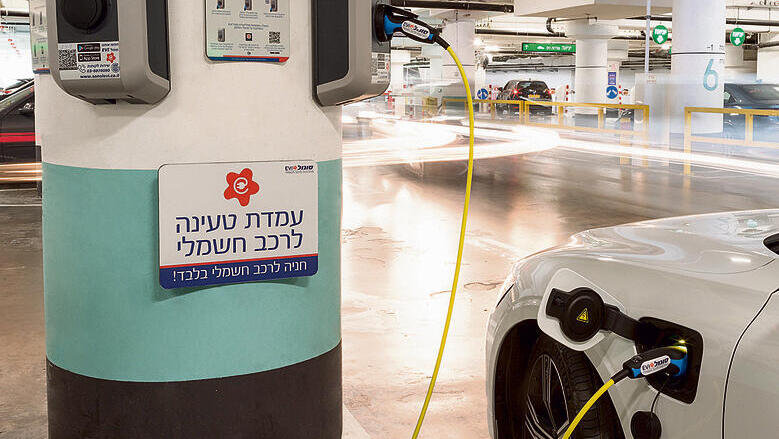
EV charging station
(Photo: Vladimir Panchenko)
That makes fast charging 250% more expensive than household electricity. At some charging networks, rates reach as high as 2.70 shekels per kWh. Some operators also impose peak-hour pricing, typically between 5 p.m. and 10 p.m., pushing costs even higher for occasional customers.
Geographic concentration
The figures point to a market in which a handful of companies control much of the charging infrastructure. According to the report, Israel's three largest charging providers — Afcon (22.4%), EvEdge (19.2%) and Sonol (17.3%) — together control 59% of the country's 8,070 charging ports.
While the Electricity Authority, which issued operating licenses to the companies, maintains that there is currently no problem with market concentration or concerns about competition, the Knesset report notes that the head of the Israel Competition Authority had not issued an opinion before the licenses were granted. It warns of "geographic concentration within the industry."
The main concern is that a single operator could become dominant in certain areas of Israel, allowing it to raise prices without facing meaningful competition and leaving nearby drivers with no practical alternative.
In a survey conducted by Israel's Central Bureau of Statistics, 64.5% of respondents reported a shortage of fast-charging stations, while about half said they had been forced to wait for an available charging port.
Compounding the problem is the partial use of government funding allocated to expanding public charging infrastructure. According to the report, of approximately 21.4 million shekels approved to subsidize public charging stations between 2019 and 2025, only about 14.8 million shekels was actually disbursed, representing a budget execution rate of 69%.
Another regulatory measure intended to encourage competition in the charging market — requiring operators to install credit card payment terminals so customers would no longer have to rely on dedicated apps or register in advance — was approved by the Electricity Authority, but its implementation has been significantly delayed.
The requirement will be enforced only in 2027 for new charging stations and beginning in 2028 for existing stations, giving operators additional time to prepare. In the meantime, drivers will continue paying high prices and searching for available charging stations using their smartphones.
Sharp decline in sales
The report also indicates that the combination of expensive charging infrastructure and government tax measures affecting electric vehicles is taking a toll on sales.
In 2024, fully electric vehicles reached a record high, accounting for 91% of sales of electrified vehicles, or approximately 68,700 vehicles. However, the trend reversed during the first nine months of 2026. The share of fully electric vehicles plunged to just 34%, as consumers increasingly turned to plug-in hybrid models, which combine electric motors with gasoline engines.
The report attributes the shift to several overlapping factors, including the limited remaining potential for installing home charging stations at private residences. As a result, drivers without a privately registered parking space are increasingly reluctant to switch to electric vehicles.
Other factors include higher taxes, increased annual vehicle registration fees and uncertainty surrounding government plans to introduce a mileage-based tax on electric vehicles in the future.