

Everyone is talking about foreign workers. In Israel, the conversation is conducted almost entirely from the receiving side: shortage of hands, recruitment costs, agricultural quotas, employment terms, expedited visas, point systems, bilateral agreements, and regulation. The narrative is familiar — a labor market, supply and demand, and immigration policy.
What is missing from the discussion is the other half of the equation. Not the country that absorbs workers, but the country that sends them. And there the story is altogether different. There, the language is not of labor. There it is, an asset.
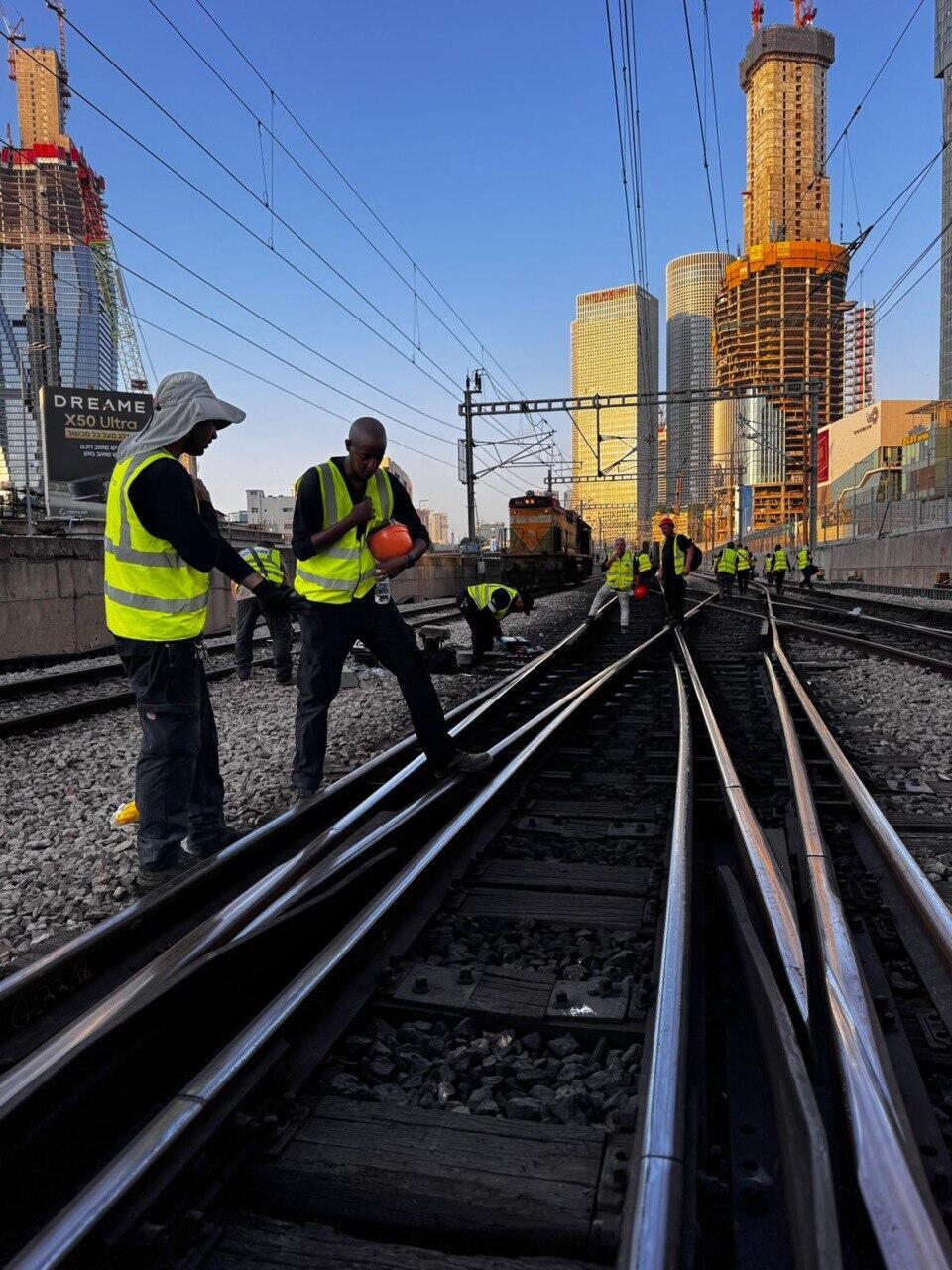
Everyone is talking about foreign workers
(Photo: Israel Railways)
Tajikistan sends Russia a labor force whose remittances are estimated at roughly 45% of its national output — forty-five percent. Almost half of an entire national economy depends on a single human corridor. That figure is neither accidental nor temporary. It is the product of decades in which Moscow served as the easy solution to an unemployment problem Dushanbe could not solve on its own.
When Russia signed a military base agreement with Tajikistan in 2006, the negotiations were not only about troop presence. It ran through that same human corridor. When the agreement was renegotiated in 2011, Moscow intensified raids on Tajik migrants as a pressure tactic. The link was never explained openly. It did not need to be. When half of a country's economy passes through the territory of another, any instruction can be issued in silence.
In 2025, the equation surfaced again, this time without subtlety. Russian police detained Central Asian workers in raids and asked them directly: " You have worked here for years, now it is time to defend us—Enlistment for Ukraine, or deportation. According to reports, 19,000 migrants were deported by November 2025 under Operation Nelegal. This is not a human rights issue at the margins of immigration policy. It is the full disclosure of a power infrastructure that had been operating all along. Labor migration, as the equation teaches, reduces to three things: collecting capital, exporting compliance, and importing vulnerability.
India manages the other side of the equation with far greater calculation. Roughly 18.5 million Indian workers live and work outside the country, about half of them in the Persian Gulf. In 2024, they sent home approximately $ 129 billion, a world record. The Modi government enacted a comprehensive law for international labor mobility in 2025, has signed more than twenty mobility agreements since 2014, and has converted its embassies into management nodes for a global human asset.
Indian workers not only send money home. They embody availability, influence, networks, dependence, and infrastructure. A country that runs eighteen million workers abroad as strategic leverage is not selling a service. It is a selling presence.
The Philippines built an entire national mythology around labor migration. Bagong Bayani, the new heroes, has been the official term for migrant workers since 1988. Tens of billions of dollars flow home each year. Behind the national rhetoric, however, operates a precise state mechanism: the Overseas Workers Agency trains citizens according to the needs of destination markets, designs educational tracks in response to foreign demand, supervises, insures, and accompanies a workforce engineered for export.
When a state recruits, trains, supervises, and insures workers for foreign markets, it is not merely participating in the global economy. It is entering it as a global player through the back door, the labor market.
Then came the American move of 2025. The One Big Beautiful Bill imposed a 1% tax on remittances from the United States abroad. One percent sounds marginal. But for countries such as Nepal, where labor remittances constitute a substantial share of GDP, even a single percentage point in the financial pipeline is a structural shift. Washington was not formulating immigration policy here in the classical sense. It was placing a hand on the pipeline that holds entire economies in place.
Developing countries are already mapping alternative infrastructures. The implication is clear. The financial pipeline itself has become a weapon, and whoever controls the pipeline controls the pressure.
So when Israel recruits Indian workers through government-to-government agreements, it may believe it is closing a workforce deal. From its own vantage point, perhaps it is. But the other side, the one that legislates mobility laws, manages a network of agreements, and runs its embassies as control nodes for a human asset, is not conducting a transaction. It is running a strategy.
Whoever enters a strategic system without understanding its rules is inside it regardless, even when convinced that the subject is only workers.
And what happens on the day the country that sells you workers decides the asset's price has gone up?
Dr. Bella Barda Bareket is an entrepreneur and a macroeconomic and geopolitical commentator