

Israel has become one of the most expensive places in the world to buy a Big Mac. The country ranks second, behind only Switzerland, in the latest edition of The Economist’s international Big Mac Index. McDonald’s flagship burger costs the equivalent of $7.67 in Israel, compared with $6.22 in the United States and just $2.42 in Taiwan.
The ranking reflects two forces: the relative cost of food and other local expenses, and the exchange rate between the local currency and the U.S. dollar.
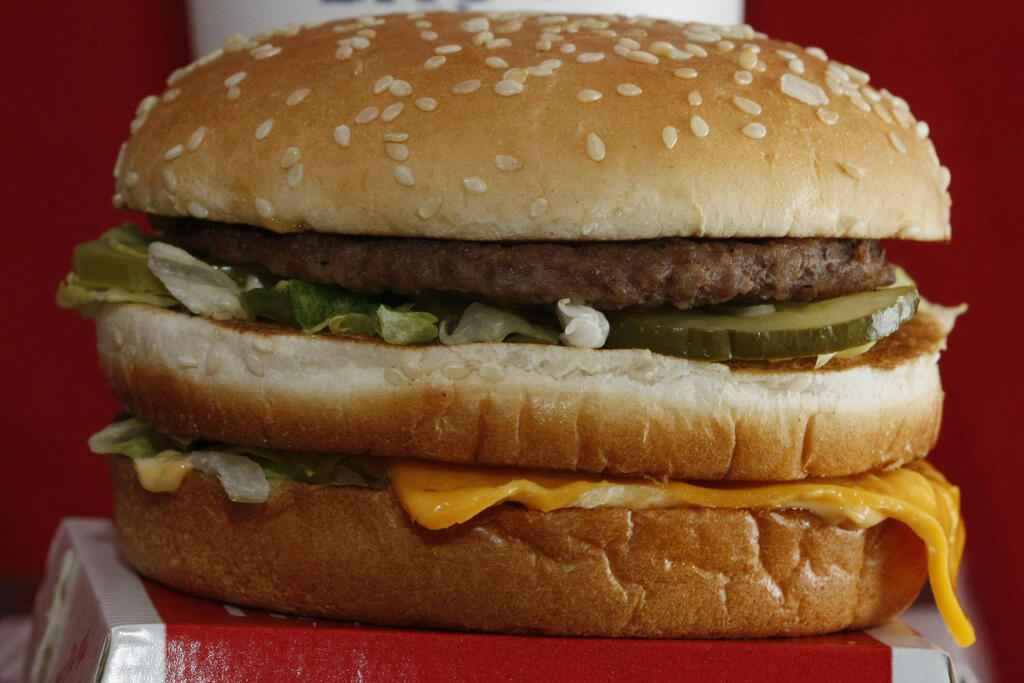
The Economist launched the index in September 1986, nearly a decade before McDonald’s entered the Israeli market. It compares the price of a Big Mac in dozens of countries by converting each local price into dollars. Originally intended as a lighthearted way to illustrate differences in purchasing power, the index has also become a useful snapshot of whether currencies appear overvalued or undervalued against the dollar.
When a local currency weakens sharply, the dollar price of a Big Mac falls. When the currency strengthens, the converted price rises. Israel offers a striking example. In late July 2024, when the dollar was worth about 3.8 shekels, The Economist ranked Israel’s Big Mac as considerably cheaper than those sold in many leading Western countries.
By the time the data for the current ranking were collected, the dollar was worth about 3 shekels. As a result, the burger’s dollar price had jumped by roughly 25%. Tel Aviv has once again become one of the world’s most expensive cities for hamburgers, and not only hamburgers, as many visitors quickly discover.
Why the Big Mac?
The Economist selected the Big Mac because it is a relatively standardized product sold around the world, with only minor local variations, and because its price reflects a broad range of economic inputs. Labor accounts for an estimated 45.5% of the burger’s price, bread for 12%, meat for 9%, electricity for 5% and rent for 4.5%, with other costs making up the remainder.
Changes in wages, ingredients, property costs, energy prices and taxation all affect the final price paid by consumers. That makes the burger a rough but useful indicator of local price levels.
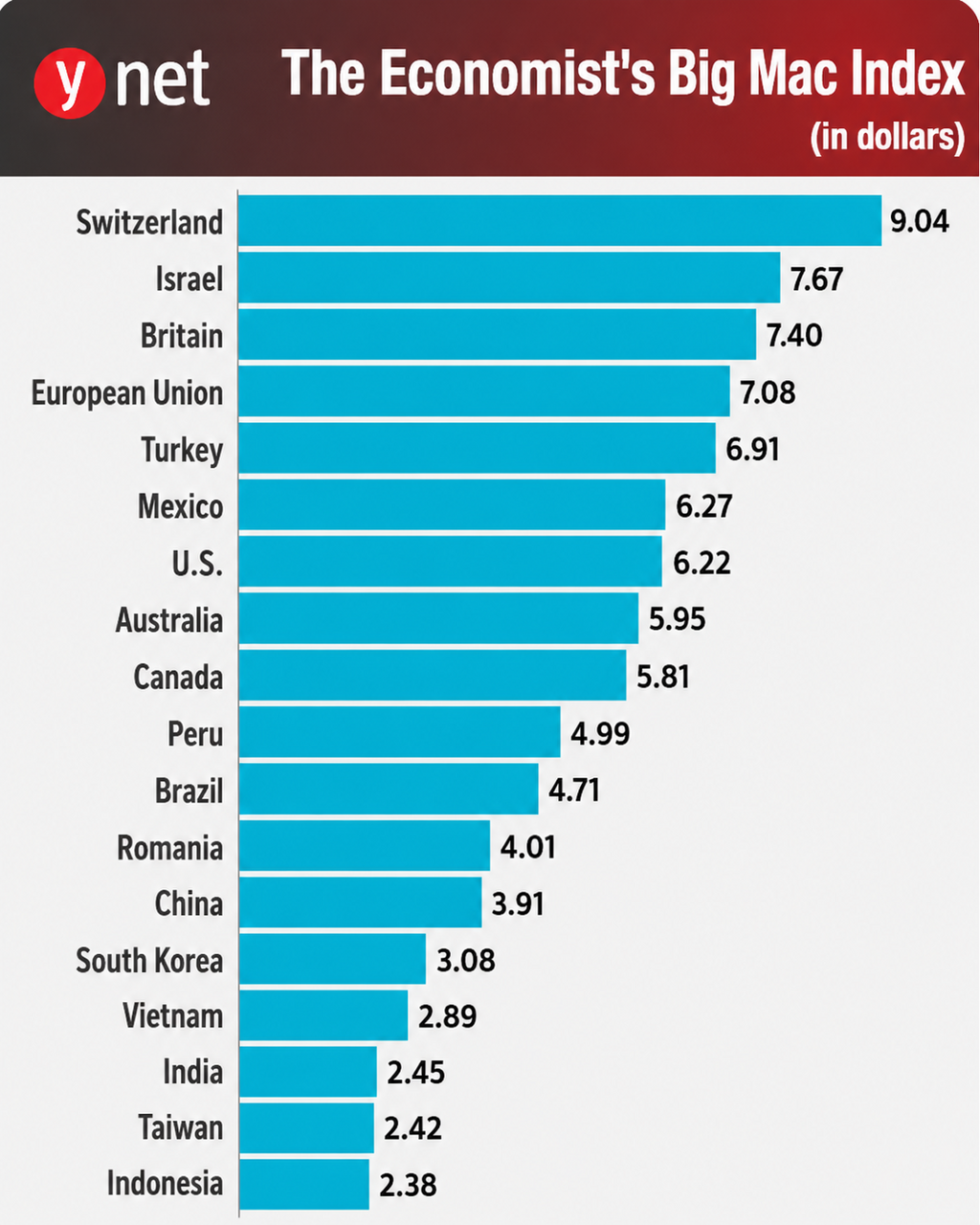
In an article marking 40 years since the index was created, The Economist’s editors wrote that extreme currency appreciation and depreciation remain as common today as they were in the 1980s, evidence that the international exchange-rate system remains in a state of persistent imbalance.
Israel’s high position is not limited to McDonald’s meals. The country also ranks among the world’s most expensive economies in comparisons published by international financial institutions and research divisions at major global banks.
Deutsche Bank’s 2025 annual price comparison placed Tel Aviv 11th among dozens of major cities for grocery costs. The city ranked similarly for the price of a single cappuccino. Comparisons by the OECD and International Monetary Fund also place Israel near the top of the developed world’s cost-of-living rankings, second only to Switzerland.
The change over the past two decades has been dramatic. In 2005, Israel ranked 21st among developed economies in comparable cost-of-living studies, placing it in a relatively comfortable position. Research by Dr. Sarit Menachem-Carmi, a senior researcher at the Aaron Institute for Economic Policy at Reichman University, paints a similar picture. Her study compared Israel’s food basket with those of five wealthy European countries with broadly similar population sizes: Austria, Denmark, the Netherlands, Finland and Sweden.
In 2005, Israel’s food prices were relatively low compared with those countries and remained so until 2009. Today, Israel’s food basket is 27% more expensive than their average. Menachem-Carmi identifies several reasons for the increase, including kosher-certification costs, high value-added tax and bureaucratic barriers that limit competition. But above all, responsibility for national economic policy and the cost of living rests with the governments that shaped those policies over the period.