

SpaceX said Tuesday it will acquire Anysphere, the company behind the popular AI coding assistant Cursor, in a $60 billion deal that marks one of Elon Musk’s most aggressive moves yet into the enterprise artificial intelligence market.
The announcement comes just days after SpaceX’s blockbuster Nasdaq debut, which valued the company at more than $2 trillion and placed it among the world’s most valuable companies. SpaceX shares rose in pre-market trading on Tuesday after the deal was announced.
Gallery
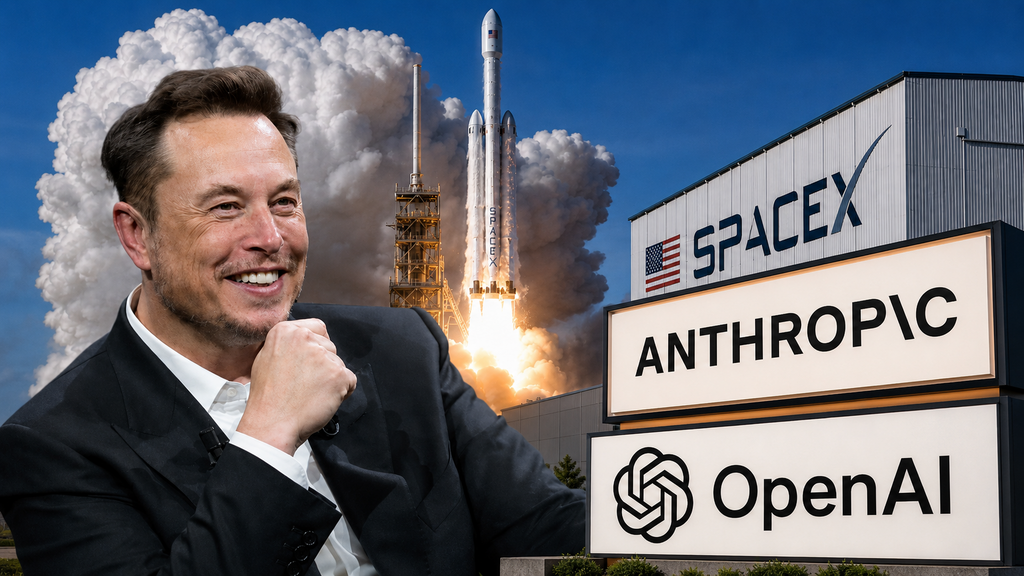
The deal marks one of Elon Musk’s most aggressive moves yet into the enterprise artificial intelligence market
(Photo: AP photo/John Raoux, Frederic Legrand – COMEO/Shutterstock)
In a regulatory filing, SpaceX said Cursor will become a wholly owned subsidiary when the transaction closes, which the company expects to happen in the third quarter of 2026. The filing also said SpaceX would be liable for a $10 billion breakup fee if the deal is terminated.
The acquisition follows an April agreement between SpaceX and Cursor, under which Musk’s company secured the right to either buy the San Francisco-based startup for $60 billion or pay $10 billion to work with it through a partnership.
Cursor, founded in 2022 by Anysphere, has become one of the most widely used AI-powered coding tools among software developers. The product allows users to write, debug and modify code using natural-language prompts, placing it in direct competition with tools such as Anthropic’s Claude Code and OpenAI’s Codex.
The deal could give SpaceX and xAI, the AI company that merged with SpaceX in February, a much stronger foothold in a market where AI firms have found some of their earliest commercial traction. AI coding assistants have spread rapidly among software engineers, helping fuel the trend known as “vibe coding,” in which developers use AI tools to generate or modify code through conversational prompts.
Cursor’s popularity among expert software engineers appears to be a major part of its appeal to SpaceX. The acquisition gives Musk’s company access not only to a fast-growing product, but also to a large base of developers already using AI in daily programming work.
Cursor has also scaled quickly as a business. According to company data shared with Reuters earlier this month, Cursor has roughly $2.6 billion in annualized business-to-business revenue, with enterprise sales growing sharply.
When the partnership with SpaceX subsidiary xAI was first announced in April, Cursor said it would use xAI’s Colossus infrastructure, the company’s massive AI data center complex in Memphis, Tennessee, to build future AI products.
“We’ve wanted to push our training efforts much further, but we’ve been bottlenecked by compute. With this partnership, our team will leverage xAI’s Colossus infrastructure to dramatically scale up the intelligence of our models,” Cursor said at the time.
That computing capacity may now become even more central to Cursor’s future. The company has relied heavily on partnerships with larger AI research firms, including Anthropic and OpenAI, for the foundation models powering its coding tools. But those companies are increasingly becoming competitors.
The acquisition gives Musk’s company access not only to a fast-growing product, but also to a large base of developers already using AI in daily programming work
(Photo: Frederic Legrand - COMEO/Shutterstock)
Anthropic’s Claude Code is now a direct rival to Cursor, even though Anthropic had previously supplied technology used by the startup. OpenAI’s Codex is also competing for developers and enterprise customers in the same fast-growing category.
The competition has intensified as AI coding tools move from experimental products into mainstream software development. Cursor’s Composer, used together with Anthropic’s Claude Sonnet model, was the tool a prominent AI researcher was reportedly using for weekend projects when he coined the phrase “vibe coding” in early 2025.
For SpaceX, the acquisition could help convert xAI from a chatbot-focused company into a broader enterprise AI player. xAI is best known for Grok, but Cursor would give the company a major product in one of the most commercially promising areas of artificial intelligence.
The deal also raises questions about how SpaceX will balance its own AI ambitions with its existing cloud computing agreements. In recent weeks, SpaceX has struck deals with Anthropic and Google to lease cloud computing capacity worth roughly $26 billion annually. Both agreements reportedly include 90-day termination clauses, meaning SpaceX could reclaim computing capacity if needed.
In March, two heads of product engineering at Cursor joined SpaceX to contribute to the company’s lunar projects and xAI, another sign of tightening ties between the companies before Tuesday’s acquisition announcement.
The acquisition makes clear that Musk is moving quickly to use SpaceX’s public-market debut as a springboard into AI. Rockets and satellites remain the company’s core identity, but the Cursor deal signals a broader strategy: turning SpaceX into a platform for computing, AI infrastructure and enterprise software.
If completed, the $60 billion purchase would give SpaceX one of the most recognizable AI coding products in the market, a developer-heavy customer base and a direct weapon in its race against Anthropic and OpenAI.