

Or Shaku - optical fiber splicer
Or Shaku, 26, from the moshav of Yatzitz in central Israel, is the only woman at Bezeq working as an optical fiber splicer on an infrastructure team. Sirens can catch her with extremely delicate fiber cables in her hands, forcing her to maintain maximum precision even as alarms blare.
For a year and a half she has worked around the clock in the field, including during emergencies, fixing infrastructure failures for hospitals, banks, police, the military and essential businesses. “And sometimes it’s also at home,” she said. “When I repair a connection that helps grandparents talk to their grandchildren, or a child get back to a computer game, you see how happy they are.”
Her work involves both fragile fiber strands and heavy equipment, maintaining the infrastructure that keeps Israel’s internet running even during war.
Gallery
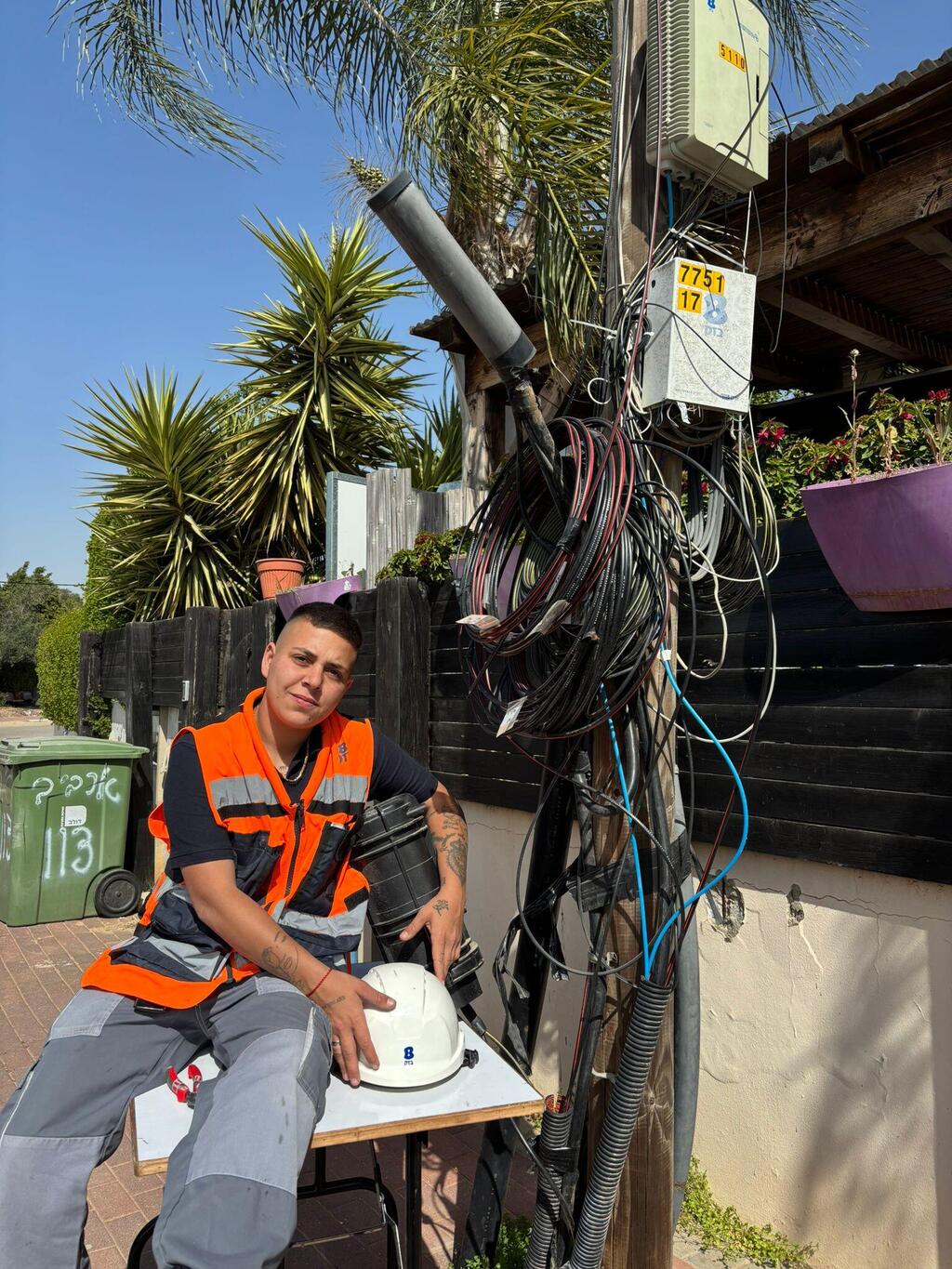
'I was caught in open areas during sirens, with interceptions overhead' Or Shaku
(Photo: Bezeq)
Shaku often climbs into Bezeq cable shafts and underground pits where fiber and cable connections are located, repairing whatever needs fixing. “A fiber strand is about as thin as a hair and affects internet speed,” she explained. “Installing and repairing fibers requires a lot of fine motor skills, precision and caution. You have to strip, clean and fuse the fiber using a special machine. I’m a very technical person and I do it even under rocket fire.”
How does your family react?
“My mother worries and calls several times a day to make sure I’m OK. At home I leave my partner and our dog, who gets anxious during sirens. But I don’t give up going to work because I know my job is essential so people can stay connected and keep daily life going.”
The work, she added, also helps her mental health. “It’s important to keep working and not sit at home feeling trapped by the situation, but to go out, solve problems and be useful. I originally trained as a computer technician, but fieldwork suits me better, so I chose this path.”
You’re the only woman in Israel doing this job at Bezeq. What does that mean?
“It means women can do jobs traditionally done by men just as well, sometimes better. In my job, for example, there are subtle details we notice that men don’t always see.”
But it’s also a very physical profession.
“That’s true. It’s not easy. There are heavy tools, working at height, underground or in shafts. It requires a lot of physical strength and mental resilience.”
What do the men on your team say?
“I’m one of them. I don’t slack off, I can do the work of ten men, and I’m not afraid of hard work. The Bezeq shafts have very heavy iron and concrete covers, and I lift them. If I can’t manage something alone, the team helps. We work together.”
Are you the main breadwinner at home?
“Yes.”
Is that why you keep working?
“Not at all,” she answered immediately. “Of course we work to earn a living, but I really enjoy my job.”
What do you do during sirens?
“If there’s a shelter nearby we go there. If not, we lie on the ground with a helmet, body armor and prayers.”
Are you afraid?
“No. I’ve been caught in open areas during sirens with interceptions overhead. Wars and threats have always existed and always will. You have to trust our army and go where you’re needed, even if it means leaving your family at home.”
Shira Saal - Keeping a chemical plant running around the clock
Shira Saal manages the Neot Hovav plant in southern Israel, one of the facilities operated by the ICL Group that produces bromine-based materials. Hundreds of employees work directly at the plant, supporting thousands of families indirectly.
The bromine products manufactured at this plant, like those produced at the company’s other facilities in Israel and abroad, are flame retardants designed to prevent ignition. That is why this production line cannot stop, in routine times or during emergencies.
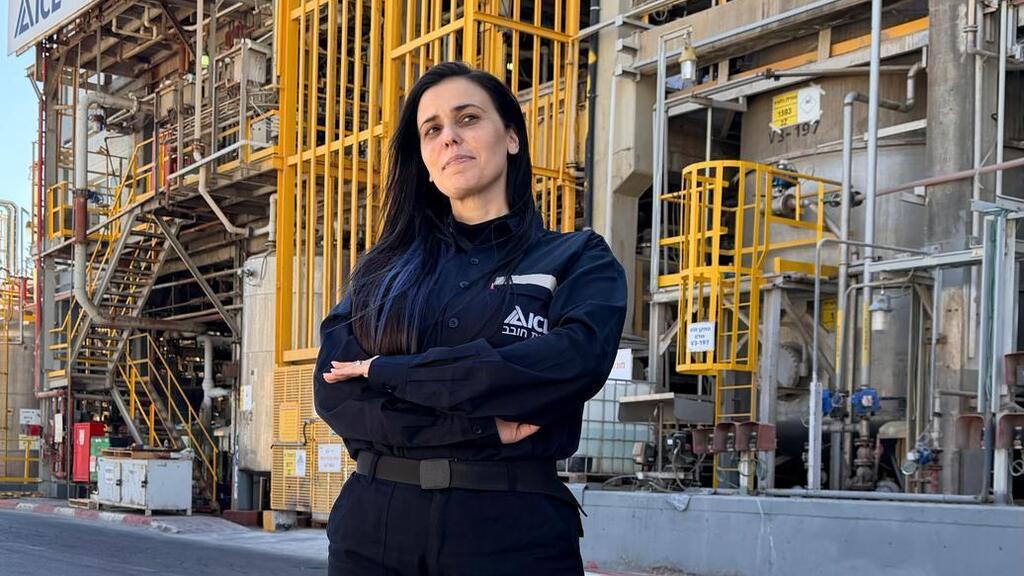
'For us, the plant is home' Shira Saal
(Photo: ICL)
Saal lives in the southern town of Meitar and is the mother of two teenagers (19, 14). “We produce bromine-based compounds that are found in many of the everyday products we use, such as screens, building materials, textiles, cable insulation, plastics and electrical appliances like washing machines, dryers and dishwashers, as well as medical and industrial equipment. Thanks to these flame-retardant materials, everyday life is safer,” she said.
So you can’t stay home in the safe room with your kids.
“That’s right. We’re an essential facility and we can’t stop. We operate 24/7 and we’re proud of that. Even during the past two and a half years of fighting, when some workers were called up for reserve duty, the teams covered for them to maintain operations."
A native of southern Israel, she grew up with the understanding that Israel Chemicals (ICL) is the largest employer in the Negev. While studying for her undergraduate degree in chemical engineering, students from her department toured several industrial plants, including the one where she works today.
Each morning about 500 employees and contractors arrive at the Neot Hovav site and we have to make sure they are safe and protected, she says. “My day starts around 6:30 or 7 in the morning and continues as long as needed,” she said. “Since the war began we’ve also had managers on rotating night duty.”
What about the kids at home?
“That’s one of my biggest challenges. When I’m home with the kids, my mind is at the plant. And when I’m at the plant and there’s a siren and my 14-year-old daughter is home alone, my heart is with her.”
Still, when asked whether she would prefer a nonessential job that would allow her to stay home during emergencies, she quickly said no. “Not everyone has the privilege of waking up and going to a job they love. For me it’s not just about income. It’s much more than that.”
"It’s also for my children, who see me as a role model. They see me doing what’s right for me and going to work out of fulfillment, not just out of necessity.”
And yet, long nights and tense security conditions, and you’re still there at the plant.
“Yes. For us, the plant is home. It is the main source of income for thousands of households in the south, and for me, as someone who was born and raised here, keeping it running means protecting our homes here. It’s not always pleasant to come here on Friday nights or Saturdays, especially during a time like this, but that fades compared to the ability to support my children and give them everything I can. Everyone who works here shares the feeling that we are also supporting the Negev.”
At the bromine compounds facility she leads, most of the people working under her are women in management roles, including in safety, environmental protection, logistics, operations and engineering. “There’s no challenge we can’t overcome when we work together. We’re simply very good,” she said with evident, and likely justified, pride.
What do your children say?
“Honestly, they’re proud of me, and that’s really a bonus. My daughter looks at me and I know she feels there’s nothing she can’t do as a woman, something I’m not sure I believed when I was her age."
Elizabeth Feldman - crane electrician at the Port of Ashdod
Every time Elizabeth Feldman arrives at work at the Port of Ashdod, she is still struck by the scale and energy of the place. The port is not only a strategic national facility but also a critical gateway keeping Israel’s economy functioning during war.
The job of a crane electrician includes daily maintenance of the cranes, requiring technical expertise, working at significant heights, focus, responsibility and the ability to handle complex malfunctions in real time.
“I’ve been drawn to technical fields since a young age and worked in them over the years. When I arrived at the port three years ago, I was amazed by the scale, the movement everywhere, the complex systems and the height of the cranes,” she said.
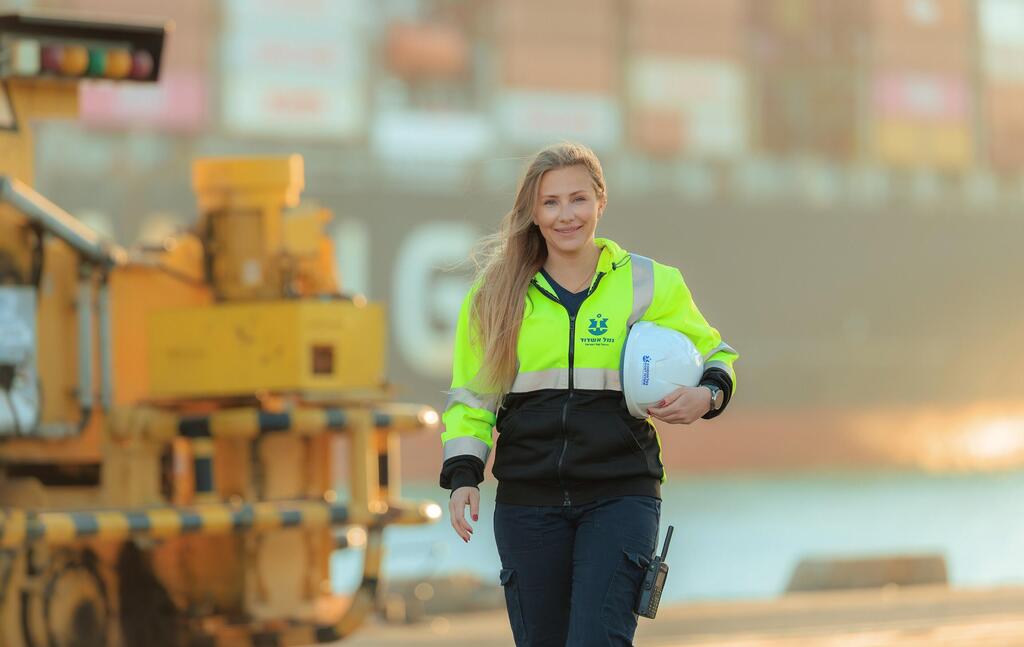
'We work even between the sirens' Elizabeth Feldman
(Photo: Oz Shechter)
Feldman, 35, a single mother to an 11-year-old daughter, describes a dynamic job involving complex systems and massive equipment. She climbs high up on the cranes to maintain them in both routine times and emergencies, admitting it is no small challenge.
“When you enter the port there’s a lot of tension and pressure. The port never stops working, the movement never pauses and everything has to keep running smoothly. For me it feels like a dream, I never imagined I would end up in a place like this,” she said.
And during wartime the pressure only increases.
“We work between sirens. The port can’t stop. When an alert sounds, crane operators and technicians must climb down and reach protected shelters placed along the docks. We wait for the Home Front Command instructions and then go back to work. It takes a few minutes and then we’re back on the cranes.”
Can you make it to the shelter in time?
“Yes. I’m in good shape. I’m like a ninja,” she laughed. "I run to the shelter and everything is fine. We also get alerts on our phones that give us about 7 to 10 minutes before the siren, so we usually have enough time to reach the shelters.”
Still, climbing down during alerts can be frightening.
“Descending from a crane isn’t like going down the stairs at home. Some cranes have elevators but the ones I work on don’t. So yes, sometimes there’s panic when the alert comes. But we’re a team. We make sure everyone is down safely and run together to the shelter.”
What about your daughter at home?
“I work shifts, so I spend many daytime hours with her. My managers are very understanding of my circumstances. But there’s no way I’d skip a shift. My daughter stays with my mother when I'm working."
What does your daughter say about you? She must be very proud.
“She’s proud of me. Sometimes she’s scared when sirens sound and I’m not with her, but she knows I’m contributing to the country, and it’s a mission.”
Asked whether she would prefer to work in a field where her role was less essential, she pauses before answering. “I want to stay where I am and not change fields, because my work has meaning. The port is a central gateway for the country’s trade. If everyone wanted to stay home, what would our country look like? That sense of mission is very fulfilling.”
Suha Mula - managing fuel stations across northern Israel
Suha Mula, 46, from the Druze town of Yarka, recently became the first Druze regional manager at the Sonol fuel company. After nine years with the company, she stepped into her current role three months ago, overseeing the day-to-day operations of 30 Sonol gas stations across the Haifa and surrounding region and directly managing 12 station managers.
“The split is equal, six women and six men. Each of the managers oversees more than one station.”
The role requires her to be constantly on the move, visiting at least two stations every day, while also overseeing on-site management and operations.

'I'm not afraid' Suha Mula
(Photo: Sonol)
Describe a typical workday for you, both now and in normal times.
“I don’t have a fixed office,” she said. “I leave home and start driving from station to station. I have to visit at least 30 stations over the course of a month, which means a minimum of two stations a day. Alongside me there are four other regional managers, and once a week we meet at the offices in Netanya to discuss ideas related to operations and improvements.”
What is happening on the ground now during the war?
“We’re an essential service, so even during the war I go into the field to support the teams,” she said. “We check that shelters are accessible and that everyone knows what to do during alerts.”
She began her career at Sonol as an employee at the Yokne'am Bypass station. She was later selected for the company’s management development program and went on to become manager of the Atlit station. She later managed the company’s stations in Acre and Mi’ilya.
In her current role, she stresses the importance of maintaining operational continuity at the stations while also ensuring the well-being of employees, understanding that the proper functioning of Sonol stations is part of the critical infrastructure that allows the economy to keep operating.
Are employees afraid to come to the stations? After all, a gas station is a very dangerous place during missile attacks.
“That’s true, but we follow strict safety rules throughout the war, which we’ve been feeling very strongly since October 7. Every station has a reinforced safe room or shelter. We also structure shifts so there are as few people on duty as possible while still maintaining essential service for customers and security forces.”
Are you afraid?
“As an observant Druze woman, I’m not afraid,” she said. “If any of my managers feel afraid, I tell them I’ll go check the station myself. My husband also works in an essential role with the Israel Electric Corporation and often travels to border areas. There’s always concern for him too, but I believe we’ll get through this and return to normal life.”
Noy Elimelech Levy - running a production line in Israel’s semiconductor industry
Noy Elimelech Levy, 32, married and mother of a 3-year-old daughter lives in Ashkelon and commutes daily to Rehovot, where she manages a production line at semiconductor giant Applied Materials. “Semiconductors are the technological infrastructure behind every device,” she said. “Our activity is vital for Israel’s economy.”
Even during the war she travels to work every day, hoping the drive between Ashkelon and Rehovot won’t be interrupted by sirens.
Do you still come to the factory every day, even during the war?
“Of course. I manage a production line in the factory, so I have to be there,” she said. “We manufacture machines used in quality control that test the semiconductor production process. My team is responsible for the testing and calibration stage before we send the machines to customers. They are all electrical and mechanical engineers, and we have to be on site, especially me as the line manager.”
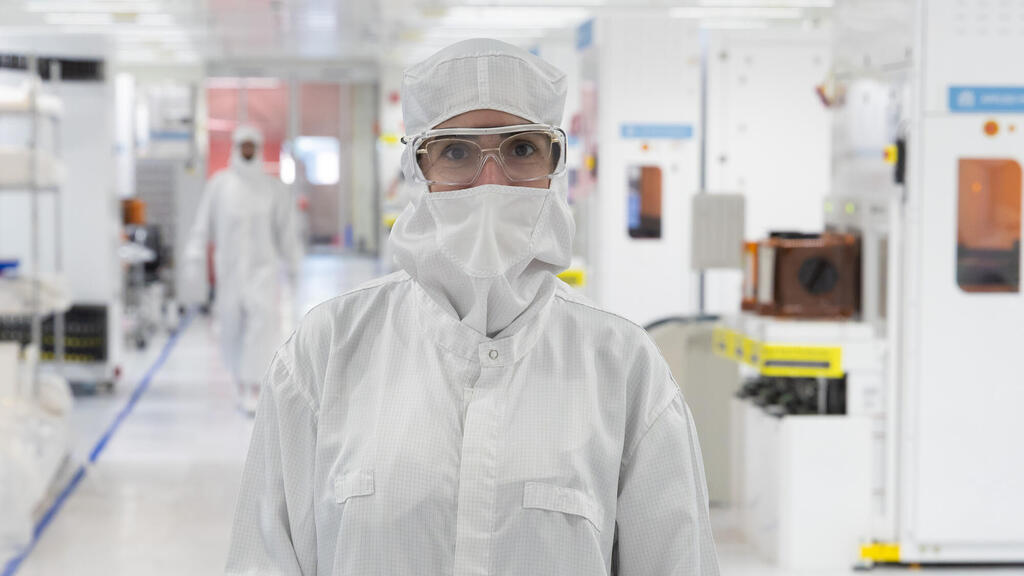
'The support at home helps a lot' Noy Elimelech Levy
(Photo: Ron Uriel)
After earning a bachelor’s degree in electrical engineering and now nearing completion of her master’s, she serves as the direct supervisor of the integration engineering team, nine engineers and one woman engineer.
In addition to managing the team, she also troubleshoots problems, ensures the process runs properly, works to improve it and makes sure the machines are delivered to customers on schedule, overseeing everything from daily task management to final shipment.
“This is the fourth or fifth round where we’ve come to the factory while much of the economy is shut down,” she said. “There’s no other option. It’s important to show stability to our customers, even during challenging times.”
What’s the hardest part?
“Leaving my three-year-old daughter at home. When I'm at work, she stays with my husband, mother or a babysitter.
And the worry?
“This round has been calmer in Ashkelon, fortunately, but I still worry about her and about how she handles my absence. Emotionally it’s a bit harder. She sometimes tugs at my heart when I leave, but I make it up to her when I get back.
For example, she’ll say, ‘Mom, I wanted you,’ but I know it’s also good for her to see her mom come home after a day of doing something meaningful. Staying at home all day is hard too.”
Is this a dilemma men face less often?
“Maybe. But being away from your children during an emergency is hard for both parents.” What helps her most, she said, is knowing her work matters. “Our presence at the factory helps the country and the economy. That’s important for the future as well.”
“That’s the thought I hold on to when I’m away from my daughter. And the support at home helps a lot, from my husband, my mother, the babysitter and my workplace, which helps cover the cost of childcare.”