

U.S. President Donald Trump is expected to decide this week on the new tariff rate to be applied to imports from Israel, a key issue in mounting trade discussions between the two allies.
For decades, tariffs on Israeli goods entering the United States were zero, under a mutual declaration of a free trade area. But in early April 2025, Trump surprised global markets by unveiling a broad set of new duties on imports from many countries, including Israel.
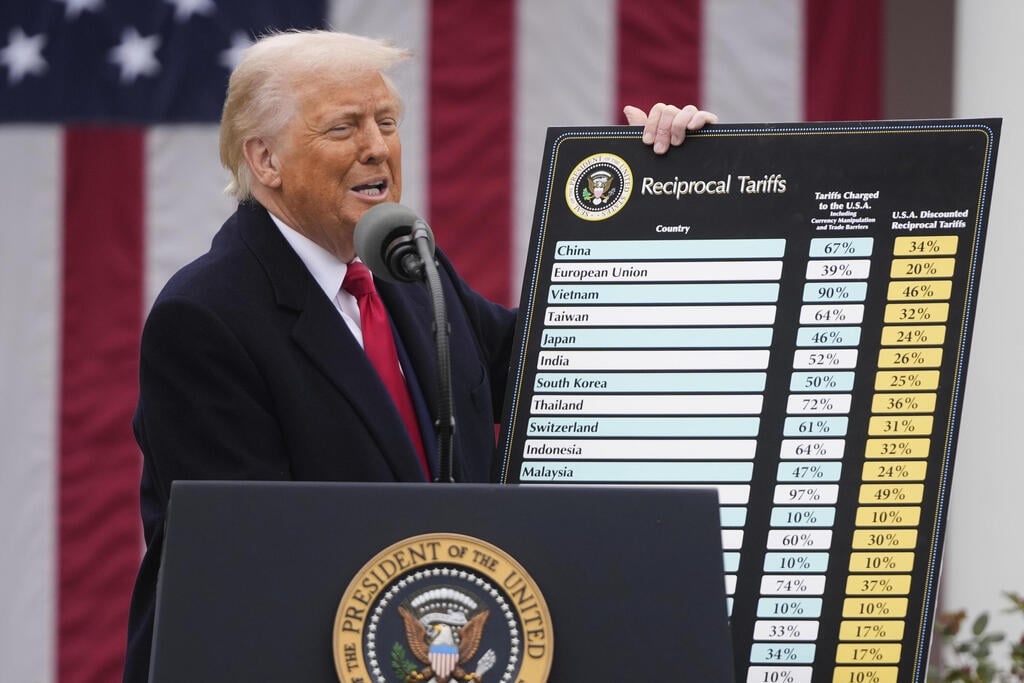
US President Donald Trump reveals his sweeping tariff plan, April 2025
(Photo: AP Photo/Mark Schiefelbein)
Israeli officials have stepped up efforts in recent days to persuade the U.S. Commerce Department to significantly reduce the proposed levy — originally set at 17% — and instead approve a more moderate rate in the 10–12% range.
The initial 17% figure was derived from calculations tied to the U.S. trade deficit with Israel. Although lower than the duties imposed on some countries — which in certain cases exceed 20% — it is higher than the roughly 10% rate that applied temporarily to most countries in the weeks after the new tariffs were announced.
Since early August 2025, the United States has temporarily set a 15% tariff on about 60% of Israeli exports heading to the U.S. Between April 2 and the start of August, that rate stood at 10%, mirroring tariff levels applied broadly under the early phase of Trump’s tariff policy.
Israeli negotiators — including Economy and Industry Minister Nir Barkat, Finance Minister Bezalel Smotrich and Prime Minister Benjamin Netanyahu’s economic adviser and head of the National Economic Council, Prof. Avi Simhon — have argued for a significant reduction in the tariff. Their pitch emphasizes Israel’s status as “one of America’s closest friends” and its ongoing security challenges, particularly threats from Iran. The premier is reported to have raised the issue directly with Trump in recent talks.
 Yoav Seidel Photo: Shmulik Amlani
Representing Israel in the negotiations in Washington has been the country’s senior trade attaché, Yoav Seidel. He told ynet that talks with the U.S. administration are nearing conclusion and “there’s reason to believe we will reach a good tariff agreement with the United States, significantly lower than 17%.”
Current U.S. tariff structures vary by sector and apply broadly to all imports, including those from Israel: aluminum, steel and copper face a uniform 50% duty; cars, trucks and auto parts are hit with 25%; and wood products are taxed at 10%–25%.
On April 1, a day before Trump’s tariff announcement, the government appeared to react urgently, with Smotrich suddenly announcing the elimination of certain tariffs on U.S. agricultural imports. However, that move applied only to a limited range of products worth a few tens of millions of dollars.
On Dec. 3, Economy and Industry Minister Barkat signed a new agricultural trade agreement with U.S. Trade Representative Jamison Greer. Under the deal, Israel will grant full tariff exemptions to about 300 U.S. food and agricultural items, some immediately, and others gradually over the next decade, moving toward duty‑free access for U.S. agricultural imports.