

The dollar’s drop below the three-shekel threshold in recent days has prompted Israelis to rush to buy U.S. currency, leading to repeated shortages among money changers nationwide. According to currency exchangers, the surge stems from concerns the rate will jump in the coming months due to security tensions and ongoing fighting with Iran and Hezbollah.
Many Israelis planning trips abroad around the Shavuot holiday and the summer vacation period are stocking up on hundreds or thousands of dollars, creating a significant shortage of U.S. banknotes. A money changer in central Israel told ynet: “Every day I run out of dollars. When a few travelers returning from abroad sell me cash, it’s snapped up within minutes. Unfortunately, there have been no regular cash shipments on flights lately because of the war and high insurance costs.”
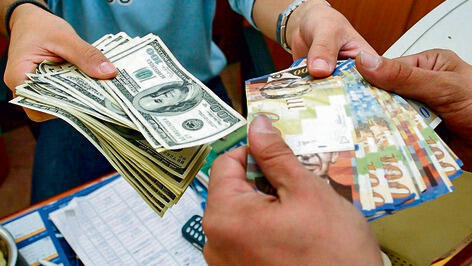
(Photo: Atta Awisat)
A Jerusalem-based exchanger added that some buyers are convinced the rate will soon spike and are purchasing thousands of dollars as an “investment” to keep in home safes. He said such heavy traffic at exchange shops, commonly known in Israel as “change” stores, has not been seen in a long time. It also includes demand for other weakened currencies, such as the British pound, at about 4.00 shekels, and the Swiss franc, which has fallen to a low of 3.80 shekels.
A senior government economic official said part of the shortage, which has also been felt to a limited extent at banks, stemmed from a halt in airborne foreign-currency shipments during about six weeks of fighting. However, he sought to reassure the public: “In recent days, shipments have resumed and the shortage is expected to gradually ease.”
Saving the industry
By contrast, the manufacturing sector is in a state of alarm. Manufacturers Association President Abraham Novogrotsky warned over the weekend that a dollar below three shekels endangers entire production lines. “It is hard to understand how the Bank of Israel and the Finance Ministry are not acting to save the industry. This is an escalation of an ongoing crisis; within a year, the dollar has fallen from around 3.70 shekels to below the dangerous threshold of 3.00 — for the first time in more than 30 years.”
Novogrotsky said this is not a temporary event but a process signaling immediate danger to the economy. “A dollar starting with a ‘2’ is a death blow to export profitability. A cumulative drop of about 20% in the exchange rate within a year completely wipes out profit margins and pushes factories toward closure.”
He added that industry is “squeezed” between collapsing dollar-denominated revenues and rising shekel-denominated expenses. “The result is canceled investments and layoffs. In high-tech and multinational companies, they are already calculating exit routes from Israel. An overly strong shekel is a sure recipe for relocation, which will hurt state revenues and lead to higher taxes.”
On Friday, the Bank of Israel set a representative rate of 3.00 shekels per dollar, while the euro was set at 3.51. However, in continuous trading before the start of the Sabbath, the U.S. currency continued to weaken and traded at around 2.98 shekels.