

The war in Gaza is reaching its end, barring any last-minute disruptions, and the hostages are returning home after the country’s hardest two years. The Tel Aviv Stock Exchange celebrated this event with sharp gains that pushed all the main indices to new highs, along with an unusually large trading volume for the holiday period of NIS 4.4 billion.
Of the 57 stock indices in the Tel Aviv 125, 37 hit record highs on the shortened trading day Thursday. The leaders of the rally were real-estate indices: the TA-Building index surged 9.1 percent, the TA-Real Estate index rose 6.6 percent and the TA-Israel Eigar (“Yielding”) Real Estate index climbed 5.1 percent. The flagship TA-35 index gained 2.3 percent, and the broader TA-125 index rose 2.9 percent.
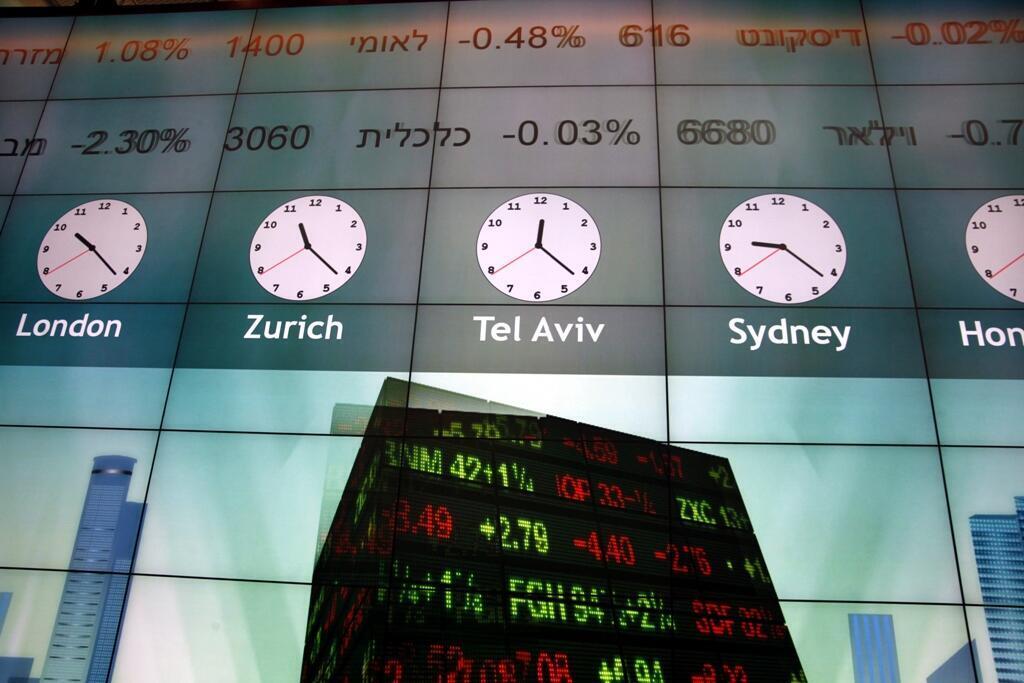
(Photo: Gettyimages)
Looking back at the Tel Aviv market since the war broke out, one might almost forget the turmoil ever occurred. The TA-125 has returned 81 percent since Oct. 7, 2023, placing Tel Aviv among the top Western exchanges and ahead of major U.S. benchmarks — the S&P 500, which has gained 56.7 percent, and the tech-heavy Nasdaq, up 71.5 percent — when examined through Oct. 9, before the weekend’s disruption on Wall Street following Donald Trump’s announcement of a renewed trade war and high tariffs on China.
Over the past five years, the Tel Aviv market’s rally has really pulled ahead. The TA-125 index has returned 132.3 percent, compared with 99 percent for the Nasdaq and 94.2 percent for the S&P 500.
Insurance stocks have driven much of the recent gains. The TA-Insurance index has jumped 250 percent since the start of the war. Like banks, insurers are seen as a mirror of the Israeli economy. They invest the public’s savings — including in the local capital market — so they benefit especially from the stock-market rally, as their assets and asset-management revenues grow. The TA-Banks-5 index has also significantly outperformed, posting a 99 percent return.
Among Israel’s 125 largest public companies, Arotec Industries — a smart munitions manufacturer — stands out, having shot up 2,095 percent to a market value of NIS 4.4 billion. Next is Meitav Investment House, whose share price has soared 746 percent to market cap of NIS 8.4 billion. Closing the top ten is El Al, which has climbed 265 percent since Oct. 7, though it fell 6.4 percent Thursday amid investor expectations that foreign airlines will resume flying to Israel once the war ends, potentially eroding El Al’s sharply gained market share.
Of the 514 stocks that traded continuously throughout this period, 141 — about 27 percent — delivered at least 100 percent returns.
Economic history suggests that the Israeli market often delivers excess returns in the year following the end of a war. But given how strong the recent rally has been — especially in the past year, which is half the time since October 2023 — questions arise: how much further can the market go, what might drive those gains, and what risks do investors face in the Tel Aviv Stock Exchange?
In conversations with senior capital-market figures, most believe there is room for further gains. Yotav Kostika, CEO of the mutual-fund company at Mor Investment House, told Calcalist that “this year’s performance at the Tel Aviv Stock Exchange have been phenomenal, and the question mark around a deal was one last thing that clouded investors, and now it’s going ahead. At this point there are additional elements that could push the stock market forward. The big, real story lies in the possibilities of expanding the Abraham Accords. If that happens, it would be a breakthrough and could bring prosperity.” Kostika also noted the possibility that elections might be advanced. “Many eyes will focus on the composition of the next government, and that will occupy investors, but there are still several months until we reach that.”
He added, “Certainly short-term profit taking could happen in the Tel Aviv market — for example in the defense sector, which has become a new elite industry in this war.”
Modi Shafrir, chief market-strategy officer at Bank Hapoalim, sees the situation similarly. “The local market is still not pricing in the potential normalization with Saudi Arabia. So there remain positive scenarios that could materialize and support further price increases. Unfortunately the Middle East tends to deteriorate, but this time there is a higher chance that things will go well. If the war truly ends, there is clear reason for upward movement.”
Yuval Beer Even, head of institutional investments at Migdal Insurance, takes a more moderate stance. “Until now the market was assuming there would be a deal, and priced that in at about 70-80 percent likelihood; now that we have certainty it helps. I don’t think we’ll see rises as strong as those we’ve seen so far, but certainly there is room for more gains in the Israeli market. The phenomena here look positive, so this is not a time to sell.” Beer Even explained that since 2023 (following the announcement of judicial overhaul) there has been capital outflow amounting to tens of billions of shekels from the local market toward S&P 500-oriented channels. “If even one-eighth of that money returns, it will be a significant boon for the market, increasing demand.”
That said, Kostika warns that given the strong rally in the local market, “profit taking in the short term is certainly possible. Financial companies are still in excellent condition. There are very strong fundamentals here, both for banks and for insurers. On the other hand, defense-industry firms may face short-term pressure because the war’s end is likely to lead to reduced domestic demand for their products. But one cannot ignore that a new elite industry has been created — the defense industry.”
Lior Yochpaz, chief investment officer at Menora Mivtachim, observed, “The jump in local equities in recent months shows that investors have already begun thinking about the ‘day after’. In my estimation, the substantial effect of the agreement will be in the real economy. It’ll be interesting to watch foreign private equity funds in Israel. In the last two years we’ve seen them mostly active in high tech — and not see them competing, for example, for a credit-card company like Cal — but I believe now we’ll see them also in more traditional sectors in light of the war’s end.”
The end of the war also spotlights a major macroeconomic issue that has occupied both Israel’s economy and its investors during the conflict: inflation and the high interest rates meant to combat it. According to Shafrir, the war’s end will reduce inflation: “Supply constraints that have characterized Israel’s economy since the outbreak of the war will ease — reservists will return to work, flights into and out of Israel will increase, and prices will fall. Accordingly, I expect rates will drop as soon as next month, and within a year they will stand at 3.75 percent or 3.5 percent. Meanwhile, mortgage rates will decline, which will support the local real-estate market.” Kostika sees things similarly: “The market already reflects an interest-rate cut in the expectation of war’s end. I think it will happen at the next meeting of Bank of Israel’s Monetary Committee in November. The housing market here is in rough shape. Developers and contractors are hopeful, but sales in the Gush Dan (Tel Aviv metropolitan) area are very low. People have no appetite to buy. Lowering interest rates could help with that, along with a generally positive atmosphere that would restore people’s desire to purchase homes.”
According to Yochpaz, “The ceasefire will let the Bank of Israel lower interest rates, also because global markets will no longer demand the risk premium they currently insist on for Israeli government bonds. The market is currently pricing in a rate of 3.5 percent, and that makes a lot of sense. We’ll see postwar growth — real interest of 1.5 percent is very high, so there is plenty of room for cuts.”
Still, Yochpaz does not expect a persistent surge in real-estate stocks, reasoning that “real estate is a function of interest rates and the sector may indeed recover. But let’s say foreign investors return to the Tel Aviv market more robustly — they are likely to favor financials, not real estate. Just as it took time for rising interest rates to be felt in credit costs, it’ll take time for lower rates to be felt in the economy.”