


The global energy market has been gripped by a prolonged shock since the start of the war in Iran, with no end in sight. Brent crude prices have already approached $110 a barrel, before falling to $92 as talks between the United States and Iran resumed. Even if a ceasefire is reached, it could collapse, as happened in June. Escalating tensions in Yemen and Iraq are adding fuel to the fire, while the war in Ukraine is also making its own contribution.
Energy is becoming an increasingly influential factor in the global economy, and developments in the Middle East illustrate that clearly.
“Two things happened at the same time,” said Dr. Amit Mor, CEO of Eco Energy Financial & Strategic Consulting and a lecturer at Reichman University. “First, the Houthis took control of large areas of Yemen and coastal territory along the Red Sea, while also gaining full control of the Bab el-Mandab Strait. In addition, pro-Iranian militias in Iraq attacked and damaged two pumping stations that transported Saudi oil through the East-West Pipeline. Those two developments pushed oil prices up by more than 10% to $109 a barrel, and as long as the straits remain blocked and the pipeline is not restored, prices are expected to remain high.”
The weakness Saudi Arabia has displayed in the face of these threats is worsening uncertainty in the markets, according to Mor.
“Saudi Arabia has been exposed as weak. They bombed for years and failed to suppress the Houthis. They also appealed to the United States to attack, but the U.S. administration is not interested in intervening," he says. "At this stage, the Houthis have the upper hand, and they have shown the world that they control critical chokepoints. And as long as the United States fails to reopen traffic through the straits, Iran is currently emerging as the geopolitical winner.”
Global inflation flares up
The surge in oil prices is hitting economies around the world just as inflationary pressures appeared to be easing. In an OECD report published last week, the inflation forecast for G20 countries was revised upward to 4.1% in 2026 and 3.6% in 2027.
The report noted that surging energy prices act as a “tax on consumption,” eroding households’ disposable income and slowing real global growth toward 2.5%-2.9%.
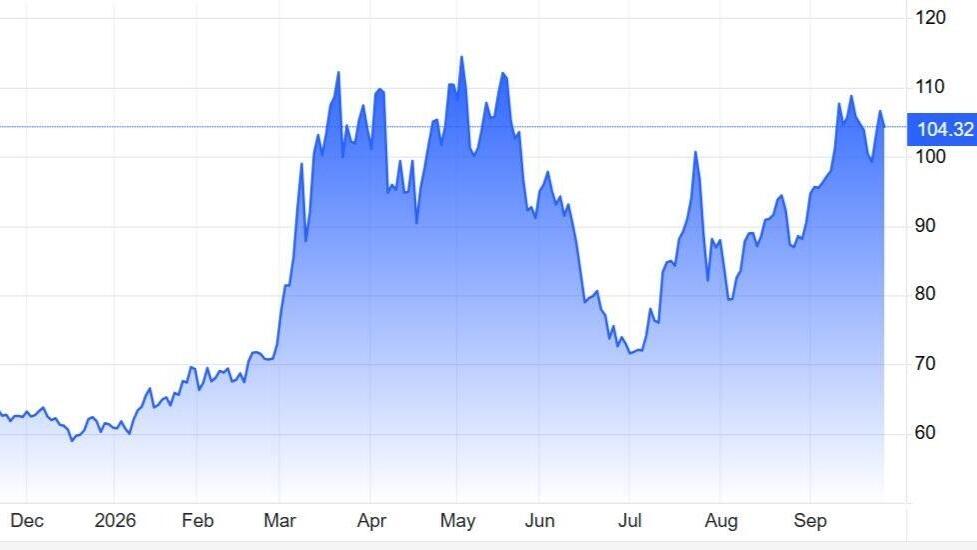
Rising Brent crude oil prices
(Illustration: Trading Economics)
An analysis by the International Monetary Fund indicates that higher energy prices have prompted many central banks around the world to freeze plans for interest rate cuts, while some are considering or have already implemented modest rate increases to prevent inflation from becoming entrenched.
Policymakers’ main concern is that rising input costs will feed into core inflation and cement higher inflation expectations.
Tensions in the Middle East are also affecting other parts of the global economy. Houthi restrictions at Bab el-Mandab are disrupting international trade and liquefied natural gas prices.
“Under normal conditions, about 12% of global trade and around 30% of the world’s container traffic passes through the Bab el-Mandab Strait,” Mor explained. “When the Houthis block the strait, most goods arriving from East Asia are forced to sail around Africa. That adds costly days at sea and drives up insurance and maritime freight rates worldwide.”
A review by the United Nations Department of Economic and Social Affairs, or DESA, said higher shipping and diesel costs are raising agricultural and industrial input prices, which are then passed directly on to supermarket shelves.
Rising prices for gasoline, diesel and jet fuel are pushing up transportation and logistics costs worldwide. As a result, manufacturing costs and agricultural inputs, such as fertilizer, are becoming more expensive, with those increases ultimately passed on to consumer goods and food prices.
According to the European Bank for Reconstruction and Development, high energy prices are driving a major transfer of capital from energy-importing countries to exporters such as the Gulf states and Norway.
Energy-importing countries are being forced to spend more foreign currency, mainly dollars, to buy fuel. That weakens their local currencies and creates a “double whammy” for import costs.
The war in Ukraine is also having a far-reaching economic impact, particularly on Europe.
“Europe is heading into winter with insufficient inventories after an exceptionally hot summer,” Mor said. “Because Qatar has halted part of its production and supply, LNG prices are surging. That increase is expected to sharply raise gas and electricity prices in Europe in the coming months.”
A weaker shekel in Israel?
In Israel, the picture is somewhat different. On the one hand, the country has a unique structural protection mechanism in the electricity sector. On the other, it remains fully exposed to fuel and import prices.
“Israel is partially protected compared with Europe,” Mor said. “In terms of electricity rates, we are protected because we have very cheap domestic natural gas from fields such as Leviathan, Tamar and Karish. Long-term contracts prevent a dramatic surge in household and industrial electricity rates, unlike what is happening in Europe.”
 Dr. Amit MorPhoto: Yael Tzur
By contrast, when it comes to transportation and consumer goods, Israel is affected by global trends. One example is the rise in gasoline prices at the pump.
Israel imports about 10 million tons of crude oil and refined petroleum products a year. Gasoline prices at filling stations are directly affected by regional refined-product prices. An increase of half a shekel per liter has already pushed the price to a record 8.25 shekels per liter.
Another clear impact can be seen in consumer prices. As a small, open economy that imports most consumer goods by sea, rerouting ships around Africa and the prolonged closure of the Port of Eilat are making shipping to Israel more expensive.
The result could be a weakening of the shekel against the dollar and higher prices across the economy.
According to analyses by the Bank of Israel and the Central Bureau of Statistics, these imported pressures could push core inflation to as high as 3%, forcing the Bank of Israel’s Monetary Committee to keep interest rates high for an extended period and placing added pressure on borrowers, including mortgage holders.
Still, Mor urges keeping the situation in perspective.
“A price level of $110 a barrel is not something we have never experienced. From 2010 to 2014, that was the price level, equivalent to about $120 in today’s terms, and the world managed to survive. The global energy market today is less dependent on Gulf oil than it was in the past, and the main question is how long the disruptions to Saudi and Gulf supplies will continue.”
If you were advising the Israeli government, what would you recommend it do to protect itself from the effects of the energy crisis?
“In the short term, there is not much the government can do. We are not going to attack the Houthis independently. What must be done, however, is to immediately increase the economy’s strategic reserves, both of crude oil and refined petroleum products. To do that, additional emergency storage facilities need to be built.
“In the medium and long term, the steps should include a major push to encourage a transition to electric vehicles, broader reliance on solar energy sources and the development of a decentralized energy system based on solar power and natural gas. These are the main tools that will give Israel energy and economic resilience against future geopolitical shocks.”