

Israeli cybersecurity company Sentra announced Wednesday that it has raised $150 million in a Series C funding round aimed at expanding its technology for protecting sensitive corporate information from unauthorized access by artificial intelligence agents, as businesses increasingly deploy autonomous AI systems across their operations.
The investment, led by Capital One Ventures, follows 300% year-on-year growth and brings Sentra's total funding to more than $250 million. The company employs 130 people, including 65 at its Tel Aviv offices, and plans to expand its workforce in Israel and internationally.
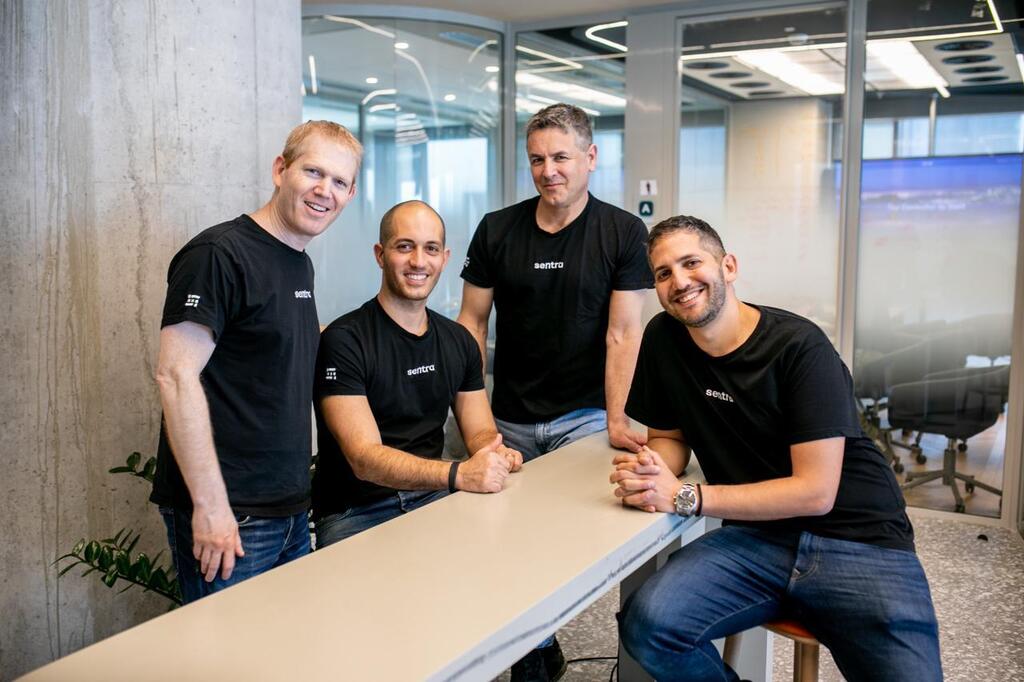
Sentra co-founders, from right: Ron Reiter, Asaf Kochan, Yair Cohen and Yoav Regev
(Photo: Yifat Golan)
Existing investors include Bessemer Venture Partners, Zeev Ventures, Standard Investments, Munich Re Ventures and Key1 Capital. As part of the new investment, a representative of Capital One will join Sentra's board of directors.
From Unit 8200 to protecting corporate data
Sentra was founded in 2021 by four Israeli technology and cybersecurity veterans: CEO Yoav Regev, who previously headed the cyber department of the IDF's elite Unit 8200 intelligence division; company president Asaf Kochan, a former commander of Unit 8200; CTO Ron Reiter, who previously managed Oracle's Tel Aviv development center; and Yair Cohen, the company's vice president of product, who held senior product positions at Microsoft and Datadog.
The company develops a platform designed to help organizations identify sensitive information, monitor who or what can access it and prevent unauthorized exposure. Its technology addresses a growing challenge as businesses integrate AI assistants, copilots and autonomous agents into workflows that involve large volumes of confidential data.
Traditional corporate information security systems were developed primarily around human users. But AI agents increasingly operate independently, accessing information and performing tasks across multiple systems, sometimes with permissions broader than those required for their intended functions.
According to Sentra, the number of AI agents deployed by businesses has multiplied in the past year, with some organizations now operating thousands or even tens of thousands of agents. Yet relatively few companies have comprehensive visibility into what information those agents can access or sufficient control over their permissions.
The problem is compounded by the distribution of corporate data across cloud environments, software-as-a-service platforms and on-premises servers. Sensitive information is often scattered across systems that traditional security tools struggle to monitor, making it difficult to identify excessive permissions and potential exposure.
Blocking AI agents before sensitive data is exposed
Rather than examining every request made by an AI agent in real time, Sentra's approach focuses on securing the underlying information before an agent attempts to access it.
The company's platform maps access permissions, classifies sensitive information and identifies areas where users or automated systems have been granted excessive privileges. It then monitors unusual access patterns and can automatically revoke permissions when an AI agent behaves unexpectedly.
Following an incident, the system can show security teams what information the agent could potentially have accessed, along with the relevant business context, helping them investigate and respond. The entire process operates within the customer's environment, meaning sensitive information is not transferred to Sentra, according to the company.
"As AI agents become increasingly common in organizations, there is growing concern that they could access data they were never authorized to see," Regev said. "This creates risks of breaches and information leaks without any external attacker having to take action."
He said companies must ensure their data is protected before AI agents encounter it, rather than relying exclusively on controls applied after an agent attempts to retrieve information.
"Sentra protects information wherever it resides and manages access for different identities, both human and AI-based," Regev said. "This allows organizations to deploy artificial intelligence tools without losing control over their data."
According to Regev, the latest investment comes as the cybersecurity industry begins to recognize that the widespread adoption of autonomous AI systems requires a fundamental change in how companies protect their information.
Expansion into new markets
Sentra plans to use the new funding to accelerate product development focused on AI security, including improved visibility into agents, copilots and AI models, as well as the sensitive information they can access.
The company also intends to strengthen its ability to enforce minimum necessary access permissions for both human users and AI identities, protect information before automated systems reach it and rapidly contain agents displaying unexpected behavior.
Beyond product development, Sentra plans to expand its sales and marketing operations, enter additional markets across Europe, the Middle East and Africa, and increase its activity in the U.S. federal sector. It will also invest in distribution channels, technology partnerships and commercial collaborations.
Headquartered in New York and Tel Aviv, Sentra is seeking to position itself in a rapidly expanding area of cybersecurity as enterprises adopt AI systems capable of operating with increasing independence.
For Regev, the challenge is no longer simply preventing unauthorized people from accessing corporate information. It is ensuring that organizations retain control over their data when automated systems can independently retrieve and process it.