

Nvidia’s earnings reports are no longer routine corporate updates. At a valuation of about $5.5 trillion, the chipmaker has become one of the most important signals for Wall Street, the artificial intelligence boom and the broader technology trade.
The company is scheduled to publish its fiscal first-quarter results on Wednesday, with investors looking far beyond the headline numbers. Nvidia’s report is expected to offer a read on demand for AI semiconductors, data center investment, capital spending by the largest technology companies and the durability of the market rally that AI stocks have helped drive.
Gallery
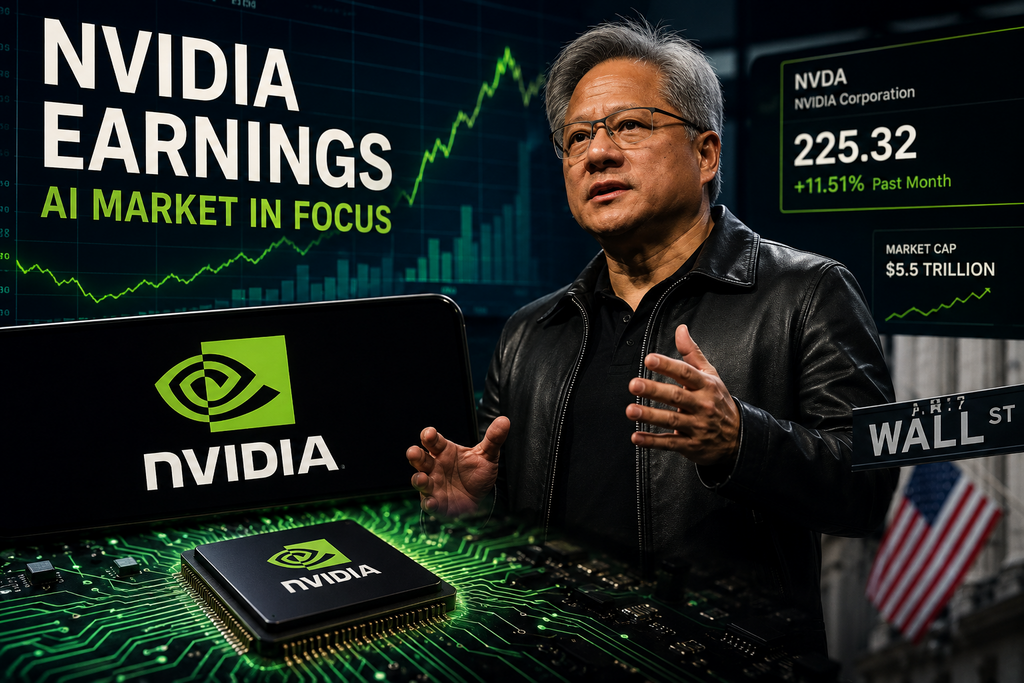
Nvidia’s report is expected to offer a key test of whether the AI-fueled market rally still has room to run
Expectations are high. Nvidia has become the dominant supplier of advanced chips used to train and run AI models, and its results are now treated as a bellwether for the entire AI infrastructure economy, from chipmakers and cloud providers to data centers and power suppliers.
Wall Street analysts expect Nvidia to report earnings per share of $1.76 on revenue of about $79 billion. The company has beaten earnings estimates for eight consecutive quarters.
In February, Nvidia reported fourth-quarter revenue of $68.13 billion, up 73% from a year earlier and above Wall Street expectations of about $66 billion. Analysts are now watching whether the company can continue that pace as demand expands and competition intensifies.
Big Tech spending remains the main engine
The clearest support for Nvidia remains the scale of AI spending by major technology companies.
Projected 2026 capital spending by AI hyperscalers, including Alphabet, Amazon, Meta and Microsoft, has risen from $531 billion in December to $725 billion, according to BNP Paribas. That surge underscores how quickly AI investment is accelerating and how central semiconductors remain to the buildout.
For Nvidia, that means the market may still be large enough to support growth even if rivals gain ground. The company currently holds about 85% of the AI chip market, but it faces pressure from established competitors such as AMD and Qualcomm, newly public firms such as Cerebras and major customers developing their own chips.
Analysts remain broadly bullish. Wells Fargo expects Nvidia’s data center capacity to rise from 9.2 gigawatts in the previous fiscal year to 15.7 gigawatts in the current one. The bank sees annual data center revenue topping $500 billion in fiscal 2028 and $600 billion in fiscal 2029, and recently set a $315 price target for the stock.
Bank of America analysts are even more optimistic, with a $320 target.
China remains the major uncertainty
China is one of the biggest open questions heading into the report.
Nvidia CEO Jensen Huang was among the executives who joined President Donald Trump at a summit with Chinese President Xi Jinping last week, but the meeting ended without major deals.

Nvidia headquarters in Santa Clara, California
(Photo: Reuters)
The U.S. has approved 10 Chinese firms as buyers for Nvidia’s H200, the company’s second-most powerful AI chip. Still, no purchases have yet been made. Trump told reporters that China is increasingly developing and relying on its own advanced AI chips, raising questions about how much revenue Nvidia can ultimately generate from those approvals.
Potential H200 sales to selected Chinese companies could create new revenue later this year. But for now, investors are likely to focus on what Nvidia says about export restrictions, demand from China and the pace at which Chinese companies are shifting toward domestic alternatives.
Traders are betting on a move
Nvidia shares have climbed sharply in recent weeks and remain near record highs. The stock closed Friday at $225.32, down 4.42% for the day, but up more than 11% over the past month and about 19% year to date.
Prediction-market traders are leaning bullish. On Polymarket, traders recently assigned a 54% probability to Nvidia shares reaching at least $240 by the end of May. Other bullish bets showed a 37% chance of the stock topping $248 and a 45% chance of crossing $256, while bearish positions remained more limited.
Options traders are also preparing for volatility. Saxo investment bank strategist Koen Hoorelbeke wrote that options markets are pricing in a move of about 8% in either direction after the earnings release.
The wider semiconductor sector has been even stronger. The Philadelphia Semiconductor Index is up 64% this year, far outpacing Nvidia’s 23% gain and the S&P 500’s 8.7% advance. That gap highlights both the strength of the AI chip trade and the growing appetite for Nvidia’s competitors.
The bar may be difficult to clear
The challenge for Nvidia is that strong results may not be enough.
The company beat analysts’ expectations last quarter, but its shares still fell after the report. That reaction reflected a familiar risk for high-growth AI stocks: Investors want proof that companies are spending aggressively on AI, but they also worry whether that spending will eventually produce returns large enough to justify the cost.
Nvidia has tried to answer that concern with an increasingly broad AI infrastructure roadmap. In March, the company said demand for its hardware and software was “off the charts.” Huang also doubled projections for Nvidia’s Vera Rubin and Blackwell products, saying they could generate more than $1 trillion by the end of 2026, instead of the earlier $500 billion estimate.
The company’s planned Vera CPU platform is another area investors will watch, as Nvidia pushes deeper into AI infrastructure beyond graphics processors.
Strong results from key suppliers such as Taiwan Semiconductor Manufacturing Co. and Hon Hai Precision have also strengthened confidence that AI demand remains robust. So have the capital expenditure plans of Nvidia’s largest customers, including Microsoft, Amazon and Meta.
Still, the immediate reaction will likely depend on more than whether Nvidia beats expectations. Investors will be listening for guidance, supply constraints, margins, China exposure, customer demand and any signs that AI infrastructure spending is either accelerating further or beginning to normalize.
For now, Nvidia remains the company most closely tied to the AI trade. Its earnings this week may help determine whether that trade still has room to run, or whether Wall Street’s expectations have finally moved ahead of even Nvidia’s extraordinary growth.