

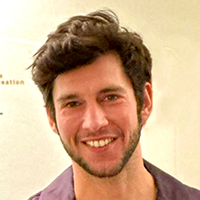
Five unmarked vehicles surrounded a car traveling along a rural road in northern Ibiza on July 10. Inside were millionaire James “Fergie” Chambers, his Jewish wife, actress Stella Schnabel, and their 5-year-old son. The couple, who were planning to move to the island from Ireland, were on their way to visit a school for the boy.
Six Spanish officers emerged from the vehicles, handcuffed Chambers and told Schnabel that the United States was seeking his extradition on money-laundering allegations. “Tell the kids I love them,” he managed to say before being taken away, according to Schnabel’s account. Since then, the heir to an American media fortune has been held at Aranjuez prison south of Madrid.
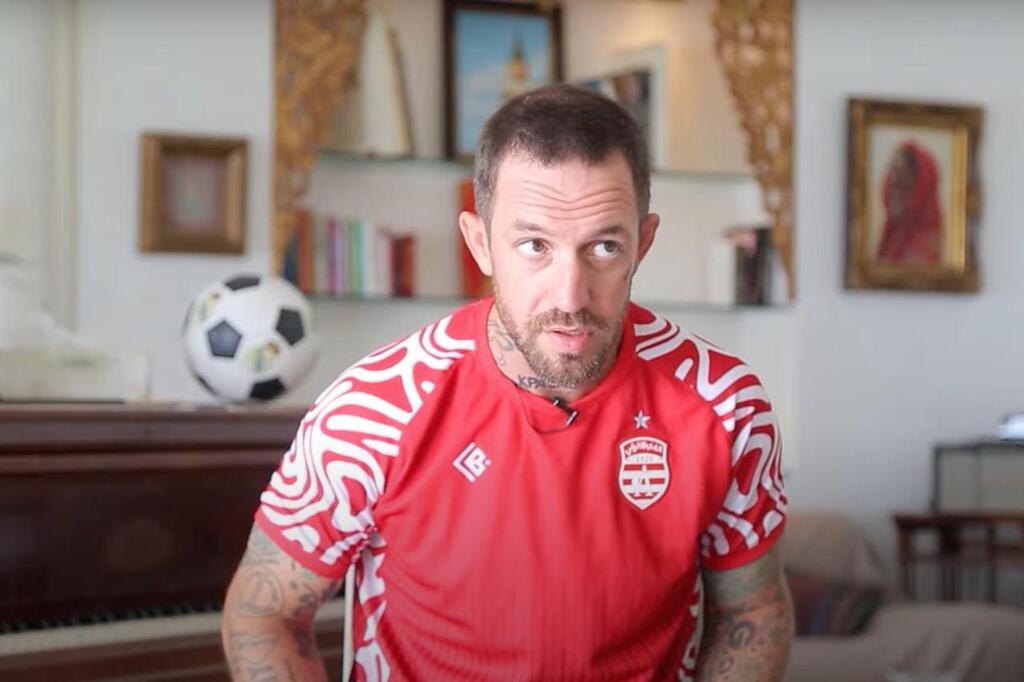
On Tuesday, Sept. 22, Spain’s Council of Ministers is due to decide whether to allow the Trump administration’s extradition request to proceed to the judicial stage. Chambers, 41, is not waiting only for that decision. The New York Times reported that he has begun seeking asylum in Spain, arguing that returning him to the United States would expose him to persecution because of his political views and support for Palestinians.
If Madrid rejects the extradition request at this administrative stage, he is expected to be released; if it approves it, the case will move to Spain’s National Court and could later return to the government. The process could take a year or more.
According to the Interpol notice and details of the request published in Spain, Chambers is accused of money laundering, rioting and conspiracy to riot. The money-laundering allegation centers on $7.5 million transferred to Tunisia that U.S. authorities allege was intended to provide material support to Hamas.
The offenses could carry a combined sentence of up to 30 years in prison. Chambers has not been convicted, and the underlying U.S. indictment remains sealed. The Justice Department has declined to comment publicly on the case.
His Spanish lawyer, Baltasar Garzón, calls the case “entirely political” and argues that there is no evidence the money reached Hamas or was used for terrorism. Veteran attorney Stanley Cohen has described it as the first known case in which the United States has sought the extradition of one of its own citizens over alleged support for Hamas.
The rioting allegations appear to relate to actions targeting Israeli defense contractor Elbit Systems. In October 2023, Chambers chained himself to the door of an office used by the company’s U.S. subsidiary in Cambridge, Massachusetts. A month later, activists raided an Elbit site in Merrimack, New Hampshire, blocking its entrance, climbing onto the roof, pouring red paint over the building and lighting flares.
Windows were smashed. Chambers spoke to reporters at the scene and later paid bail and legal expenses for several activists. Some pleaded guilty to criminal trespass and property-damage charges and received short jail sentences. Chambers himself was not arrested or charged over that action.
The effort by his supporters to portray Chambers solely as a humanitarian donor is complicated by his own public statements. A week after the Oct. 7 Hamas attack, he wrote that “no faction of the Palestinian resistance, Hamas or other, has done anything wrong.” In another interview he described the Hamas attack as “a moment of hope and inspiration” for tens of millions of people. He has also said that Israel “does not deserve to exist” and called it “a false state propped up by the West.”
On social media, Chambers also wrote: “We need to start making people who support Israel actually afraid to go out in public.” In the months that followed, he repeatedly appeared wearing a keffiyeh, described Hamas as a resistance movement and said he had left the United States because it had become dangerous for anti-Zionists.
Built a commune and paid activists
The money that allowed Chambers to turn words into funding came from one of the biggest and relatively private names in the American economy. He is a great-grandson of James M. Cox, the former Ohio governor and 1920 Democratic presidential nominee who founded the company that became Cox Enterprises.
The privately held Atlanta-based conglomerate owns businesses in media, internet services and the automotive industry, including news site Axios, Autotrader, Kelley Blue Book and Manheim. Chambers’ father is also a co-owner of the NBA’s Atlanta Hawks, while his grandmother, Anne Cox Chambers, was for years among the world’s richest women.

Zaccharie Risacher of the Atlanta Hawks. Chambers’ father is a co-owner of the team
(Photo: AP Photo/Mike Stewart)
“Fergie” grew up in Brooklyn and attended Saint Ann’s, the private school associated with New York’s artistic elite. He has said he only realized the scale of his family’s wealth at age 11, when a classmate showed him Forbes’ list of the 400 richest Americans. Before that, one of his main glimpses of it was his grandmother’s estate in southern France, which included a large vineyard.
His childhood was marked by hospitalizations, treatment and addiction, according to his account in an extensive Vanity Fair profile. In middle school, a teacher gave him Lenin to read. The ideas remained even as the identities surrounding them changed.
As an adult, he was at various points a conservative Catholic opposed to abortion, a CrossFit gym owner and an activist against the Dakota Access Pipeline, before becoming a self-described Marxist-Leninist revolutionary. He has tattoos of Stalin and Mao, visited Russian-occupied Donbas after Moscow’s invasion of Ukraine and praised Vladimir Putin. In 2024, he said “the most important thing for the prosperity of humanity is the destruction of the US.”
Even his attempt to live outside capitalism was heavily supported by family capital. After the Dakota pipeline protests, he bought land in Georgia and established a commune with fellow activists, where members reportedly received $2,000 a month in exchange for working on the property and participating in political-theory studies.
He later purchased at least 260 acres in Alford, Massachusetts, building six residences, a communist library and a martial-arts gym while declaring landlords and capitalists unwelcome. His collective, the Berkshire Communists, offered free housing to people who identified as communists and agreed to work on the property.
His final rupture with the family came in 2023, after Cox invested $10 million in Atlanta’s police and firefighter training center, known by opponents as “Cop City,” a project whose critics Chambers had helped fund. He called his relatives “enemies of the people” and “Cox Klux Klan” and sold his shares back to the family.
Chambers said the initial payment was $250 million, with more money to follow. The result was a communist with a quarter-billion dollars in liquidity, a staff and, according to his wife, the ability to fund roughly 100 projects in 20 countries.
The ideology did not require an austere lifestyle. Before their planned move to Ibiza, the couple reportedly paid 7 million euros for a house in south Dublin, several million above the average price on the street.
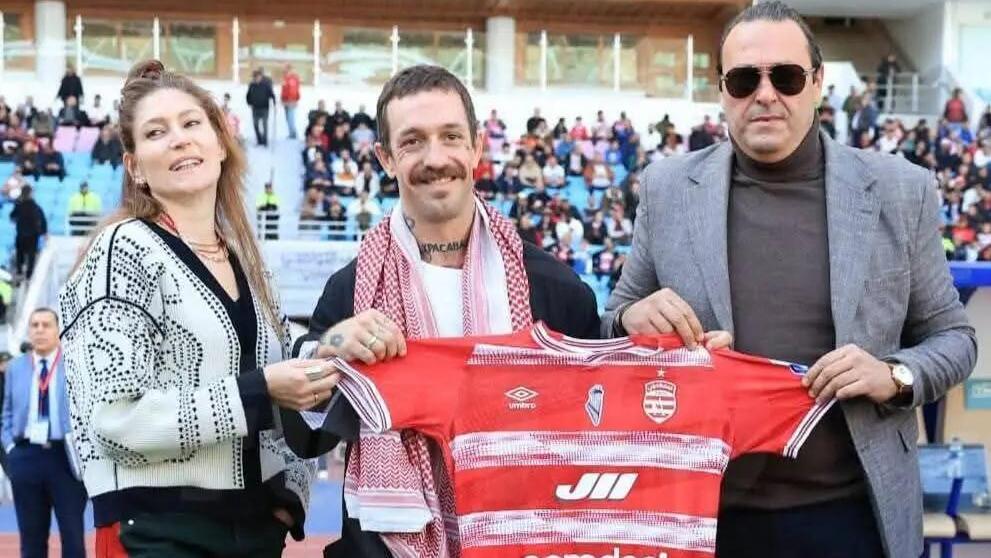
Ceremony marking the acquisition of Club Africain football club
(Photo: Club Africain)
One beneficiary of his wealth was Club Africain, the Tunis soccer club associated with the working class and strong support for the Palestinian cause. Chambers, who converted to Islam and moved to Sidi Bou Said, injected millions of euros into the club, helped settle debts and salaries and financed training facilities and youth pitches.
By May 2025, he had paid 3.5 million euros of a pledged 4 million euros, helping the club eliminate about 90% of debts that had stood at nearly 6 million euros.
His defense argues that the $7.5 million at the center of the U.S. case was transferred to Tunisia for purposes including his business interests and Club Africain, not Hamas. At the same time, Chambers donated more than $1 million to projects in Gaza, including bakeries, water supplies, medical treatment and aid for children. His representatives say they have records documenting the donations. U.S. authorities have not publicly disclosed the evidence underlying the sealed case.
Calmed himself on the plane by reading the Quran
Chambers describes his conversion to Islam as part of a long religious search. He has said he had been interested in Islam since reading Malcolm X’s autobiography as a child and was later exposed to it through Palestinian activism and Black liberation movements.
He said Islam gave him discipline and helped him cope with his alienation from Western society and his attraction to “sex, drugs and violence.” When he left the United States, he said, he calmed himself on the plane by reading the Quran.
In Tunisia he began studying Arabic and praying five times a day at a mosque. He moved there after the arrests connected to the Elbit protest, when he was already concerned about a possible federal investigation. Tunisia has no extradition treaty with the United States.
His support for Palestinians did not begin with his conversion. It fit into the Marxist-Leninist worldview he had adopted, in which Israel is regarded as an extension of American power and the Palestinian struggle as part of a global anti-colonial movement. The Oct. 7 attack turned the issue into a central focus of his activism.
Chambers had known Schnabel, an actress and the daughter of Jewish artist and filmmaker Julian Schnabel, since their days at the private school in Brooklyn, though their romantic relationship began only in 2020.
Chambers was sitting at a West Village restaurant with his then-wife, Cameron Park, from whom he was separated but not yet legally divorced, when he spotted Schnabel across the restaurant and introduced himself again: “It’s Fergie from Saint Ann’s.”
She came over, invited him to visit a store she was running from her home and they exchanged numbers. According to his account, she later texted him: “Find me someone to have a baby with,” and he immediately thought it would be him. The relationship began soon afterward. They had a son and married in February 2024.
Schnabel says she can account for every dollar her husband transferred. “Fergie is a devoted philanthropist committed to supporting global humanitarian efforts,” she said in a statement, urging Spain to reject what she called his “political persecution.”
After his arrest, FBI agents searched the vacation home the couple had rented in Ibiza. Garzón said they found nothing. Schnabel has also said that when she recently arrived in New York, agents detained her at JFK Airport and seized her phone.
A support campaign has already formed around Chambers in Spain. About 150 artists, activists and academics, including Richard Gere, Cynthia Nixon, Viggo Mortensen, Greta Thunberg and Judith Butler, have signed a letter urging Spain to reject the extradition request.
Ione Belarra, the former social rights minister and current Podemos leader, has described him as “the first political prisoner” in Spain jailed over his support for Palestine. Sumar, a partner in Prime Minister Pedro Sánchez’s governing coalition, has also called on the government to reject the request.
That does not amount to official Spanish government support, but Madrid’s political climate could work in Chambers’ favor. Spain formally recognized a Palestinian state in May 2024, and Sánchez has repeatedly accused Israeli authorities of committing genocide in Gaza, while his government has pursued increasingly critical policies toward Israel.
Spanish law and the U.S.-Spain extradition treaty bar extradition for political offenses, although terrorism is explicitly excluded from that protection. The treaty also allows Spain to reject a request if there are sufficient grounds to believe it was made to prosecute or punish someone for a political offense.
Garzón, the former judge who became internationally known for seeking the extradition of Chilean dictator Augusto Pinochet, now finds himself on the other side of the argument, trying to persuade Spanish authorities not to send his client home.
Even without the criminal case, Chambers’ life had already become the subject of a film. The documentary “All About the Money,” which followed his commune, move to Tunisia and activism against Elbit, screened at this year’s Sundance Film Festival. Director Sinéad O’Shea has said that after seeing a version of the film, Chambers tried to pay her not to release it.
Now he mostly asks Schnabel to bring him books in prison. On her most recent visit, she brought him Gramsci and added Borges’ “The Aleph.”
On Tuesday, the 22 members of Spain’s Council of Ministers are due to meet in Madrid. Their decision will not yet determine whether Chambers is extradited to the United States, but it could decide whether he finishes those new books in his cell at Aranjuez or outside prison.