

Nvidia’s extraordinary AI-fueled growth is showing little sign of slowing, with the chip giant reporting quarterly revenue of $96.2 billion, more than double the level a year earlier, while laying out an increasingly ambitious plan to expand far beyond selling graphics processors.
Operating income reached $63.7 billion, up 124% year over year, while gross margin stood at 75%, according to a financial and strategic presentation outlining Nvidia’s second-quarter fiscal 2027 performance and longer-term plans.
The message from CEO Jensen Huang was clear: Nvidia increasingly sees itself not simply as the dominant supplier of AI chips, but as a central infrastructure provider for an emerging global computing industry.
“AI has reached its inflection point. It’s doing useful work. Its tokens are productive and profitable. Now, compute is revenue,” Huang said in the presentation.
At the center of Nvidia’s growth remains its data center business, which generated $89 billion during the quarter. But the composition of that business is changing rapidly.
Traditional hyperscale customers, including the giant cloud providers that have driven much of Nvidia’s growth to date, accounted for $48.7 billion, up 13% from a year earlier.

Nvidia CEO Jensen Huang
(Photo: Nvidia)
A second category comprising AI clouds, industrial customers, enterprises and what Nvidia describes as sovereign AI initiatives generated $40.3 billion, surging 138%.
That shift is important to Nvidia’s long-term strategy. Rather than relying primarily on a handful of giant technology companies, the company is seeking to expand the market for its systems to governments, specialized AI providers, research centers and enterprises building their own AI infrastructure.
Rubin becomes the next growth engine
Much of Nvidia’s next phase centers on Vera Rubin, the successor to its Blackwell generation of AI systems.
The presentation describes Rubin as currently ramping and estimates an opportunity of roughly $40 billion for every gigawatt of data center capacity built around the architecture. That compares with about $25 billion per gigawatt for Grace Blackwell Ultra and $18 billion during the earlier Hopper generation.
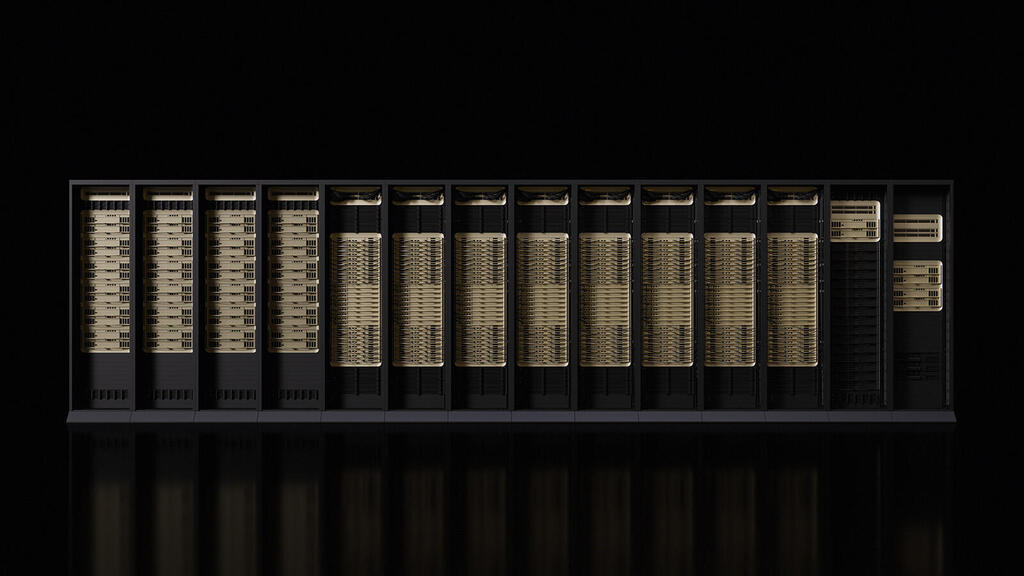
Nvidia's Rubin platform
(Photo: Courtesy of Nvidia)
Nvidia says Rubin will combine its Vera CPU, Rubin GPU and three forms of networking into an integrated computing platform.
The company projects that Rubin can deliver 30 times more throughput per megawatt while cutting the cost per AI token by 35 times compared with Blackwell Ultra.
Nvidia also expects Rubin systems to account for roughly 20% of its third-quarter data center revenue, according to the presentation.
The strategy reflects a broader change in how Nvidia wants customers to view its technology. Instead of selling individual processors, the company is increasingly packaging CPUs, GPUs, networking and software as a single AI factory architecture.
That approach is designed to make Nvidia technology useful across the entire AI lifecycle, including training large models, fine-tuning them, preparing data and running the increasingly important inference workloads that generate responses for end users.
Moving beyond GPUs
Nvidia is also broadening its ambitions in server processors.
Its Vera CPU is described as the company’s first CPU designed specifically for agentic AI, with Nvidia projecting that the business could double in fiscal 2028 and create a roughly $20 billion server CPU opportunity.
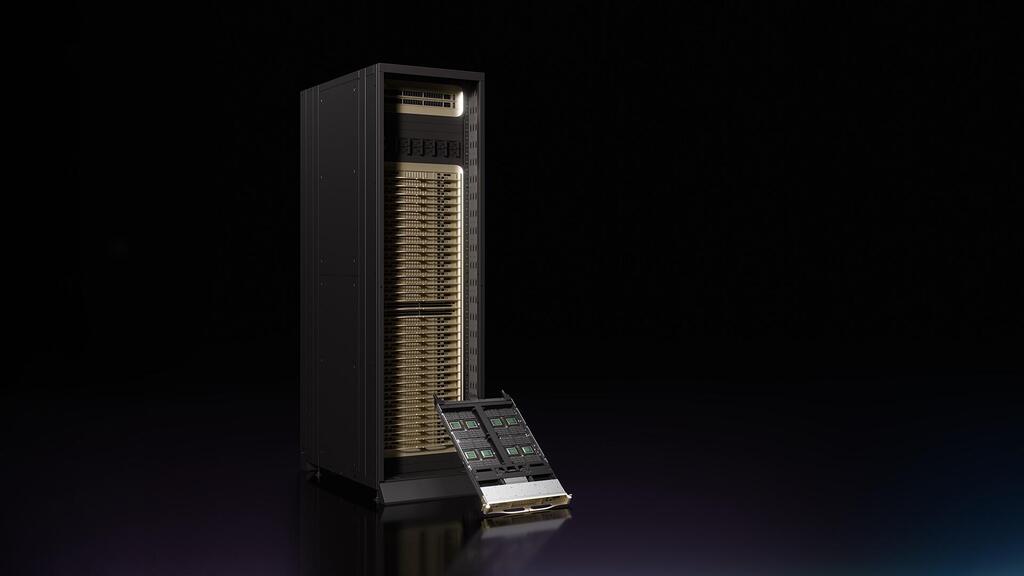
Vera, the CPU for agents
(Photo: Nvidia)
The presentation claims Vera will provide five times the bandwidth per watt of other data center CPUs.
Nvidia is simultaneously expanding into specialized inference through Groq 3 LPX, which it describes as an architecture aimed at highly interactive AI services. The system is moving into full production, according to the presentation, with Nvidia claiming performance of four times as many tokens per second as the next-best alternative.
Together, those products illustrate Nvidia’s attempt to capture a larger portion of the computing stack rather than remaining primarily dependent on GPU sales.
A costly race to secure supply
The enormous demand for AI hardware is creating a problem of its own: securing enough memory and components to keep up.
Nvidia expects gross margins to fall from 75% in the second quarter to about 74% in the third, before reaching a projected trough of 71% to 72% in the fourth quarter because of tight memory supply and rising component prices.
Margins are then expected to recover, stabilizing around 72% to 73% in fiscal 2028.
To reduce supply risk, Nvidia says it is making $279 billion in upstream commitments to secure critical components and memory capacity over the coming years.
The scale of those commitments shows how dramatically Nvidia’s role has changed. The company is no longer merely purchasing components for its own products; it is increasingly using its financial strength to shape the supply chain required for the wider AI infrastructure boom.
Financing the AI buildout
Nvidia’s ambitions extend downstream as well.
The presentation outlines a strategy in which Nvidia helps mobilize outside capital for new AI data centers, particularly so-called neo-cloud providers that lack the balance sheets of Amazon, Microsoft or Google.
Under one model described in the presentation, Nvidia provides minimum revenue guarantees for cloud capacity. Those guarantees can help operators obtain financing from lenders, allowing them to buy Nvidia hardware. Nvidia receives payment for the equipment and may then receive a share of future rental revenue above an agreed threshold.
The company characterizes the structure as a way to expand demand while reducing the financial burden on emerging AI infrastructure providers.
Nvidia also points to more than $500 billion in financing mobilization involving partners including Apollo, BlackRock, Blackstone and KKR to support third-party computing infrastructure.
A separate arrangement involving SoftBank is described as carrying a $105 billion total guarantee cap to secure 4.25 gigawatts of capacity over 20 years, potentially supporting multiple generations of Nvidia hardware.
Taken together, Nvidia’s plans reveal a company attempting to influence both sides of the AI boom: securing the components needed to build its systems while helping arrange the capital needed for customers to buy and deploy them.
From chipmaker to AI infrastructure platform
Nvidia generated $21.3 billion in free cash flow during the quarter, according to the presentation, giving it considerable financial firepower to pursue that strategy.
Its broader thesis is that three forces will reinforce each other: increasingly interchangeable and scalable hardware led by Vera Rubin, Nvidia’s CUDA software ecosystem and hundreds of billions of dollars in outside capital available for AI infrastructure.
The presentation ultimately sketches a far more expansive future for Nvidia than the one that made it the defining company of the generative AI boom.
The company is betting that the next stage will not simply be about selling more GPUs. It will be about supplying complete AI factories, securing their components, providing the software that runs them and helping organize the financing required to build them.
Nvidia projects revenue growth of roughly 70% in fiscal 2028. The company’s argument is that such growth would no longer be driven only by another cycle of chip demand, but by AI computing becoming a permanent layer of global infrastructure.
In Huang’s formulation, compute itself is becoming revenue. Nvidia is now trying to position itself at virtually every point where that revenue is created.