


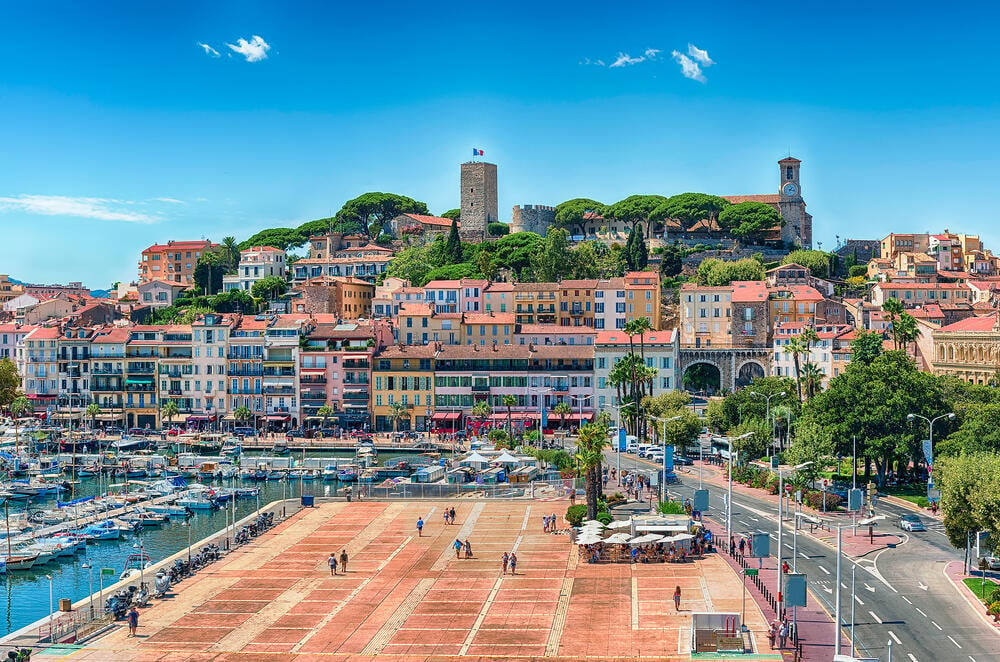
The French Riviera city of Cannes rolled out the red carpets this week, with photographers, packed hotels and all the trappings of a major global event. But this was not the famed film festival, which took place last month. This time, the crowds came for the World Digital Infrastructure Congress.
The attendees were data center entrepreneurs, hyperscale executives, server farm investors and decision-makers from the companies building the physical backbone of the artificial intelligence boom.
It is a vast global market, growing rapidly as AI use expands. For investors, it has become the new gold, and many are rushing to secure a position before the market becomes too crowded.
Among the thousands filling conference halls and meeting rooms were quite a few Israelis. Israel, they say, offers an attractive base for managing data repositories and AI models: available land, relatively cheap electricity and extensive data infrastructure.
Israel’s representative in Cannes was Shelly Landsmann, the former CEO of Microsoft Israel and today a founding partner of data center company NED and chair of its advisory board.
“The conference takes place once a year, and this is my fifth year attending,” she said from Cannes. “It is amazing. It used to be held in Monaco and was tiny. We were just a few people in a hotel. Today you cannot find a room, apartment or hotel anywhere in the area because of the conference. The plane here was full. That reflects the number of players and partners who have entered this business.”
It is indeed one of the defining businesses of the current era. The world is increasingly divided between those developing artificial intelligence and those supplying the infrastructure needed to develop it. In Israel, investors have discovered over the past two years that it is easier to invest in AI real estate than in AI itself.
Veteran real estate companies, infrastructure groups, investment funds and businesspeople of all kinds, including singer Omer Adam, have reported moves into data centers and the power sources needed to operate them. In today’s market, if you are not there, you are being left behind.
This week, Kardan Israel announced the establishment of a subsidiary that will consolidate its activity in data centers. Kardan is an example of the new wave of data real estate investors, with stakes in server farms in Kfar Saba and Shoham.
“The data center sector is experiencing accelerated growth worldwide and in Israel, and we see it as a significant growth engine for the group,” said Alon Vulkan, CEO of Kardan Israel.
Kardan Israel is known primarily for income-producing real estate, but data centers appear to offer substantial returns.
One of the most prominent figures in the new trend is Ofer Yanai, the controlling shareholder of Nofar Energy, who this week reported the purchase of land in Shoham for 361 million shekels to build a new data center.
“This is picking gold off the floor,” Yanai was quoted as saying in Calcalist. “What is happening now with the whole data centers story is unlike anything that has happened before in terms of the ability to create value. I took Nofar public at the height of the renewable energy hype in 2021, and today the situation is 100 times stronger in terms of economic power. You can build and sell a data center within three years and remain with $850 million in your pocket. And that is for a small 50-megawatt data center like the one being built in Shoham.”
Also this week, Stark Power announced the acquisition of U.S. data center company Sage. Then there is the Anan Group, which has been drawing striking valuations, perhaps because one of its front-facing investors is singer Omer Adam.
Anan was founded by real estate entrepreneur Maor Malul, Israeli-Swiss businessman Nissim Sariel-Gaon and Adam, together with his father Yaniv. The group is building two data centers, in Tzora and Afula, and plans to reach a total capacity of nearly 200 megawatts.
Adam’s entry into data center investment has become one of the industry’s strongest catalysts. In April, Anan reported an agreement with AI infrastructure company Crusoe Technologies, which will use its 40-megawatt data center in Afula to operate a supercomputer for artificial intelligence. The long-term contract is worth hundreds of millions of dollars. Industry sources joke that Adam’s data center income is already surpassing his music profits.
Last month, Eitan Yochananoff, controlling shareholder of the Yochananoff supermarket chain, also entered the field, buying land in Yavne to build a data center campus. Rami Levy does not want to miss the opportunity either: his group is examining the construction of data centers on company-owned land in Kiryat Gat and Netanya, as well as the purchase of additional land.
Everyone, it seems, wants a share of the new gold.
(Photo: google)
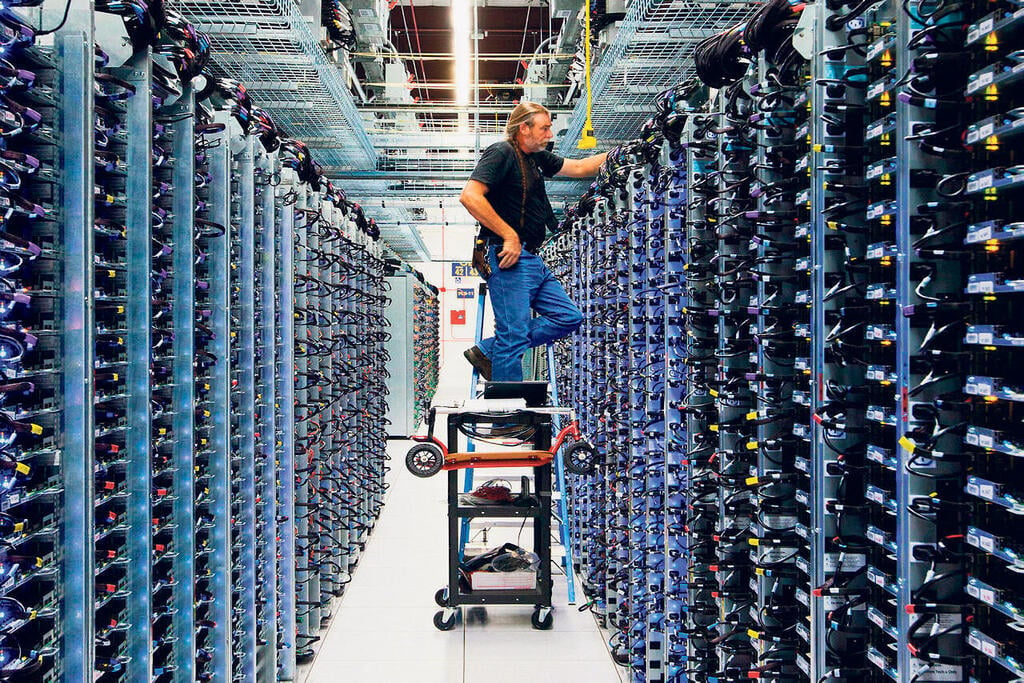
The unprecedented acceleration in the local market mirrors an even more feverish global trend. Since the start of the year, international tech giants including Microsoft, Google, Amazon Web Services and Oracle have reported investments of tens of billions of dollars in hyperscale facilities, the massive server farms that power cloud computing and AI.
These companies are crossing oceans and continents to secure another Nvidia AI chip, another square meter for an AI server, another megawatt of power to operate and cool the facility. Demand for their AI and cloud storage services is soaring, but the resources needed to supply it are increasingly scarce.
Several veteran companies have operated in Israel’s data center market for decades, dating back to the time when server farms were used mainly for communications services and data storage. Companies such as MedOne, which operates four facilities in Israel, Bynet, which operates sites in Shoham, Jerusalem and Tel Aviv, and Bezeq International, which operates a communications facility in Petah Tikva, divided the market long before the latest boom.
Israel’s national cloud project, Nimbus, brought the winning companies, Google Cloud and AWS, to Israel, where they established four data centers. The companies that did not win the tender, Microsoft and Oracle, later built facilities in Israel as well, showing that the need existed even without costly government encouragement. From there, the industry took off.
According to the Israel Data Center Association, dozens of data centers operate in Israel with a combined capacity of more than 400 megawatts, equivalent to one medium-sized data center in the United States. Several dozen more are now being planned or built, with additional facilities in licensing and planning stages totaling 2 gigawatts. Together, these projects could bring the Israeli market to 1 terawatt, or 1,000 megawatts, in the coming years, a tenfold increase within a decade.
The most prominent company in the field is Zahi Nahmias’ Mega Or. It is involved in no fewer than seven data centers in Israel, with a combined capacity of more than 300 megawatts, and plans to open three more with similar capacity. Mega Or has signed agreements with Nvidia to build a data center and supercomputer for Nvidia itself in Mevo Carmel, and with Nebius in Modi’in.
At the beginning of the year, the company estimated that data center activity would account for about 65% of its operating income within three years, with total revenue of more than 1 billion shekels a year. Mega Or’s stock has soared by about 400% over the past year, reaching a market value of roughly 24 billion shekels.
Dana Azrieli’s Azrieli Group acquired control of Norwegian data center company Green Mountain and U.S. company Compass, launching an international data center operation managing campuses in Europe, North America and Israel that are leased to global hyperscalers. Data centers are now the group’s main growth engine, while mall revenues struggle to keep pace. Other companies that have moved aggressively into the sector include Doral Energy and Ampa, Alony Hetz, Prime Energy, Ludan and Enlight.
NED has a different profile from other companies in the field. It brings expertise in building and operating data centers and partners with other companies on the real estate side. CEO and co-founder Daniel Efrati was an investment banker in the United States in telecom and technology, where he first became interested in data centers.
“That was during an era when people in America still did not fully understand why companies needed to move their computer systems out of their offices,” he says. “Since then, the market has changed beyond recognition.”
The company was founded in 2020 by Efrati, Landsmann and David Bloom of the British investment group Goldacre-Noé. It operates in a strategic partnership with Britain’s Kao Data, which manages five data centers in London and Europe. Its business model is wholesale colocation: giant centers that host several large clients at the same time.
NED is now building a campus in Netanya together with the Levinstein Group, with Electra carrying out the work. The project, a protected underground campus with a total capacity of 50 megawatts, is being built at an investment of 1.3 billion shekels. Half of it is expected to be occupied this year.
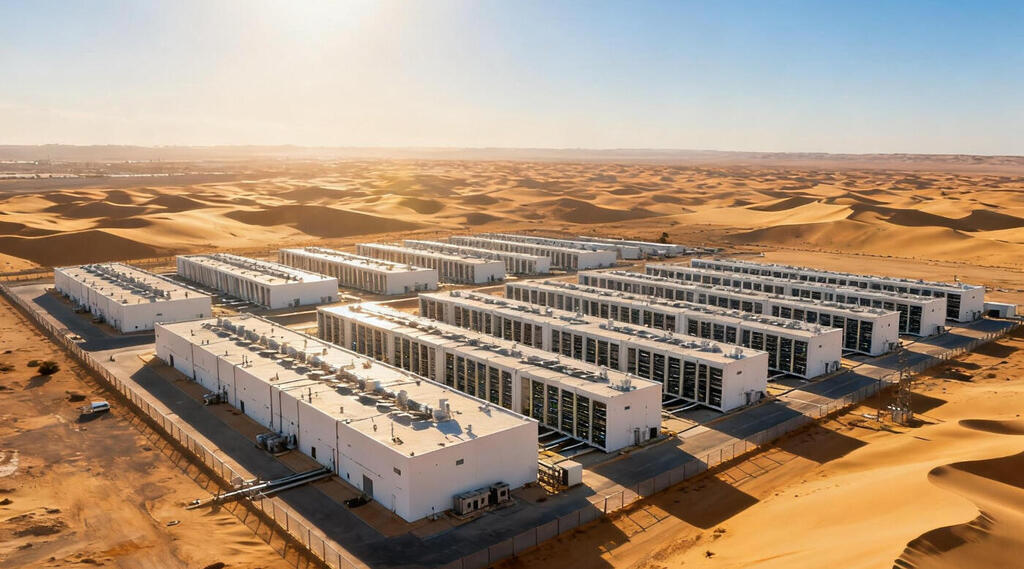
It is, in effect, an AI factory: a new-generation data center designed for AI workloads, AI training, high-performance computing and direct liquid cooling for chips.
But the data center boom is not only exciting the real estate sector. The government is also embracing the new gold. In February 2026, the government approved a resolution defining data centers as “national infrastructure.” A new bill proposes a fast-track planning route for AI-ready data centers with capacity of more than 50 megawatts. The idea is to turn Israel into a leading producer of AI factories, building 10 such facilities every year.
(Photo: Pollo AI)
Efrati says the data center sector faces enormous engineering and environmental challenges that could slow its growth. The main challenge is power supply. Electricity is so central that data centers are measured by the power they consume, not by the size of the site or the number of processors inside it.
Power consumption per server rack has risen by hundreds of percentage points in recent years, and AI requires especially large amounts of electricity. There is also the acute issue of cooling the processors and storage halls, which itself demands enormous amounts of power. As a result, an AI campus like those now being built in Israel can consume enough electricity to power a small city.
Another challenge is environmental damage. Advanced cooling systems are designed to cool chips directly, using water mixed with special chemicals. Growing public awareness and criticism of data centers becoming some of the country’s largest energy consumers have pushed operators to provide clear proof of corporate and environmental responsibility.
The active involvement of real estate developers in data centers is increasing the amount of storage capacity offered in Israel, but it does not necessarily guarantee advanced technological standards or operational continuity. Running a data center is complex, with strict service contracts and penalties for downtime.
“There is a difference between building a data center and operating one,” Landsmann says. “Real estate players still do not understand what it means to assemble the electromechanical systems. They do not know what it means to operate them, to meet contracts, to pay the penalties in those contracts. When you calculate all those expenses, some players may discover that the gold they thought they had is just a simple metal, aluminum.”
The government’s enthusiasm has also drawn criticism. The Society for the Protection of Nature in Israel warned that the government decision could harm open spaces, burden the electricity grid and trigger a chain of environmental and energy consequences.
“This is a dangerous gamble on Israel’s energy security,” the organization said.
Another issue surrounding Israel’s new gold rush is the need to secure and protect the facilities. Last March, Iranian drones struck an Amazon Web Services data center in the Gulf. The damage was not severe, but it disrupted Amazon services for several days.
In Israel, the Nimbus government tender did not require underground construction. The reasoning was to reduce construction costs and because each facility has backup at a sister site. Other companies in Israel have invested additional money in building enormous shelters dozens of meters underground.
In one respect, Israeli companies may be especially attractive: electricity prices in Israel are relatively low by global standards, allowing companies to offer international clients more competitive terms.
What will ultimately tip the balance? For now, prospective clients do not appear likely to take too long to decide. Every available chip is being snapped up quickly, and that situation appears likely to continue for years.